
Sudan on Foreign Life Support — 2,000 Colombians and Imported Drones Extend the War in 2026
 Marie Dubois
Sudan on Foreign Life Support — 2,000 Colombians and Imported Drones Prolong the War in 2026
On September 3, in Ad-Da'ein, the memory of a hospital destroyed by a drone strike returned to the forefront of the Sudanese dossier. On the same day, the independent international mission supported by the UN explained why this war no longer resembles a simple struggle between two Sudanese military factions. According to its report, external networks provide fighters, transit, logistics, and technologies to the Rapid Support Forces (RSF), while the Sudanese army also benefits from drones coming from abroad. On the ground, this changes everything. When a column can no longer pass through the route due to rain or an ambush, the drone takes over.
The essential point is therefore not only moral or legal. It is operational. Sudan is becoming a theater where the strategic depth of each camp depends less on Khartoum than on the corridors that pass through Chad, Libya, Somalia, and other more distant rear bases. This is new at this scale.
A Report Describing a Now Transnational War
- The UN mission mentions up to 2,000 former Colombian military personnel engaged alongside the RSF.
- It also cites fighters from South Sudan, Chad, and Ethiopia, sometimes identified by language, accent, or uniform.
- Intermediaries operating notably from Colombia and the United Arab Emirates are said to have used Chad, Libya, and Somalia as transit points.
- The report further estimates that there are reasonable grounds to believe that the army has used drones supplied from abroad in operations that have struck civilians and civilian infrastructure.
This last point deserves to be emphasized. The temptation would be to reduce the matter to a single camp, the RSF, because the most spectacular part of the report concerns the foreign recruitment networks that support them. But the heaviest conclusion lies elsewhere: both camps are upgrading thanks to external contributions. This means that the Sudanese war is entering a phase of sustainable sophistication, not just a simple interlude of opportunistic assistance.
Civilians Pay the Price of Upgrading
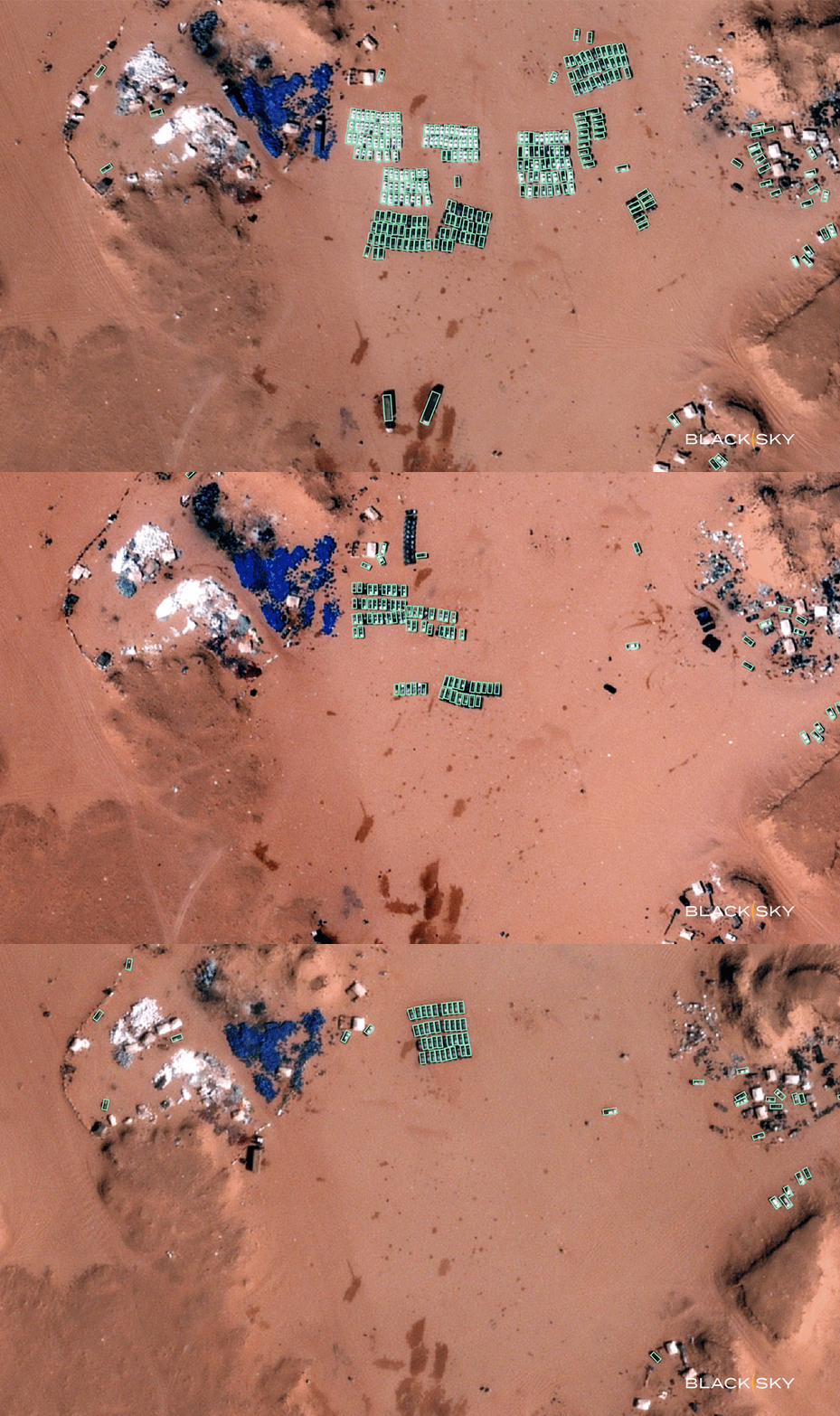
The report directly links this external aid to more distant and destructive strikes. It notably cites an RSF attack in Kalogi, South Kordofan, which reportedly killed 114 people. It also mentions an army strike in Ad-Da'ein, in Eastern Darfur, which allegedly resulted in at least 70 deaths and destroyed a large hospital. In El-Obeid, in North Kordofan, repeated drone strikes attributed to the RSF between July and August could, according to the mission, amount to war crimes.
For a European reader, these figures may seem to blend into the mass of atrocities already known since 2023. That would be a mistake. The novelty is the ability to strike far behind the front line. In Sahelian wars, I often looked at the road map before the official statement. Here, one must look at the range, supply routes, and the availability of trained crews. A war that receives foreign operators, parts, transit intelligence, and drones is no longer just a war of poorly connected African positions. It becomes a networked war.
Why This Evolution Matters Beyond Sudan
The report arrives a week after border tensions with Chad and after several months of increasing regional accusations. This timing matters. The more borders serve as logistical corridors, the more they become objectives themselves, areas of suspicion, or spaces of plausible denial. A neighboring state can swear its neutrality and still see its territory used by recruiters, transporters, or brokers. This is exactly what makes this type of conflict so difficult to contain.
For Marie Dubois, the lesson recalls certain mechanisms of the Sahel, but with a higher degree of industrialization. In the Sahel, an armed group primarily relies on mobility, local anchoring, and administrative collapse. In Sudan, both camps add a technological and commercial layer to this. Specialized fighters arrive, drones extend the range, and external routes repair losses. The war becomes less dependent on the consent of local populations and more dependent on international networks capable of buying military time.
This is also why a limited embargo on Darfur seems increasingly inadequate. If flows pass through several countries, if equipment strikes in Kordofan as well as in Darfur, and if both the regular army and the RSF benefit from imported capabilities, then the problem is no longer an isolated front. It is a regional architecture supporting the war.
What We Know — and What Remains Unclear
Precision is necessary. The mission speaks of "reasonable grounds" and not a definitive judgment. Some foreign fighters have been identified by testimonies, accents, or uniforms; this is not the same as a fully documented chain of command. Direct state responsibilities remain, in part, in a gray area where private intermediaries, opportunistic freight forwarders, and military subcontractors deliberately obscure the traces. This fog is part of the system.
But uncertainty does not negate the trend. It almost confirms it. When a war operates through brokers, transit, and imported operators, evidence often arrives in fragments while the military effect is immediate.
The Next Operational Risk
The danger is not only the continuation of fighting around major Sudanese cities. The real risk, in the coming weeks, is the extension of strikes and pressures towards logistical nodes and refuge areas, particularly along the Darfur-Kordofan arc and near the Chadian border. If the networks described by the UN remain active, each camp will retain the capacity to compensate for its losses and strike the enemy's depth without regaining full control of the ground. This is the perfect formula for a long war.
Sudan is therefore not only ravaged by two rival armies. It is supported, prolonged, and distorted by networks that do not live in El-Fasher or Ad-Da'ein, but that make the next strikes on these cities possible. The next warning signal will be simple: not a new diplomatic statement, but the next successful attack against a hospital, a camp, or a logistical crossroads that was thought to be out of reach.
On September 3, 2026, foreign networks supplied 2,000 Colombian fighters to the Rapid Support Forces (RSF) in Sudan, while the Sudanese Army utilized foreign-supplied drones in operations. This support has led to increased military capabilities and significant civilian casualties, with recent attacks resulting in over 180 deaths. The conflict is becoming more sophisticated and transnational, with logistics corridors extending beyond Sudan's borders.
- 2,000 Colombian fighters are engaged with the RSF.
- Foreign networks are providing logistics and technology to both the RSF and the Sudanese Army.
- Drones supplied from abroad are being used in operations against civilians.
- Recent attacks have resulted in significant civilian casualties, including 114 deaths in Kalogi and 70 in Ad-Da'ein.
- The conflict is evolving into a more sophisticated and transnational war.