
Swarm Aero Gamera Gives the US Air Force a 9,000-Nautical-Mile Pacific Option
 S.W
S.WSwarm Aero Gamera Gives the US Air Force a 9,000-Nautical-Mile Pacific Option
A 72-foot unmanned aircraft that can carry more than 2,800 pounds is not a bigger MQ-9. It is an attempt to change the arithmetic of airpower in the Western Pacific. Swarm Aero unveiled its Gamera system on September 14, 2026, as the U.S. Air Force searches for aircraft cheap enough to buy in quantity and useful enough to carry bomber-class weapons. That combination matters more than the marketing phrase low cost.
Gamera Is Designed Around Weapons, Not the Airframe
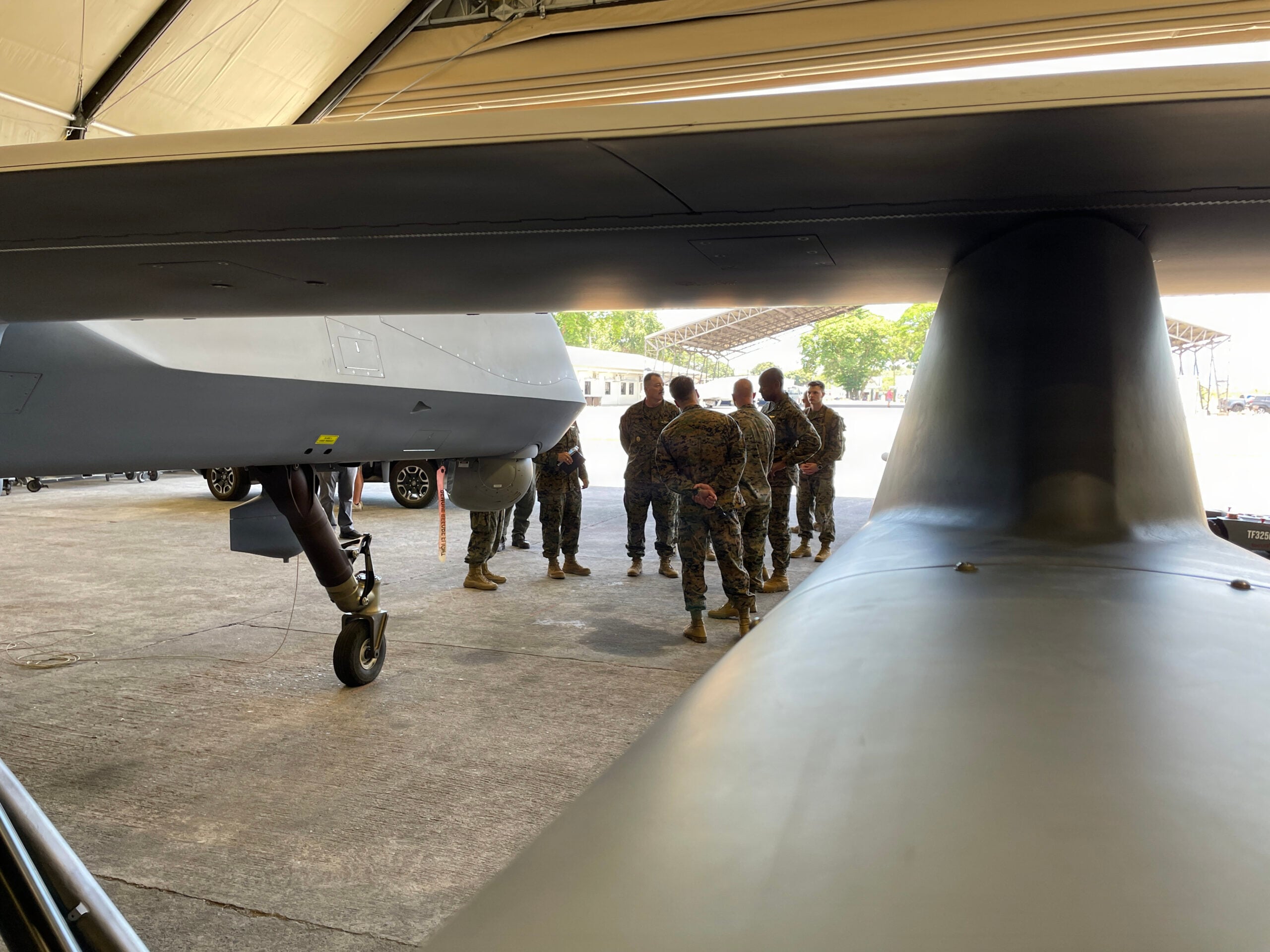
According to Defense News, Gamera is a Group 5 unmanned aerial system with a projected range of 9,000 nautical miles before refueling. Swarm says it can carry the Long-Range Anti-Ship Missile (LRASM), the Joint Air-to-Surface Standoff Missile-Extended Range (JASSM-ER), and other cruise or hypersonic weapons. The company has not published a unit price, but claims comparable strike effects could cost one-tenth as much as existing platforms.
Those numbers describe a concept, not a fielded capability. There is no public production schedule, weapons-certification timeline, demonstrated datalink architecture, or survivability test record. A 9,000-nautical-mile range also says nothing about how long the aircraft can remain on station with a useful payload, how much tanker support it needs, or whether it can operate from austere Pacific bases. The relevant question is whether the Air Force can turn the claim into a repeatable sortie-generation system.
The Pacific Problem Is Distance Times Attrition
The Air Force is pursuing Massed Modular Aircraft (MMA) because traditional exquisite platforms are difficult to replace after the first missile salvo. The service’s own description of the program emphasizes risk-tolerant uncrewed aircraft that can be produced in large numbers. The Air Force has framed the requirement around a new era of uncrewed airpower, while Swarm’s co-founder Oliver Palmer explicitly linked Gamera to a long contest with China centered first on Taiwan.
In a Taiwan contingency, the problem is not simply reaching the target. It is keeping enough launch platforms alive through Chinese surveillance, electronic attack, air defenses, and strikes on runways. An MQ-9-class aircraft is valuable for intelligence, surveillance, and reconnaissance, but its cost and operating model make commanders cautious about exposing it to a dense missile envelope. A cheaper aircraft carrying JASSM-ER or LRASM creates a different choice: commanders can trade airframes for access without spending a decade replacing each loss.
That is the theory. In practice, a large aircraft with a 72-foot wingspan is not automatically easy to hide, disperse, or repair. Pacific geography punishes maintenance assumptions. Guam, northern Australia, Japan, and Philippine locations offer depth, but each adds fuel, munitions, communications, and security demands. If Gamera needs specialized ground equipment or a long runway, its range will not solve the basing problem. The aircraft must be designed as part of a distributed package, including mobile launch support, redundant control nodes, and pre-positioned spares.
LRASM Changes the Value Calculation
The most important claim is not that Gamera can perform MQ-9 missions more cheaply. It is that one airframe could carry weapons normally associated with bombers or high-end strike aircraft. LRASM gives the platform a sea-denial role against surface combatants; JASSM-ER gives it a land-attack option from outside many tactical air-defense envelopes. A force of relatively inexpensive launchers could complicate the People’s Liberation Army Navy’s movement through the Philippine Sea and force Chinese planners to spend missiles on aircraft they would prefer to ignore.
But missile carriage is only the middle of the kill chain. The aircraft still needs targeting data, resilient communications, navigation under jamming, and a battle-management network that can survive the loss of satellites and fixed command posts. In a maritime fight, a stale target track turns a long-range missile into expensive ballast. Gamera’s contribution will therefore depend less on its brochure payload than on whether the Air Force and Navy can share sensors and authorize weapons employment across a contested network.
China Will Attack the Manufacturing Math
Beijing does not need to defeat every Gamera in the air. It can attack the industrial and logistical system that produces, arms, controls, and repairs them. That makes Swarm Aero’s manufacturing approach as important as the aircraft’s range. The company says it has invested tens of millions of dollars since 2022 and received millions in Air Force Research Laboratory contracts, including work on affordable mass production. Those are useful credentials, but they are not yet a surge capacity.
The United States has repeatedly discovered that a low-cost weapon is not low cost once its engine, seeker, datalink, test equipment, and software pipeline are counted. The same warning applies to Gamera. If the platform is cheap but LRASM and JASSM-ER inventories remain limited, the Air Force will own a large fleet of empty launchers. If each aircraft requires contractor-maintained software and a narrow supplier base, production volume will become a slogan.
The Judgment
Gamera is the right direction for the Indo-Pacific because it treats aircraft losses and missile range as budget variables rather than exceptional events. A 9,000-nautical-mile aircraft carrying 2,800 pounds of weapons could give the United States and its partners more ways to distribute maritime strike across the first and second island chains. But a prototype announcement is not a deterrent force.
The test is brutally simple: can Washington buy hundreds, arm them with enough missiles, operate them from multiple bases, and keep their networks alive after the opening attacks? Until those four questions have public answers, Gamera is an attractive answer to the Pacific airpower problem, not yet a solution. The math only changes when the factory can keep up with the war.
Sources
Swarm Aero unveiled the Gamera unmanned aircraft system on September 14, 2026, designed for the U.S. Air Force with a range of 9,000 nautical miles and the capability to carry advanced missiles like LRASM and JASSM-ER. This system aims to provide a cost-effective solution for airpower in the Western Pacific, addressing challenges posed by traditional aircraft in a potential conflict with China. However, its operational viability remains uncertain due to logistical and production concerns.
- Gamera has a range of 9,000 nautical miles and can carry over 2,800 pounds of weapons.
- It is designed to carry LRASM and JASSM-ER missiles.
- The U.S. Air Force is exploring cost-effective unmanned aircraft options.
- Swarm Aero has invested significantly in the development of Gamera since 2022.
- The operational effectiveness of Gamera depends on various logistical and operational factors.