
Taiwan 2027 $2 Billion Aid Buys Time Not Deterrence
 Marcus Chen
Taiwan 2027 $2 Billion Aid Buys Time Not Deterrence
Two billion dollars sounds large until it is divided by the problem it is supposed to solve. The reported U.S. Fiscal Year 2027 Taiwan package splits $1.0 billion for direct assistance and $1.0 billion to replenish American equipment sent under drawdown authority. That is useful money. It is not a force structure.
Army Recognition reported on 18 July that the allocation sits inside a wider $11.7 billion Pacific Deterrence Initiative and is designed to accelerate air defense, anti-ship strike, battlefield awareness, unmanned systems, communications and sustainment. The logic is right. Taiwan does not need prestige platforms first. It needs mobile launchers, dispersed sensors, magazines, repair teams and command posts that can keep working after the first missile salvo.
But there is a hard distinction between a faster aid channel and a credible denial posture. Washington is trying to compress delivery timelines that used to run five to more than ten years under Foreign Military Sales. That fixes one bottleneck. It does not answer the next question: how many launchers, missiles, operators and survivable nodes are actually in the field on day one?
The Useful Part Is The Mechanism
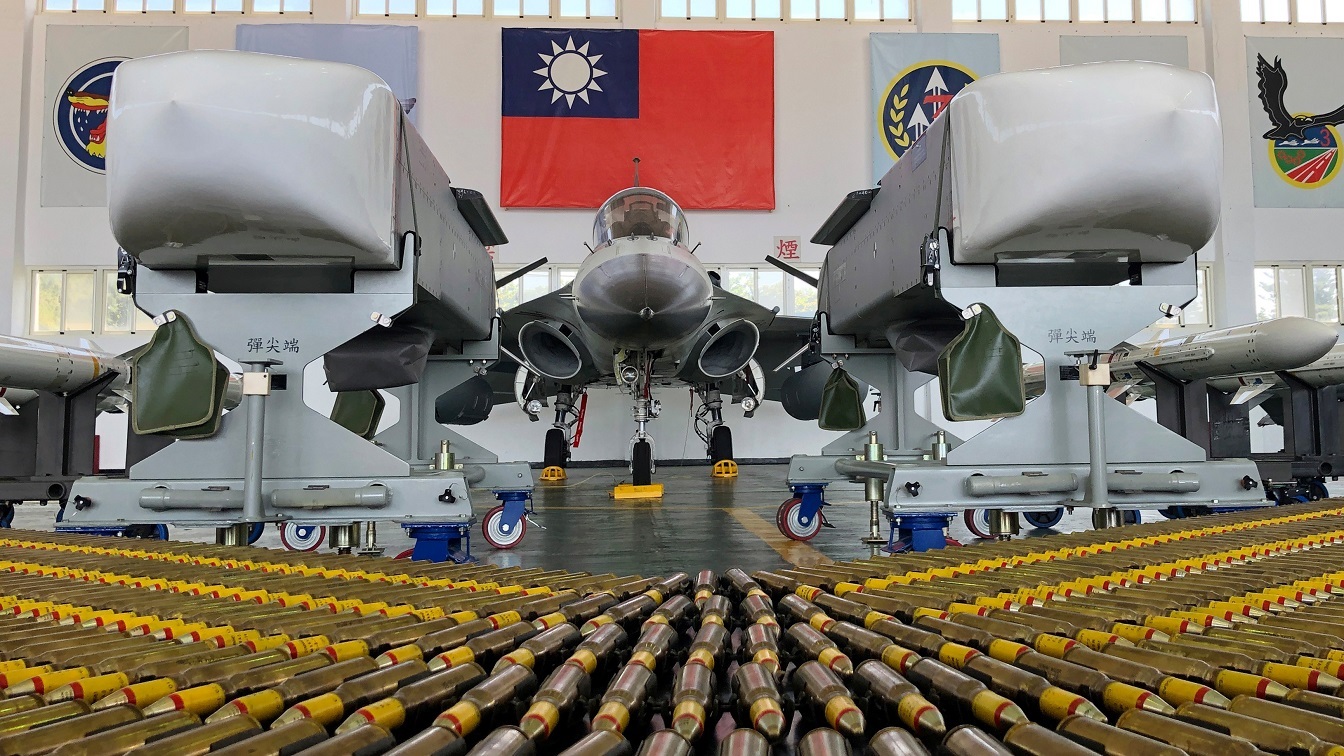
The important change is not the headline number. It is the move toward direct procurement, drawdown transfers and training support through the Department of Defense. For a Taiwan contingency, speed matters more than the elegance of the acquisition paperwork. A launcher delivered in 2027 is more valuable than a perfect program office briefing in 2032.
That is why the replenishment half of the package matters. The United States cannot keep drawing from its own stocks without replacing what leaves the inventory. Anyone who has served on a destroyer knows that readiness is not a press release. It is parts, trained watch teams, fuel, weapons and maintenance windows. The same rule applies to Taiwan aid. If the U.S. empties shelves to help Taipei but does not refill them, deterrence gets thinner in two places at once.
Still, $2 billion buys a narrow set of effects. It can move munitions, radios, drones, counter-drone kits and training teams. It cannot by itself harden every air base, duplicate every command node, build enough decoys, expand reserve competence or create a deep missile stockpile. The budget line is a down payment on a denial concept, not proof that the concept works.
HIMARS Shows The Scale Problem
Lockheed Martin describes HIMARS as a wheeled launcher that can carry six Guided Multiple Launch Rocket System rockets, two Precision Strike Missiles or one ATACMS missile. That modularity is exactly why Taipei wants the system. A launcher that can move between firing points, shoot, reload and disappear is the right shape for an island under missile threat.
CSIS Missile Threat lists ATACMS Block 1A range at up to 300 kilometers, while the older Block 1 reaches 165 kilometers. Those distances matter on Taiwan. From mobile firing points on the island, 300 kilometers can threaten ports, staging areas and command sites across much of the immediate battlespace. It can also force the People's Liberation Army to spend more effort hunting launchers before it can mass amphibious or airborne forces.
But one launcher firing one ATACMS is not a campaign. If a HIMARS battery has to survive Chinese ISR, drones, special operations teams, cyber disruption and ballistic missile strikes, the launcher is only the visible tip of the system. The real combat power sits in reload trucks, hiding sites, communications discipline, engineers who prepare alternate positions and commanders willing to delegate fire authority when networks are degraded.
This is where money becomes operational math. A $1.0 billion direct assistance account can disappear quickly once it is spread across air defense interceptors, anti-ship weapons, drones, secure communications, training and medical support. Patriot or NASAMS interceptors, coastal defense missiles and unmanned systems all compete for the same dollars. Taiwan needs all of them because China will not present one clean target set.
Anti-Ship Firepower Is The Center Of Gravity
Taiwan already has an indigenous missile base that fits the denial mission. CSIS assesses the Hsiung Feng III as a Taiwanese supersonic anti-ship cruise missile with a standard range of roughly 120 to 150 kilometers and an extended-range variant around 400 kilometers. It is ship- and ground-launched, carries a semi-armor-piercing high explosive payload and uses terminal active radar homing.
That is the right family of weapons for a cross-strait fight. The PLA Navy and civilian roll-on/roll-off fleet would need predictable approach lanes, ports, assembly areas and protected sea lines. Taiwan does not need to defeat the entire Chinese military. It needs to make those lanes too expensive to use on schedule.
The problem is density. A few batteries can create political confidence. A lot of batteries, with reloads and decoys, create operational uncertainty for Beijing. The difference is not semantic. If Chinese planners can map Taiwan's mobile launch force and suppress it in the opening phase, the island has bought symbols. If they must assume surviving missiles from multiple axes for days, Taiwan has bought time.
China Is Testing The Other Side Of The Equation
The same week makes the point. Defense News reported that China has sustained coast guard patrols east of Taiwan and conducted a 7,300 kilometer submarine-launched ballistic missile test from the South China Sea into the Pacific. Those are different tools, but they serve the same larger purpose: stretch the operating map and make U.S. and allied planners defend more problems at once.
For Taiwan, the answer cannot be a single silver bullet. It has to be a mesh of mobile fires, air defense, maritime surveillance, civil resilience and command redundancy. The U.S. package is valuable if it pushes that mesh into the field faster. It is less valuable if it becomes another list of equipment categories without the dull work of exercises, dispersal routes, reload drills and wartime repair.
The uncomfortable conclusion is simple. The 2027 money buys time, and time is worth buying. But deterrence will be measured in surviving launchers, usable magazines and commanders who can still shoot when the network is broken. Until those numbers are visible, $2 billion is an opening move pretending to be an answer.
Sources
- Army Recognition, 18 July 2026, U.S. plans $2 billion aid for Taiwan to counter China in new Indo-Pacific defense strategy.
- IndoPac weekly update, 18 July 2026, Taiwan joint defense exercise and Indo-Pacific security roundup.
- Defense News, 15 July 2026, China coast guard patrols east of Taiwan and submarine-launched missile test.
- Lockheed Martin HIMARS product data.
- CSIS Missile Threat data on ATACMS and Hsiung Feng III.
The U.S. plans a $2 billion aid package for Taiwan in Fiscal Year 2027 to enhance military capabilities against China. This package includes direct assistance and replenishment of U.S. military equipment. Taiwan requires mobile launchers and effective air defense systems to deter potential threats from China, which has been increasing military activities in the region. The aid aims to improve Taiwan's readiness and operational capabilities.
- The U.S. plans a $2 billion aid package for Taiwan in FY 2027.
- The aid includes $1 billion for direct assistance and $1 billion for replenishing U.S. equipment.
- Taiwan needs mobile launchers and dispersed sensors for effective defense.
- China is conducting military activities near Taiwan, including missile tests.
- Taiwan's indigenous missile capabilities are crucial for deterrence.