
Taiwan's $14 Billion Arms Delay Exposes the Real 2026 Gap
 Marcus Chen
Taiwan's $14 Billion Arms Delay Exposes the Real 2026 Gap
The $14 billion package is not just another Taiwan arms sale caught in Washington process. It is the package Taipei needs when the clock is already running.
Alexander Yui Tah-ray, Taiwan's top representative in Washington, told the Associated Press this week that Taiwan still sees no formal change in U.S. policy, even as the proposed package remains in limbo after President Donald Trump's May meeting with Xi Jinping. Secretary of State Marco Rubio has tried to narrow the language, saying the sale is under review rather than paused. Acting Navy Secretary Hung Cao used plainer words in May: some foreign military sales were being held to preserve munitions for the Iran war.
For Taipei, the vocabulary matters less than the delivery schedule. The Taiwan Strait does not care whether a case is paused, reviewed, sequenced, or held for stockpile management. A launcher that arrives in 2029 cannot hit a landing force in 2027.
The Package Is a Fire Plan
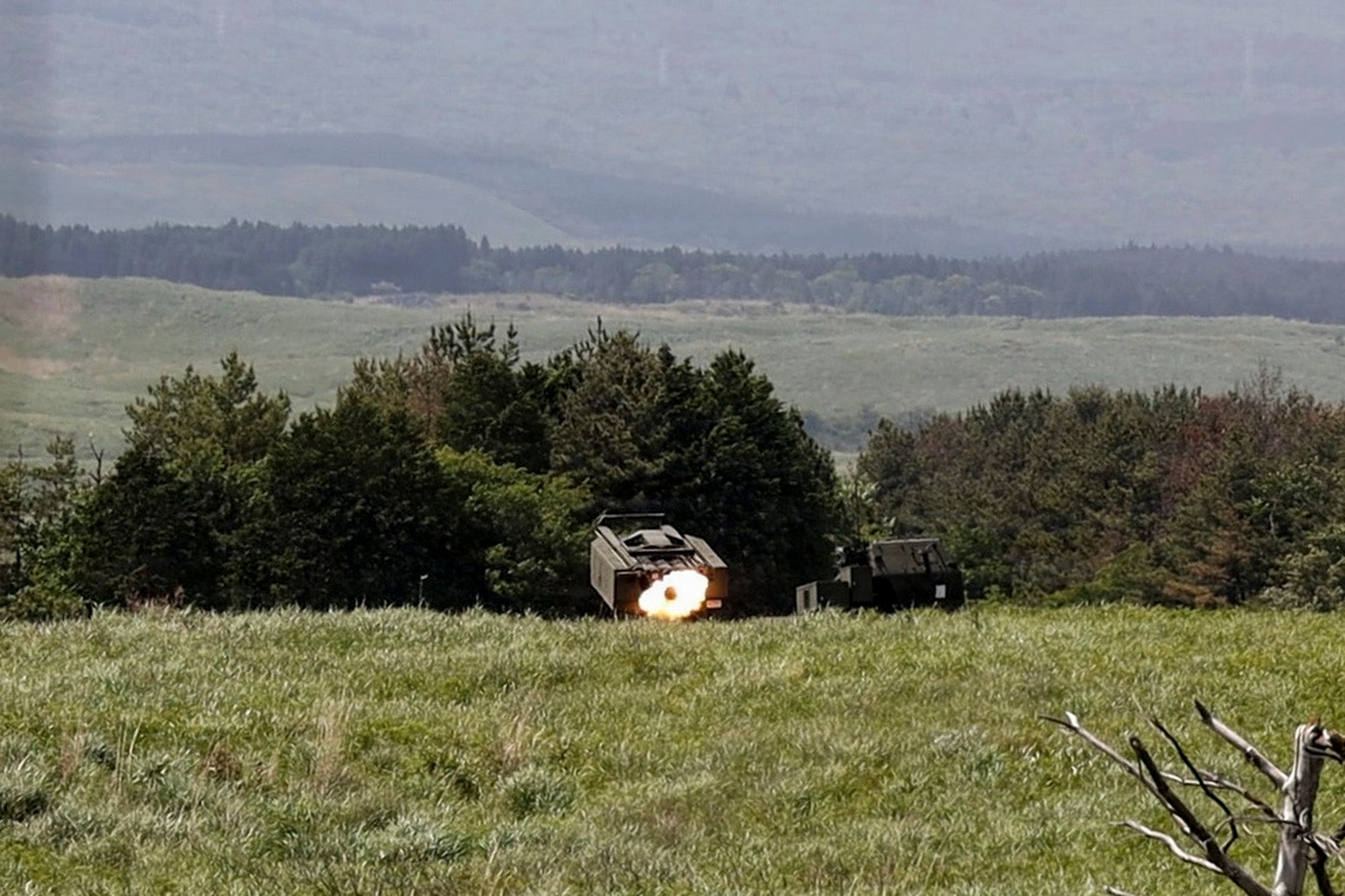
The public pieces of the last big Taiwan tranche tell us what the missing package is really about. In December 2025, the Trump administration notified Congress of more than $11.1 billion in Taiwan sales: 82 M142 HIMARS launchers, 420 ATACMS missiles, 60 M109A7 self-propelled howitzers, ALTIUS loitering systems, Javelins, TOW missiles, and tactical networking software. The Defense Security Cooperation Agency priced the HIMARS case alone at $4.05 billion. The U.S.-Taiwan Business Council called it the largest Taiwan package by value, and Taiwan Security Monitor later put the broader backlog at roughly $32 billion.
That is not a symbolic shopping list. It is a fire plan.
A Chinese amphibious operation would have to move troops, armor, engineering units, air-defense vehicles, fuel, and follow-on echelons across roughly 80 nautical miles of water at the Strait's narrowest useful approaches. The first wave is not enough. The People's Liberation Army has to keep the bridgehead alive and feed it under missile, drone, artillery, and air attack.
HIMARS and ATACMS are useful because they compress Taiwan's response time. A mobile launcher hidden inland can fire on ports, staging areas, air-defense nodes, or landing ships and move before counterbattery fire arrives. M109A7s matter for a different part of the fight: killing troops and vehicles that survive the beach and begin pushing inland. Javelins and TOWs are not glamorous, but anyone who has served on a destroyer knows unglamorous weapons are often what decide whether a concept survives contact with maintenance, weather, and fear.
The Exercise Shows the Shortfall
This is why Taiwan's first live-fire HIMARS drill toward the Strait, reported by Axios this week, deserves to be read together with the arms-sale delay. The drill showed a real capability emerging. It also showed a small one. Taiwan can practice shoot-and-scoot tactics with the systems it has. It cannot build a deep wartime magazine through exercises.
The arithmetic is ugly. If Taiwan ultimately receives 82 additional HIMARS launchers and 420 ATACMS, that averages just over five ATACMS per launcher before any reload math, attrition, dud rate, target duplication, or training expenditure. In an invasion scenario, five shots per launcher is not a campaign. It is an opening night.
That does not mean the sale is useless. It means the sale is late even when it is approved. Foreign Military Sales notifications are political events. Deliveries are industrial events. The gap between the two is where deterrence gets thin.
Washington Has a Stockpile Problem
Rubio's stockpile argument should not be dismissed. The United States is trying to support Ukraine, sustain operations connected to the Iran war, keep its own Indo-Pacific war reserve, and reassure Taiwan with weapons drawn from many of the same production lines. PAC-3 MSE interceptors, NASAMS missiles, ATACMS, air-defense radars, guided artillery, and loitering munitions are not produced by speech. They come from factories with suppliers, motors, seekers, test ranges, and labor constraints.
But this is also the point. If Washington cannot approve and schedule Taiwan's package while no shots are being fired across the Strait, it should stop pretending the problem will become easier during a crisis. In a real Taiwan contingency, U.S. ports, airlift, sealift, undersea cables, satellite networks, and munitions depots would all be contested politically or physically. Beijing does not have to sink every ship. It only has to make the resupply problem slow enough that Taiwan fights with what it already has.
There is a political cost too. Treating a Taiwan package as leverage with Beijing tells the People's Liberation Army that American commitments can be timed around summit management. That does not mean Washington must approve every Taiwanese request instantly. Some requests are badly prioritized. Some platforms consume money that would be better spent on mines, drones, air defense, hardened command posts, and repair capacity. Taipei's own legislature has also slowed funding for special procurement, as Taiwan Security Monitor noted in March.
The First Island Chain Needs Magazines
Still, the core issue in June 2026 is not whether Taiwan should buy more. It is whether the United States can deliver the specific weapons that match its own denial-defense theory.
The Pentagon's January defense strategy talks about holding China inside the first island chain. That line runs through Taiwan. A denial defense there depends on magazines, mobility, targeting, and survivable command networks, not diplomatic mood music. The December package was built around that logic. The delayed $14 billion sale now tests whether the logic has an acquisition system behind it.
Yui is right that Taiwan cannot wait for the U.S. cavalry. But Taiwan also cannot manufacture ATACMS, PAC-3 interceptors, and HIMARS launchers at American scale by itself in the next two years. It can harden, disperse, train, stockpile fuel, build drones, improve reserve units, and make the PLA pay for every mile of water. Those are necessary moves.
They are not substitutes for munitions already promised in Washington's own war plans.
The uncomfortable conclusion is simple. The $14 billion sale is being discussed as a diplomatic signal, but the real signal is logistical. If the United States wants Taiwan to be a hard target in 2026, it has to move weapons faster than Beijing moves pressure. Right now, the math still favors delay.
Taiwan faces significant delays in receiving a $14 billion arms package from the U.S., which includes critical military equipment such as HIMARS launchers and ATACMS missiles. This delay jeopardizes Taiwan's defense capabilities against potential Chinese aggression, as the U.S. struggles to balance military support for both Taiwan and Ukraine. The situation highlights the logistical challenges in U.S. defense commitments and Taiwan's urgent need for these weapons by 2026.
- Taiwan's $14 billion arms package is delayed, impacting its defense capabilities.
- The package includes 82 HIMARS launchers and 420 ATACMS missiles.
- Taiwan's military exercises reveal a capability gap due to the arms delay.
- The U.S. is balancing support for Ukraine and Taiwan, affecting arms deliveries.
- Taiwan cannot independently produce the required military equipment in the near term.