
Taiwan's 2026 Anping-Class Cutters Add 16 Missiles to Strait Defense
 Marcus Chen
Taiwan's 2026 Anping-Class Cutters Add 16 Missiles to Strait Defense
Taiwan's coast guard has just demonstrated something more consequential than a successful missile test: twelve patrol cutters can become a 192-launcher antiship force on short notice. That is the real meaning of the Hsiung Feng III launch from the coast guard catamaran Qijin. The hardware is useful. The conversion plan is more important.
The Test Put a Coast Guard Hull Into the Navy's Fight
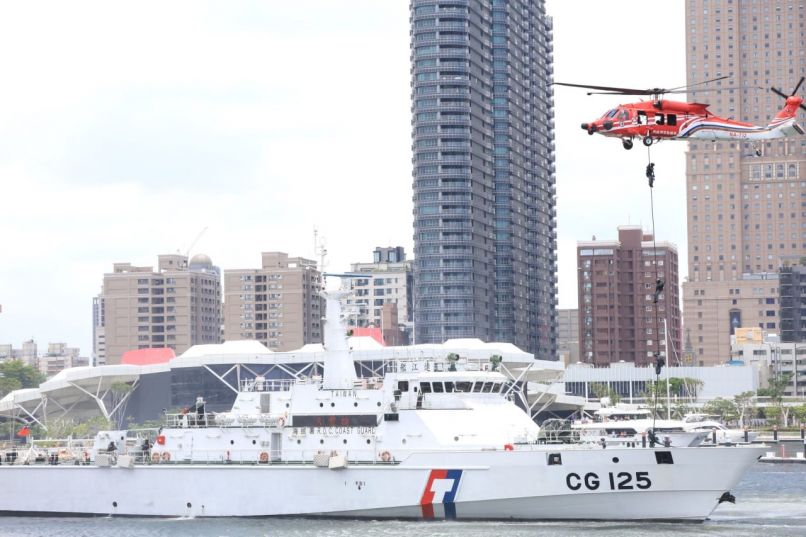
According to The Maritime Executive and reporting by Baird Maritime, the trial involved an Anping-class patrol vessel firing a locally built Hsiung Feng III supersonic antiship missile at a decommissioned Taiwan Navy frigate during a sinking exercise. The missile traveled about 50 nautical miles before hitting its target. A subsonic Hsiung Feng II launch followed.
Fifty nautical miles is more than half the Taiwan Strait's width at its narrowest commonly used crossing points. It is not a claim that an Anping-class cutter can independently control the strait. It is a useful reminder that a law-enforcement hull operating near Taiwan's coast can carry a weapon whose reach extends well beyond the immediate littoral.
The Anping class is a high-speed catamaran design. Taiwan has built twelve hulls, with ten active, and the ships can be fitted with up to sixteen missile launchers. Several sister ships have already conducted similar trials. On paper, twelve hulls multiplied by sixteen launchers equals 192 firing positions. In practice, the number of available missiles, trained crews, targeting networks, and serviceable launchers will be smaller. The arithmetic still changes the problem for a Chinese planner.
Why the Conversion Matters in a Blockade
Taiwan's navy has only several dozen missile-capable surface combatants. Adding twelve fast, distributed platforms would not replace frigates or corvettes, but it could complicate the opening hours of a blockade or amphibious campaign. The cutters could disperse among ports, commercial traffic, and coastal facilities during peacetime, then move into preplanned firing areas after a wartime transfer of command.
That is sea denial, not sea control. An Anping-class ship is not designed to stand in a missile exchange with a People's Liberation Army Navy destroyer. Its value comes from forcing Chinese forces to search for more launch points, allocate surveillance assets to small contacts, and defend against a larger number of simultaneous shots. A missile battery that survives because it is mobile and difficult to classify may be more valuable than a larger ship that is easy to track.
The conversion also fits Taiwan's geography. The coast guard already operates around offshore islands, fishing grounds, and gray-zone pressure points. Its crews have routine access to the maritime picture. If the command relationship, rules of engagement, and communications architecture are rehearsed before a crisis, the coast guard can add sensors and launch platforms without waiting for new ships to be built.
The Weak Link Is the Kill Chain
Missile capacity is not the same as combat power. The Hsiung Feng III has the speed and range to threaten surface vessels, but the cutter still needs a reliable track, an engagement-quality solution, and a command authority able to release weapons under intense electronic warfare. Chinese aircraft, drones, coast guard ships, and maritime militia vessels would create a dense and deliberately confusing picture. Firing at the wrong contact would be politically and militarily disastrous.
Taiwan therefore needs to integrate the Anping class with shore-based radars, naval aircraft, unmanned systems, and mobile missile units. The recent test proves the launcher can work against a known target. It does not yet prove that the full sensor-to-shooter chain will work while satellites are disrupted, data links are jammed, and command posts are being attacked.
There is a second problem: magazine depth. If each vessel carries sixteen launchers, Taiwan must stock enough Hsiung Feng missiles to reload the force after the first engagement. A one-time salvo is a deterrent signal. A force that can fire, relocate, reload, and fire again is an operational capability. The distinction will determine whether these cutters are a serious wartime asset or an impressive demonstration fleet.
Taiwan Is Borrowing China's Gray-Zone Logic
The political message is as important as the tactical one. The South China Morning Post described the firing as evidence of deepening links between Taiwan's coast guard and navy. That link is a response to China's own use of ostensibly civilian or paramilitary maritime forces. Beijing has made the distinction between law enforcement and military coercion deliberately difficult to police; Taiwan is now preparing to make the same ambiguity work in its favor.
This is not symmetrical. China's coast guard fleet is vastly larger, and many Chinese cutters are much bigger than Taiwan's patrol vessels. Taiwan cannot win a hull-count competition. It can, however, make every attempt to isolate the island more dangerous by distributing antiship weapons among platforms that are difficult to identify before a conflict begins.
The Test Is a Warning About Readiness
The conversion plan will matter only if Taiwan funds missiles, reloads, maintenance, hardened communications, and realistic exercises. It also needs a clear legal mechanism for transferring coast guard ships into naval control. Those details are less photogenic than a supersonic missile strike, but they decide whether the force survives first contact.
The lesson is simple: Taiwan does not need every coast guard cutter to become a corvette. It needs enough of them to create uncertainty about where the next antiship salvo will come from.
China's blockade problem is already difficult because Taiwan's coastline is crowded, mountainous, and full of potential hiding places. Twelve Anping-class cutters armed with up to sixteen missiles each will not stop the People's Liberation Army Navy by themselves. They can force it to spend more time finding, classifying, and suppressing Taiwan's shooters before it can close the strait. That is a modest capability, but in the first forty-eight hours of a war, modest capabilities multiplied across 192 launch positions can become the difference between pressure and paralysis.
Taiwan's coast guard demonstrated the missile capabilities of its Anping-class cutters, which can be armed with up to 16 Hsiung Feng III missiles each, totaling 192 launchers. This capability enhances Taiwan's defense strategy in the Taiwan Strait, complicating potential Chinese military operations. The recent test involved a successful missile launch against a decommissioned frigate, showcasing the cutters' operational readiness and strategic value.
- Taiwan's coast guard can convert patrol cutters into missile platforms.
- Each Anping-class cutter can be equipped with up to 16 missile launchers.
- The Hsiung Feng III missile has a range of 50 nautical miles.
- Taiwan's strategy involves using coast guard vessels for military deterrence.
- The conversion plan complicates potential Chinese military operations.