
Taiwan's 2026 HIMARS Strait Drill Shows a Real Firepower Gap
 Marcus Chen
Taiwan's 2026 HIMARS Strait Drill Shows a Real Firepower Gap
Thirty-two rockets fired and four did not. That is the useful part of Taiwan's first west-coast High Mobility Artillery Rocket System live-fire drill, not the television picture of bright flashes over the Taichung shoreline.
The Republic of China Army fired U.S.-supplied M142 HIMARS launchers toward the Taiwan Strait on June 10 during a two-day anti-invasion exercise near Taichung. AP reported that the drill used reduced-range practice rockets and simulated a response to a Chinese amphibious landing. USNI News, citing Taiwan's Ministry of National Defense and TaiwanPlus, reported that the launchers moved to new firing positions within three minutes and that four of 36 planned rockets failed to launch.
The Three-Minute Number Matters
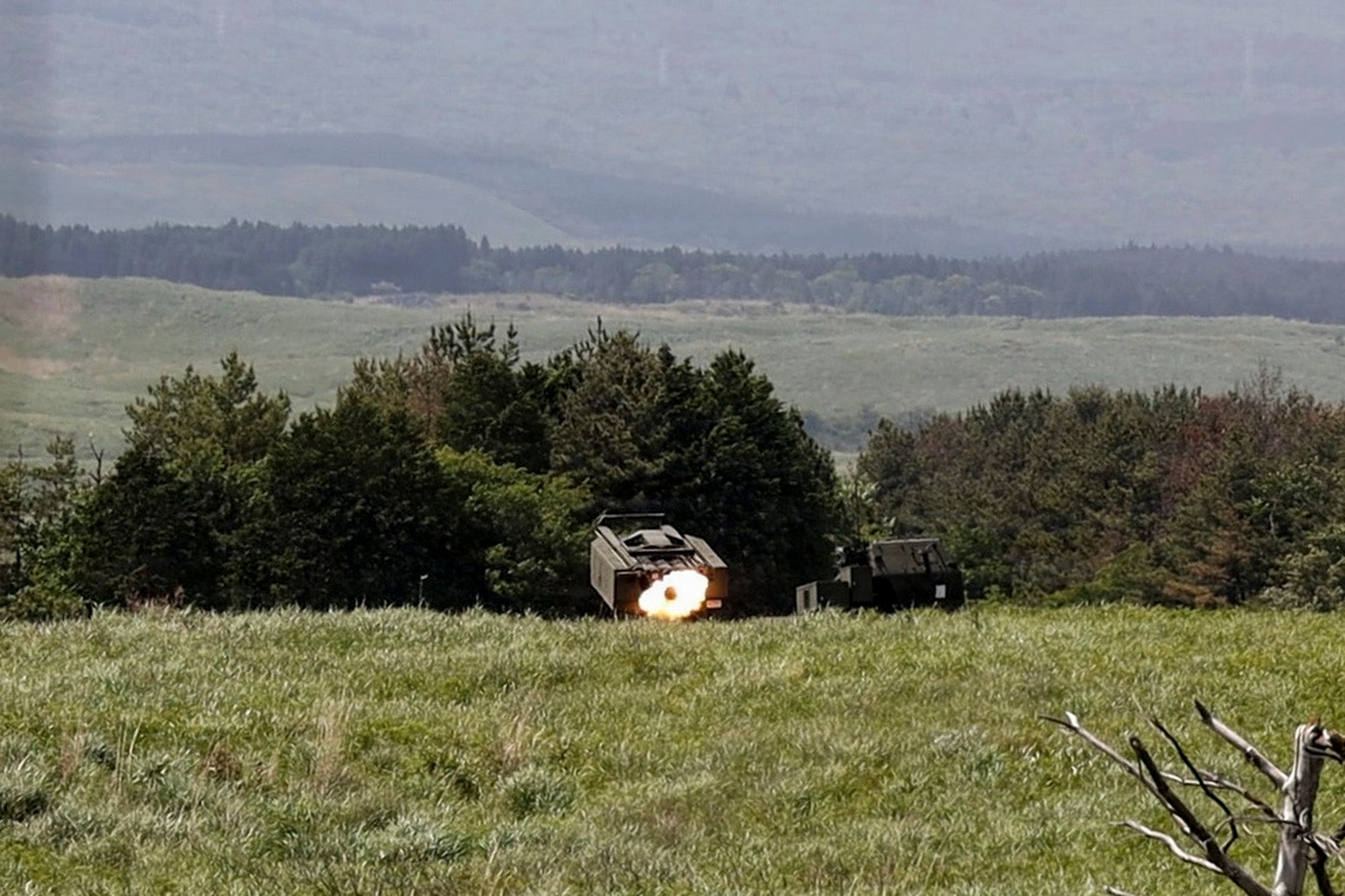
HIMARS is not magic artillery. It is a six-wheeled launcher carrying one pod of six Guided Multiple Launch Rocket System rockets or one Army Tactical Missile System missile. Its value for Taiwan is that it can leave cover, fire, and disappear before Chinese counter-battery sensors and drones close the loop. In a Taiwan Strait fight, minutes are not a public-affairs metric. They are the difference between a launcher that fires twice and a launcher that becomes wreckage on a road shoulder.
The three-minute relocation claim is therefore the most important data point from the exercise. Anyone who has served around naval gunfire or missile operations knows that the weapon is only one part of the cycle. The rest is command approval, target quality, communications discipline, reload access, road movement, emissions control, and a crew that does not freeze when the plan breaks.
Taiwan's western coast makes that hard. The west side is where the population, ports, airfields, highways, and likely landing beaches sit. It is also where concealment is harder than it looks on a map. A launcher that can move quickly still needs pre-surveyed hides, decoy positions, bridge routes that can bear its weight, and air defense cover against drones and loitering munitions. The live-fire drill showed the concept. It did not prove the network.
Four Misfires Are Not a Footnote
The reported four launch failures out of 36 planned rockets translate to an 11 percent failure rate for that drill. That number should not be overread; training rounds, new crews, and early integration all produce ugly data. But it should not be waved away either. Taiwan is buying time with precision fires. A launcher that is expected to blunt a landing force must work under worse conditions than a scheduled media exercise.
The arithmetic gets uncomfortable quickly. If a battery fires 36 rockets and loses four at the tube, that is four fewer shots at landing craft, staging areas, air-defense radars, or logistics nodes. If the same friction appears when Chinese forces are jamming communications, flying drones, and striking road junctions, the real shortfall compounds. Taiwan does not have the luxury of large salvo wastage.
This is why the drill's flaws were useful. Taiwan needs to find launch, reload, command-and-control, and maintenance problems now, in public if necessary, rather than in the first twelve hours of a blockade or landing attempt. A clean demonstration would have been less informative.
HIMARS Changes the Landing Problem, Not the War
HIMARS gives Taiwan a harder punch against ships, beachheads, ports, and airfields. USNI News noted that Taiwan wants a force of 111 launchers after a planned order of 82 additional systems, on top of its earlier procurement. The weapons family can cover ranges from short practice shots to about 186 miles with existing long-range missiles, with extended-range concepts pushing farther. On Taiwan's outlying islands, Army Tactical Missile System rounds could threaten embarkation infrastructure on the Chinese coast.
That creates a real problem for the People's Liberation Army. An amphibious assault is a logistics event before it is a heroic assault. Troops need roll-on/roll-off ships, ferries, port staging areas, air cover, fuel, beach exits, engineering units, and follow-on ammunition. Precision rocket artillery aimed at those nodes can turn a landing plan into a traffic jam under fire.
But the same logic cuts against easy optimism. China will not sail across the Strait pretending HIMARS does not exist. It will try to suppress launchers before H-hour with ballistic missiles, cruise missiles, cyber attacks, special operations, drones, and electronic warfare. It will hunt the trucks' support system: fuelers, reload vehicles, command posts, data links, and repair teams. Killing the launcher is ideal. Breaking the kill chain around it may be enough.
That is the part Washington and Taipei should focus on. The launcher count is visible. The supporting architecture is harder to photograph and easier to underfund.
The Arms Delay Makes the Drill Political
AP reported that the United States announced plans in December to sell 82 more HIMARS systems to Taiwan, but that the package appears to have been put on hold after President Donald Trump met Xi Jinping in Beijing last month. If that delay holds, the June drill becomes more than a training event. It becomes a signal to Washington that Taiwan can use the systems it receives, and to Beijing that the island is not waiting passively for diplomatic weather to improve.
That signal is useful but incomplete. Taiwan's defense problem is not whether HIMARS can fire from Taichung. It is whether enough launchers, munitions, sensors, reloads, hardened depots, and trained crews can survive a first strike and keep firing for days. One good battery can embarrass an attacker. A distributed rocket force can change an invasion timetable.
The distinction matters because deterrence in the Taiwan Strait is built on operational doubt. Beijing does not need to believe invasion is impossible. It needs to believe the first wave may fail, the follow-on wave may arrive late, and the political clock may run faster than the military plan. HIMARS contributes to that doubt only if Taiwan can make the system boringly repeatable.
The Real Lesson
The June drill was not a decisive shift in the cross-strait balance. It was a progress report. Taiwan demonstrated that it can move American rocket artillery onto its China-facing coast, fire into the Strait, and reposition quickly. It also demonstrated that integration is still messy.
That is the honest picture. Taiwan does not need a perfect HIMARS force. It needs a survivable one, supplied deeply enough and rehearsed hard enough that Chinese planners have to budget for missed schedules, burning landing craft, blocked beach exits, and ports under threat before the first ship leaves Fujian.
Thirty-two rockets fired. Four stayed in the launcher. The gap between those two numbers is where Taiwan's defense either becomes a real denial strategy or another impressive demo reel.
The Republic of China Army conducted a live-fire drill using M142 HIMARS on June 10, 2026, near Taichung, simulating a response to a Chinese amphibious landing. During the exercise, 32 rockets were fired, but 4 failed to launch, indicating an 11% failure rate. The drill emphasized the importance of rapid repositioning and effective command and control in military operations against potential threats from China.
- Taiwan conducted a live-fire drill with M142 HIMARS on June 10, 2026.
- 32 rockets were fired, with 4 failing to launch, resulting in an 11% failure rate.
- The drill simulated a response to a potential Chinese amphibious landing.
- Taiwan aims to procure 111 HIMARS systems to enhance its defense capabilities.
- The exercise highlighted the need for effective command and control and logistics in military operations.