
Taiwan's 2026 MQ-9B Sea Guardians Near Deployment but Cannot Close the Strait
 Marcus Chen
Taiwan's 2026 MQ-9B Sea Guardians Near Deployment but Cannot Close the Strait
Taiwan is finally moving its MQ-9B SeaGuardian fleet toward operational use. That is useful news for maritime surveillance. It is not a solution to the island's surveillance problem.
Recent reporting by Taiwan News says Taiwan's US-made aircraft are nearing operational deployment, while South China Morning Post reported that the drones have been tested against Chinese gray-zone activity. The timing matters: Taipei is trying to watch more of the water around the island without sending manned aircraft into every encounter with the People's Liberation Army Navy (PLAN) and China Coast Guard.
The MQ-9B can help. But four large remotely piloted aircraft cannot maintain a continuous picture of a coastline, an air-defense battle, and a wartime blockade at the same time. Taiwan is buying a sensor layer, not sea control.
A Long-Endurance Sensor Finally Enters the Fight
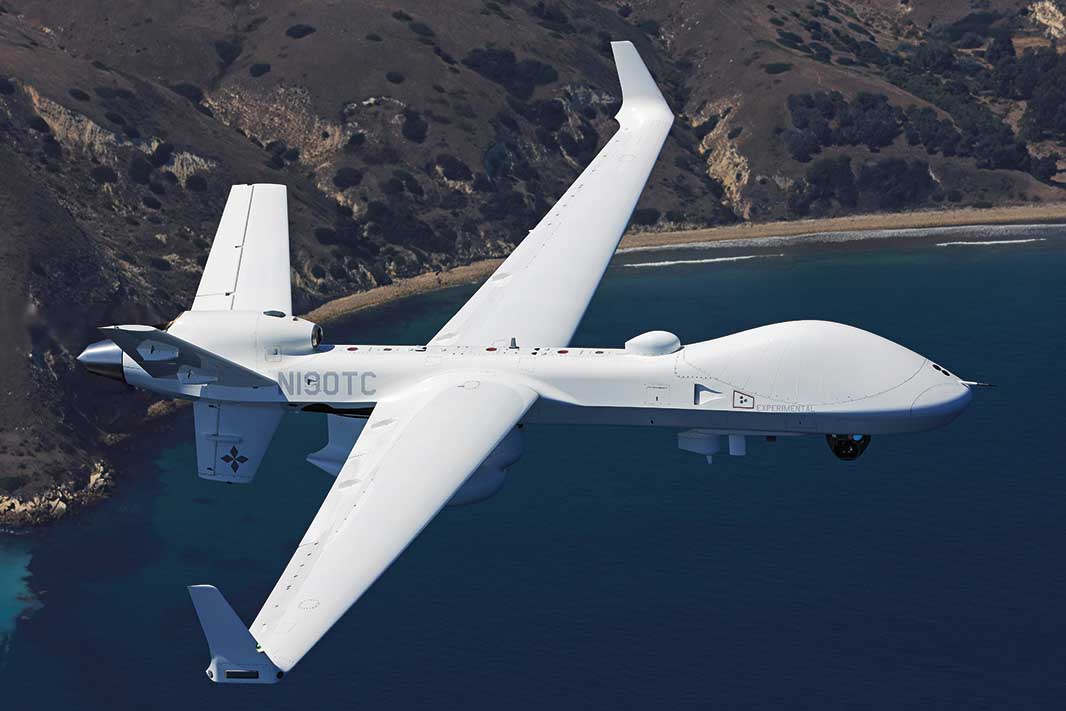
General Atomics lists the MQ-9B as a high-altitude, long-endurance remotely piloted aircraft with more than 40 hours of endurance, a service ceiling above 40,000 feet, and a wingspan of roughly 79 feet. The SeaGuardian configuration adds maritime surveillance equipment, including a maritime search radar, electro-optical and infrared sensors, and systems for tracking surface contacts. Its satellite communications link allows controllers to operate the aircraft well beyond line of sight.
Those numbers solve a familiar Taiwanese problem. Fighter patrols are fast but expensive, conspicuous, and limited by crew fatigue. Small drones are cheaper and easier to disperse, but they cannot stay on station for a full day or carry the same sensor package. The MQ-9B sits between those categories: persistent enough to watch shipping lanes and large enough to carry useful radar, but still dependent on ground stations, satellite bandwidth, runways, and a permissive enough electromagnetic environment.
What Four Aircraft Can Actually Do
The first mission is gray-zone monitoring. Chinese coast guard ships, maritime militia, naval vessels, and aircraft routinely pressure Taiwan without crossing the threshold of open war. A SeaGuardian can record patterns, cue other sensors, and reduce the number of hours that Taiwan must put pilots at risk. It can also provide a common operating picture for the navy, air force, and coast guard.
The second mission is cueing. An MQ-9B does not need to sink a ship to matter. If its radar detects a contact and passes a track to a coastal missile battery, a frigate, or another aircraft, it compresses the time between detection and decision. That is the correct asymmetric logic.
But the arithmetic is harsh. Four aircraft do not equal four aircraft continuously overhead. Maintenance, crew shifts, weather, transit time, training, and the need to keep aircraft available for contingencies reduce the number on station. Even if Taiwan generated an excellent sortie rate, the fleet would cover selected sectors and windows, not every approach to the island. A wartime opponent would attack the network rather than wait for the drone itself to be shot down.
The Vulnerability Is the Network
The MQ-9B's endurance is impressive only if the support architecture survives. Taiwan needs multiple launch and recovery locations, hardened control facilities, redundant communications, spare engines and sensors, and crews trained to hand off control without losing the track. It also needs a plan for operating when Chinese jamming degrades satellite links or when airfields are under missile attack.
This is where the platform's apparent affordability becomes misleading. Buying the airframe is the visible part of the program. Keeping it in the air requires protected runways, data links, maintenance capacity, intelligence analysts, and a command system that can turn a sensor observation into a military action. The same warning applies to Taiwan's broader drone expansion: recent Taiwan News reporting described supply-chain hurdles and uncertain military demand even as Taiwanese companies win export attention.
A drone industry built for commercial export is not automatically a military production base. Taiwan must stockpile components that cannot be replaced quickly, qualify domestic substitutes, and decide whether its priority is a handful of exquisite systems or thousands of attritable ones. It needs both, but the procurement logic is different.
Useful for Deterrence, Insufficient for War
The MQ-9B gives Taiwan a better way to observe the gray zone and a more persistent tool for maritime intelligence, surveillance, and reconnaissance. It may also make Chinese coercion more expensive by preserving evidence and forcing the PLA to account for another sensor in its operating area.
It will not stop a blockade. It carries no magic answer to Chinese fighters, surface-to-air missiles, cyber attacks, or a massed missile strike. In a conflict, the aircraft would need escorts, decoys, dispersed basing, and a resilient command network. Without those, a long-endurance drone becomes a valuable target with a very long flight plan.
Taiwan should treat this deployment as the beginning of an architecture, not the completion of a capability. The SeaGuardians can extend the island's eyes. They cannot keep the Strait open. That gap will be measured in coverage hours, spare parts, and surviving data links—not in the number printed on the purchase contract.
Sources
- Taiwan News, reporting on Taiwan's MQ-9B operational testing and drone-industry supply-chain constraints, November 2026.
- South China Morning Post, reporting on Taiwan's MQ-9B testing against PLA gray-zone operations, September 2026.
- General Atomics Aeronautical Systems, MQ-9B SeaGuardian technical specifications.
Taiwan is deploying 4 MQ-9B SeaGuardian drones for maritime surveillance as of November 2026. These drones will assist in monitoring gray-zone activities by Chinese forces. However, the deployment does not provide Taiwan with the capability to maintain sea control or effectively counter a blockade. The operational use of these drones is seen as a step towards enhancing Taiwan's surveillance capabilities, but significant vulnerabilities remain in the support network.
- Taiwan is deploying 4 MQ-9B SeaGuardian drones for maritime surveillance.
- The drones are intended for gray-zone monitoring against Chinese activities.
- The MQ-9B has a service ceiling above 40,000 feet and over 40 hours of endurance.
- Taiwan's drone deployment does not equate to sea control or blockade capabilities.