
Taiwan's 49-Aircraft Surge Shows China's Pressure Campaign Is Maturing
 Marcus Chen
Taiwan's 49-Aircraft Surge Shows China's Pressure Campaign Is Maturing
Taiwan reported 49 Chinese military aircraft in its air-defense identification zone in a 24-hour period this week, reportedly the highest daily count recorded by Taipei in 2026. The number dropped sharply in the following daily release, which listed 11 aircraft and 13 Chinese military and coast guard vessels. That sequence matters. It looks less like the opening move of an invasion than a maturing pressure campaign that can surge, pause, and surge again without requiring a formal exercise.
The Number Is a Signal, Not an Order of Battle
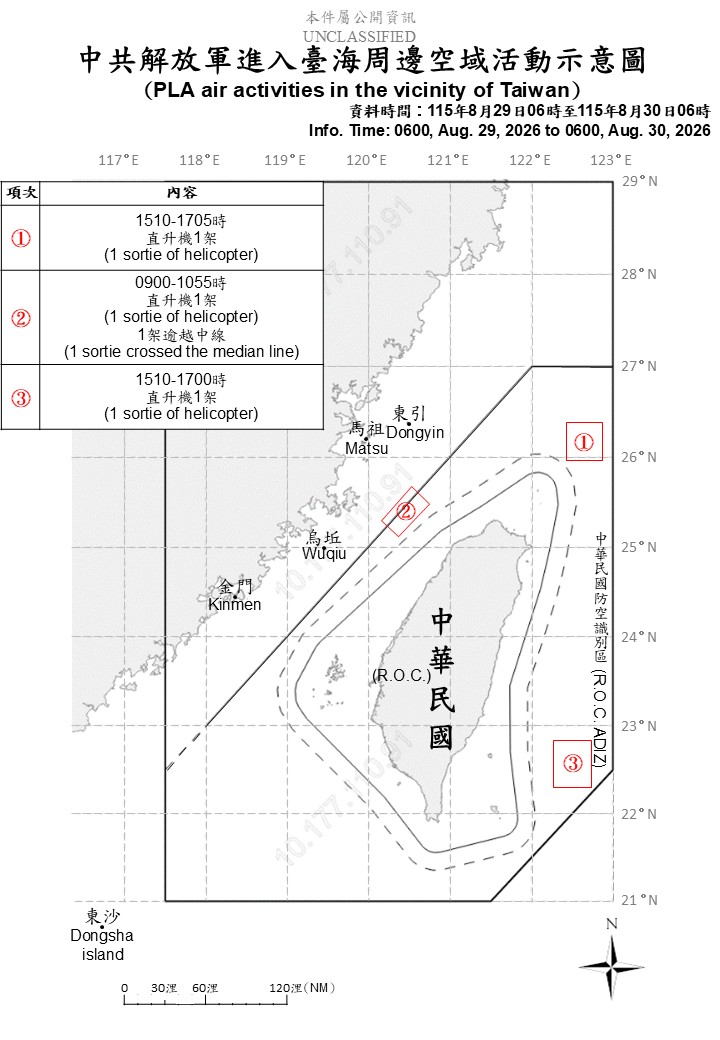
Taiwan's Ministry of National Defense daily releases are useful, but the aircraft count needs careful handling. An ADIZ is not sovereign airspace, and an aircraft entering it has not necessarily violated Taiwan's territorial airspace. The count also aggregates different missions. A combat-air-patrol package, a bomber escort, an unmanned aircraft, and a support sortie do not impose the same tactical problem.
Still, 49 aircraft in one reporting window is not administrative noise. It requires China to generate sorties, coordinate command-and-control, manage tanker and intelligence support, and sustain crews at a tempo visible to the other side. The follow-on count of 11 aircraft is equally revealing. Beijing can turn the dial down without ending the pressure. That complicates Taiwan's readiness cycle and makes any single day's number a poor guide to the underlying trend.
Institute for the Study of War's November 6 China-Taiwan update placed the activity in the context of continued coercion rather than a discrete invasion rehearsal. Taiwan News separately reported the later 11-aircraft, 13-ship tally. Read together, the sources point to a campaign built around calibrated military presence: enough activity to force a response, not enough to make the political decision for war.
What the Surge Costs Taiwan
Taiwan's immediate problem is not that 49 aircraft can defeat its air force in a day. It is that repeated alerts consume the readiness margin on which a smaller defender depends. Fighters have finite engine hours. Ground crews need rest. Surface-to-air missile units must remain connected to the air picture. Commanders must decide when to launch aircraft, when to rely on passive sensors, and when to preserve combat power.
The relevant calculation is cumulative. If Taiwan treats every large sortie as a crisis, China can impose maintenance and personnel costs without firing a shot. If Taiwan treats the activity as routine, it risks missing the transition from routine coercion to operational preparation. That is the gray-zone trap: the defender must be ready for the exception while paying for the rule.
China also gains a training benefit. Large packages allow the People's Liberation Army Air Force and the PLA Navy to rehearse the geometry of pressure around Taiwan: approach routes, fighter support, electronic coverage, and coordination with surface forces. The objective is not merely to fly near Taiwan. It is to make Taiwan's response predictable and to map the seams between air-defense, maritime, and political decision-making.
The Maritime Layer Is More Important Than the Headline
The same reporting window included Chinese ships and coast guard vessels. That is the more important direction of travel. Aircraft can create alarm quickly, but ships can remain, inspect, shadow, escort, and complicate access to ports and offshore islands. A pressure campaign that combines aircraft with coast guard and naval presence gives Beijing more options below the threshold of blockade.
Recent commentary on an alleged Chinese “anaconda strategy” toward Taiwan's outlying islands is best treated as analysis, not proof of an adopted plan. But the concept captures the operational logic. China does not need to begin with a landing on Taiwan's west coast. It could first test whether maritime law-enforcement forces can isolate or intimidate smaller islands while military aircraft hold Taiwan's attention elsewhere.
That is why the 11-aircraft follow-on report should not be read as de-escalation by itself. If the maritime presence persists, Beijing may be shifting the burden from a visible air surge to a slower, harder-to-answer maritime campaign. The force mix matters more than the aircraft headline.
Washington's Reinforcement Problem
The reported possibility of a future China visit by U.S. Secretary of War Pete Hegseth and Admiral Samuel Paparo, according to the South China Morning Post, adds a diplomatic layer to the military picture. Communication channels can reduce the risk that a sortie or close encounter becomes a shooting incident. They do not solve the force problem.
In a real crisis, U.S. forces would need to find, fuel, arm, and protect aircraft and ships across the first island chain while Taiwan absorbs the opening pressure. A carrier strike group is valuable, but it cannot be everywhere at once. Submarines, long-range aviation, distributed missiles, logistics hubs, and allied access determine whether Washington can turn political commitment into sea control or merely demonstrate presence.
For Taiwan, the answer is not to chase every Chinese aircraft with an expensive fighter. It is to preserve a layered force: mobile air defenses, hardened command networks, unmanned surveillance, runways that can be repaired, and enough trained personnel to sustain operations after the first week. The United States should measure assistance against that endurance problem, not only against the number of platforms announced.
The Pressure Campaign Is Working Because It Is Reversible
Beijing can generate a 49-aircraft day, return to 11 aircraft the next day, and claim that neither event constitutes a blockade or an exercise. That reversibility is the point. It keeps escalation ambiguous while making Taiwan spend real resources on every decision.
The best indicator to watch next is not another record count. It is whether high sortie days become synchronized with coast guard activity, unusual naval deployments, logistics movements, or changes in China's public legal messaging. Those combinations would show that the campaign is moving from signaling toward operational preparation.
For now, the math favors coercion. China can vary the tempo; Taiwan must maintain readiness continuously. Unless Taipei and Washington build a force that can absorb that pressure without exhausting itself, the next crisis may begin long before anyone calls it a blockade.
Sources: Taiwan Ministry of National Defense daily PLA activity releases; Taiwan News reporting on the November 2026 aircraft and vessel counts; Institute for the Study of War, China & Taiwan Update, November 6, 2026; South China Morning Post reporting on possible U.S.-China defense contacts.
Taiwan reported a surge of 49 Chinese military aircraft in its air-defense identification zone, followed by a drop to 11 aircraft and 13 vessels. This activity is part of a pressure campaign by the Chinese military, aimed at testing Taiwan's readiness without escalating to an invasion. The presence of both aircraft and naval vessels complicates Taiwan's defense strategy and indicates a sustained military presence in the region.
- Taiwan reported 49 Chinese military aircraft in its air-defense identification zone in a 24-hour period.
- The number of aircraft dropped to 11 in the following report.
- The activity is part of a pressure campaign rather than an invasion rehearsal.
- Chinese vessels were also reported alongside the aircraft.
- Taiwan's readiness is being tested by the repeated alerts and sorties.