
Taiwan's HIMARS Shift Tests Whether Artillery Can Survive China's Drones
 Marcus Chen
Taiwan's HIMARS Shift Tests Whether Artillery Can Survive China's Drones
Taiwan is reorganizing its army around a simple battlefield calculation: a gun that needs 11 people is harder to hide, replace, and keep supplied than a launcher that needs three. The island's next restructuring phase will expand artillery, drones, coastal combat, and air defense while reducing dependence on large formations. That is a sensible response to China's massed fires. It is also a test of whether Taiwan can turn equipment purchases into a functioning kill chain before the first day of a war.
The Crew Equation Is the Point
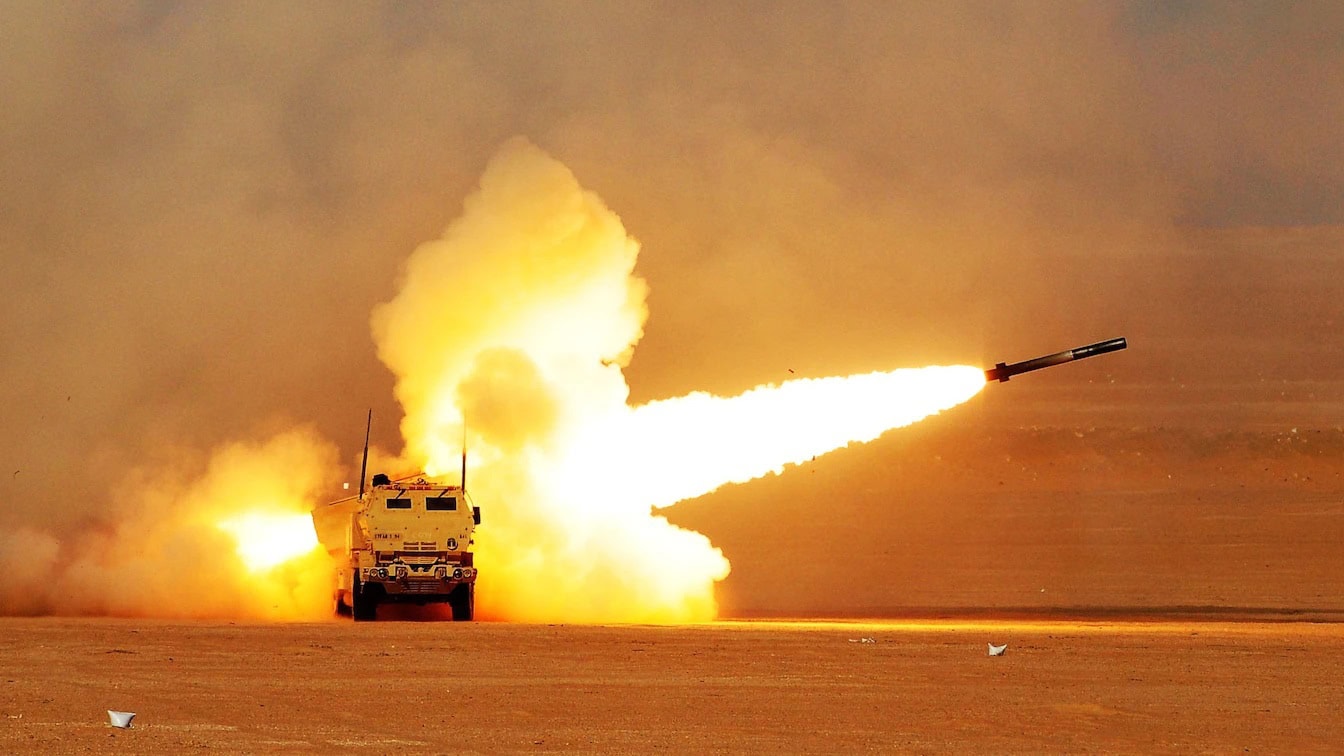
The Defense Post reported on October 26 that Taiwan's army corps will reorganize artillery units as they introduce High Mobility Artillery Rocket Systems (HIMARS) and M109 self-propelled howitzers. An unnamed defense official, cited by the Taipei Times, said the new platforms require roughly three soldiers per vehicle, compared with nine to eleven for a towed artillery piece.
That difference is not administrative trivia. It releases personnel for additional combat units, expands the number of rocket-artillery companies that can be built into battalions, and makes it easier to disperse firing units across Taiwan's constrained road network. A towed battery that remains in position for too long becomes a target. A mobile launcher can fire, move, and reconnect with a new sensor feed before Chinese counter-battery systems complete the cycle.
The numbers still conceal a problem. Three operators per launcher does not mean three people sustain a fires unit. Taiwan will need ammunition handlers, mechanics, fuel, communications specialists, air-defense teams, and redundant command posts. HIMARS improves the tactical ratio; it does not erase the logistics tail. If the island buys launchers faster than it builds reload stocks and repair capacity, the visible modernization will outrun its combat power.
Putting Drones Beside the Guns
The more important change is organizational. Taiwan plans to place reconnaissance aircraft, first-person-view attack drones, loitering munitions, conventional artillery, and rocket launchers under corps-level fires headquarters. The stated aim is a digital network that moves from detection to strike without passing through a slow chain of separate commands.
The equipment list includes domestically produced reconnaissance and FPV drones, Altius-600M loitering munitions, Altius-700M anti-armor drones, and Altius-600ISR systems. These are not substitutes for HIMARS. They solve different parts of the same problem: finding mobile targets, forcing Chinese units to move, and presenting enough simultaneous contacts that a defender's targeting system becomes saturated.
Ukraine has shown why this matters. Artillery without persistent reconnaissance fires blind; drones without protected fires can observe but cannot exploit a fleeting target. Taiwan's geography makes the pairing even more important. Roads, tunnels, urban districts, and mountainous terrain create concealment, but they also break line-of-sight communications. A drone-to-shooter network must keep working when satellites are jammed, fiber links are cut, and headquarters are under attack.
China's Drone Advantage Will Be the Stress Test
Beijing's advantage is not just the number of missiles it can fire across the Strait. The People's Liberation Army can use drones for reconnaissance, decoys, electronic attack, and one-way strikes against artillery positions, radar sites, and ammunition points. Taiwan's reform therefore has two jobs: increase its own ability to find and strike, while making its fires units difficult to locate.
That is why the army's counter-drone training matters as much as the new launchers. A HIMARS battery that cannot detect an approaching quadcopter, defeat a loitering munition, or relocate through a damaged transport network is not a survivable long-range fires capability. Taiwan also plans to expand air-force security forces into a brigade-sized formation to protect bases and radar sites with Stinger missiles, Kestrel anti-armor rockets, and other weapons. The reform recognizes that rear areas are now part of the artillery fight.
The decisive question is not whether Taiwan can field more drones. It is whether its sensors, shooters, and logistics can keep operating after China attacks the network connecting them.
What Washington Must Watch
The restructuring also explains why Taiwan's proposed $14 billion US arms package is strategically important, even before a contract is signed. Additional Patriot PAC-3 MSE interceptors and National Advanced Surface-to-Air Missile Systems would protect the bases and command nodes that allow mobile fires to survive. Without that air-defense layer, Taiwan may possess modern launchers but lose them during the opening missile and drone campaign.
Washington should measure the reform by trained crews, reloads, dispersed exercises, and disconnected operations—not by the number of launchers delivered. The island needs repeated drills in which corps headquarters lose communications, drone feeds are corrupted, and batteries must receive targets from alternate sources. Those are not exotic scenarios. They are the baseline conditions of a fight with China.
The Math Is Better, Not Yet Complete
Taiwan is moving in the right direction. Smaller crews, mobile rocket artillery, organic drones, and stronger point defense are more credible than simply adding manpower to exposed formations. The reform also avoids a common mistake: treating asymmetric defense as a shopping list instead of a command-and-control problem.
But the math only works if Taiwan can sustain the network. Three soldiers per launcher is useful; three soldiers with no reloads, no protected communications, and no counter-drone cover is a target package. Taiwan has begun the hard part by changing its force structure. Now it must prove that those units can survive the first 72 hours, keep firing, and do so without waiting for a perfect picture from a headquarters that may already be gone.
Sources
Taiwan is reorganizing its military structure to enhance artillery and drone capabilities in response to China's military threats. The introduction of HIMARS and M109 howitzers will allow for smaller crews and more mobile artillery units. Taiwan plans to integrate drones with artillery units for improved targeting and operational effectiveness. The proposed $14 billion arms package is crucial for enhancing air defense and protecting military assets.
- Taiwan is reorganizing its military to reduce reliance on large formations and enhance artillery and drone capabilities.
- The introduction of HIMARS and M109 howitzers will allow for smaller crews and more mobile artillery units.
- Taiwan plans to integrate drones with artillery units for improved targeting and operational effectiveness.
- China's drone capabilities pose a significant threat to Taiwan's artillery and military operations.
- Taiwan's proposed $14 billion arms package is crucial for enhancing air defense and protecting military assets.