
Terra Industries in Ghana aims for 50,000 drones and changes Sahelian security 2026
 Marie Dubois
Terra Industries in Ghana Aims for 50,000 Drones and Changes Sahelian Security 2026
In Accra, Terra Industries' Pax-2 site is not yet a frontline. However, if it starts as announced in June, it will impact the patrol routes that run from northern Ghana to Burkina Faso, the Nigerian hydroelectric dams, and the isolated mines where armed groups are already testing the limits of states. DefenceWeb reported on May 22, 2026, that the Nigerian company has begun construction of its second factory in Ghana, with a goal of producing 50,000 aerial systems per year at full capacity by 2028.
The figure is striking because it is African. Since Barkhane, since the Russian rotations in Mali, and since the American training programs in Nigeria, the continent's security is often described as an addition of external partners. Here, the message is different: a company from Lagos and Accra wants to mass-produce surveillance drones, tactical devices, and interceptors aimed at African threats.
A Factory, Not Just a Showcase
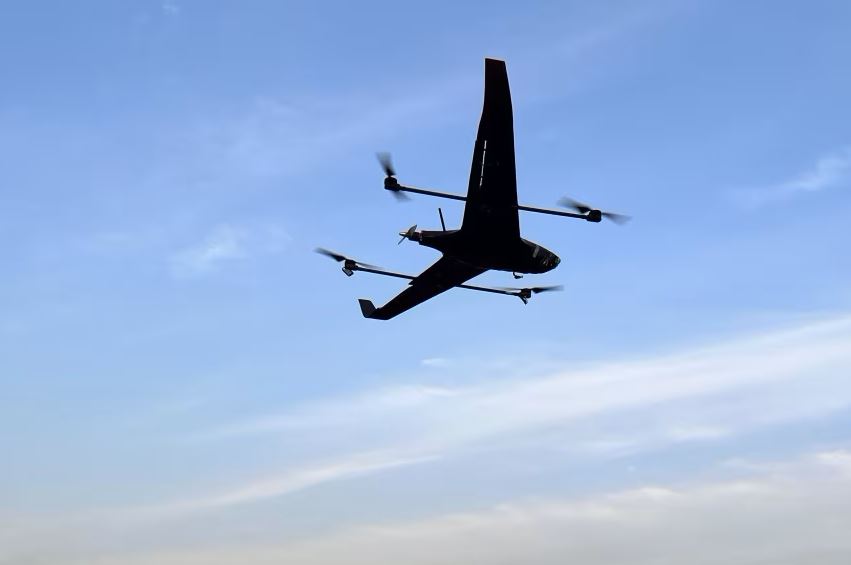
Pax-2 is set to add more than 3,150 square meters of industrial space to Terra Industries' setup, which already has about 1,400 square meters in Abuja. According to the company cited by DefenceWeb, the total would exceed 4,500 square meters under one roof and create 120 engineering jobs in Ghana. An announced annual capacity of 50,000 units, even if partially achieved, changes the conversation about technical sovereignty in West Africa.
The announced range is revealing. The Archer VTOL is presented as a long-range surveillance and strike platform. The Iroko aims for rapid tactical deployment. The Kama, more interesting for security forces, is a high-speed interceptor designed for counter-drone operations, with a reported speed of up to 300 km/h. Terra claims to already produce Archers, Irokos, and twenty Kama prototypes per day in Abuja, while the Ghanaian site is primarily expected to accelerate the production of the Iroko and the Kama.
On the ground, this means one simple thing: West Africa is no longer just looking to buy drones; it is starting to organize the industrial pace that allows for losses, repairs, and replacements. This is often where Sahelian armies fail. They receive a batch of equipment, only to discover six months later that batteries, propellers, software, and operators are missing.
The Threat Driving This Production
The decision comes at a time when armed groups in the Sahel and the Lake Chad basin are learning quickly. Modified commercial drones are no longer curiosities. In Mali, insurgents have already used armed drones against positions of the Malian Armed Forces and Africa Corps. In Nigeria, attacks on energy infrastructure and isolated convoys force security forces to monitor overly long routes with too few personnel. Between Tamale, Ouagadougou, and the Ivorian border, a section patrolling without eyes above is working blindly.
DefenceWeb emphasizes that Terra Industries explicitly links its expansion to the spread of commercial drones, fiber optic systems, and improvised munitions by non-state actors. This aspect deserves to be taken seriously, even if production figures remain to be verified. An FPV drone is inexpensive, requires little training, and forces the adversary to disperse its vehicles. An interceptor like the Kama promises the opposite: to make counter-drone defense cheap enough to be placed near a dam, a mine, or a border post.
The question is not whether an African drone will replace a helicopter. The question is whether a patrol 80 kilometers from its base can receive an image, an alert, and an interception capability before the attack begins.
Ghana, Nigeria, and Useful Geography
The choice of Ghana is not neutral. Accra offers a more stable political environment than many Sahelian capitals, a more predictable industrial base, and a position oriented towards north-south corridors. For coastal states, the jihadist threat is no longer abstract. Northern Benin, Togo, Côte d'Ivoire, and Ghana all look at the same map: armed groups are descending through paths, classified forests, cross-border markets, and cattle routes.
A factory in Accra will not secure these spaces alone. But it can shorten the cycle between operational need and technical adaptation. An operator around a gold mine in Ghana, a dam in northern Nigeria, or a post near the Burkinabe border does not ask for the perfect drone. They ask for a device that takes off despite the dust, whose parts arrive in days rather than months, and whose data does not go into an opaque foreign architecture.
Terra insists on the local manufacturing of software, cells, propellers, and lithium-ion batteries, while acknowledging that it imports some sensors and cameras, notably from South Korea. Total sovereignty is a slogan; useful sovereignty often starts with subsystems that can be repaired and modified locally. From experience, an army that does not master its maintenance ends up adapting its tactics to its breakdowns.
The Risk of Private Security Outpacing the State
Terra's model also targets critical private infrastructures: power plants, gold and lithium mines, dams, industrial sites. The company claims to protect assets valued at around $11 billion and has already won a $1.2 million contract to protect hydroelectric dams. This makes sense. Private sites pay faster than ministries, and their needs are concrete.
But this advance of the private sector poses a political problem. If mines and power plants receive the best surveillance systems first, while neighboring villages remain without alerts, armed groups will exploit the gap. The Sahel has already shown this mechanism: one secures an islet, then the threat bypasses the islet and taxes the surrounding population. A useful drone architecture must therefore be linked to public forces, gendarmerie units, and prefects.
What to Watch Now
There are still unknowns. The figures announced by Terra Industries are those of the company; they will need to be confirmed by actual production, deliveries, and user feedback. It is still unclear how many devices will go to public forces, how many to private sites, or at what final price after sensors, control stations, training, and support. This is where many African programs deflate: the purchase seems affordable, but maintenance does not.
However, it would be unwise to reduce Pax-2 to a communication operation. The Ghanaian factory arrives at a time when armed groups understand that the low sky, that of drones a few hundred meters up, has become a tactical space. If the first batches of Iroko and Kama actually come out of Accra with identifiable public contracts, the Gulf of Guinea will have crossed a discreet threshold: one where the fight against armed groups no longer solely depends on what Paris, Washington, Moscow, or Beijing agree to deliver.
Terra Industries is constructing a drone manufacturing facility in Accra, Ghana, with a goal of producing 50,000 drones annually by 2028. This initiative aims to enhance local security capabilities against armed groups in the Sahel region. The facility will focus on producing surveillance and tactical drones, addressing the operational needs of security forces in West Africa.
- Terra Industries aims to produce 50,000 drones annually by 2028.
- The new facility in Accra will add over 3,150 square meters of industrial space.
- The company is already producing drones daily in Abuja.
- The drones are intended for surveillance and tactical operations against armed groups in the Sahel.
- The expansion is linked to the increasing use of modified commercial drones by non-state actors.