
The 2026 Statement by Defense Minister Koizumi at Shangri-La Indicates Japan's Equipment Transfer Strategy to 17 Countries
 Tanaka Takashi
2026 Koizumi Defense Minister's Remarks at Shangri-La Indicate Japan's Equipment Transfer Strategy to 17 Countries
At the venue in Singapore, Defense Minister Shinjiro Koizumi touched on a rather specific counter-question about why Japan, which does not possess nuclear weapons or strategic bombers, is referred to as "new militarism," rather than an abstract discussion of "peaceful nations." His remarks at the Shangri-La meeting on May 31, 2026, appear to be a political response to criticism from China. However, to the author, who has long observed supply and joint training in the Japan Maritime Self-Defense Force, it seems to represent a more practical turning point.
The focus is not on the strength of the remarks. It is the connection formed by the revised domestic framework for defense equipment transfers in April, the Japan-U.S. defense ministerial meeting on May 30, and the Japan-Philippines defense ministerial meeting on the 31st, which are all linked by a single line. Japan is no longer just discussing whether to "sell or not sell" equipment. In times of crisis, it has begun to treat which countries can continue to use which equipment and maintenance capabilities as a deterrent for the entire region.
The Core of the Remarks is Not a Rebuttal but the Supply Chain
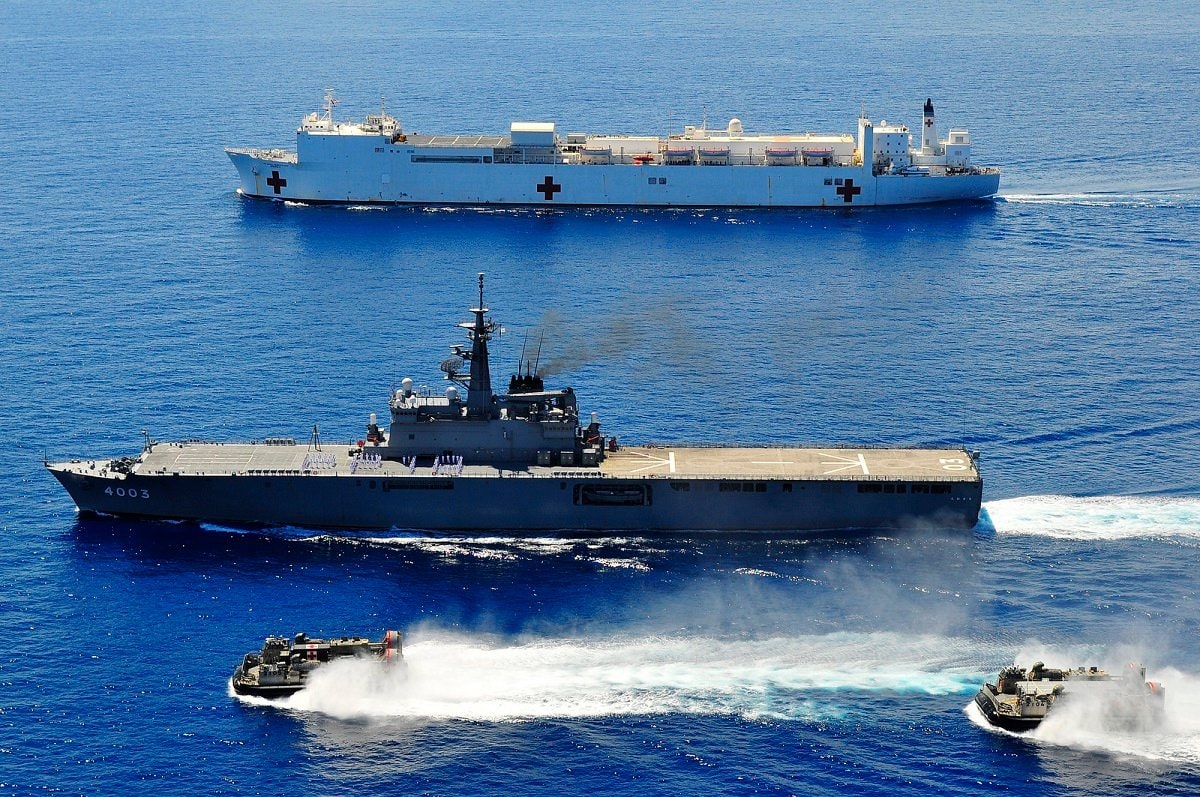
According to the speech published by the Ministry of Defense, Koizumi stated the need for a free and open sea, international law, and dialogue, and then presented regional defense equipment cooperation as a third pillar. What is important here is that he positioned equipment transfer not merely as an export industrial policy but as a means to concretely enhance deterrence and response capabilities. The expression of avoiding situations where necessary equipment is lacking and logistics are cut off in times of crisis reflects a distinctly naval awareness of issues.
AP reported that Koizumi stated, "Division weakens deterrence, while unity strengthens it." While this is diplomatic language that sounds good, the reality on the ground is harsh. If the U.S. military, Self-Defense Forces, Australian military, Philippine military, and South Korean military operate under separate supply systems from the first island chain to the South China Sea, while peacetime exercises may be feasible, the ability to continue fighting in a crisis will diminish. Japan's beginning to discuss equipment transfer, joint production, and maintenance support as a cohesive unit likely stems from an understanding of this weakness.
The Position of Joint Missile Production Seen in the Japan-U.S. Talks
On May 30, the day before, at the Japan-U.S. defense ministerial meeting, the U.S. side welcomed Japan's revision of its equipment transfer framework and evaluated it as contributing to the strengthening of the Japan-U.S. alliance's deterrence. According to the Ministry of Defense announcement, "Operation Supercharge," which includes joint development and production of the SM-3 Block IIA and AMRAAM, was discussed. This is a flashy name, but the substance is about increasing the production rate of munitions and missiles.
When considering the Taiwan Strait and the Korean Peninsula, the first things to become insufficient are not expensive vessels but interceptor missiles, air-to-air missiles, supplies, and maintenance personnel. The number of escort ships in the JMSDF is less critical than the speed at which SM-3s and ESSMs can be replenished, which often determines the limits of combat sustainability. If the joint production of AMRAAM affects not only the Japan Air Self-Defense Force but also the future capabilities of the U.S. military and Australia, and possibly the Philippine Air Force, this is more about redesigning a regional munitions depot than equipment cooperation.
The Practical Significance of the 17-Country Framework and the Philippines Case
According to an analysis by IISS, the institutional revision on April 21 enabled Japan to export lethal equipment to 17 countries with which it has defense equipment and technology transfer agreements. The list includes the United States, the United Kingdom, Australia, India, the Philippines, Indonesia, Vietnam, and others. This number is not just a legal list; it represents a boundary indicating which countries Japan will include in its emergency equipment network.
In that sense, the Japan-Philippines defense ministerial meeting on May 31 is noteworthy. According to the Ministry of Defense announcement, they agreed on the prompt transfer of decommissioned Abukuma-class escort ships, the transfer of one TC-90 within the fiscal year 2027, and to consolidate training, maintenance, and equipment management. The Abukuma-class is not the latest ship but an older escort vessel with a standard displacement of about 2,000 tons. Nevertheless, it could serve as a practical tool for the Philippine Navy to fill gaps in exclusive economic zone monitoring and coastal defense.
Here, overestimation is to be avoided. The transfer of old ships alone will not change the balance of power in the South China Sea. The issue is how much support Japan can provide for radar, communications, onboard weapons, maintenance parts, and crew training. The success of equipment transfer will not be measured at the point of handing over the hull but rather three years after the transfer, when that ship is still at sea.
Two Risks Associated with Rebutting China
In response to China's criticism of "new militarism," it is natural for Japan to emphasize transparency and adherence to international law. Breaking Defense reported that Koizumi stated that Japan does not possess nuclear weapons or strategic bombers, contrasting this with China's massive military buildup. The logic is easy to understand. However, the regional perception is not determined solely by logic.
The first risk is that equipment transfer may occur too quickly while domestic explanations lag behind. Within Japan, increases in defense spending, counterattack capabilities, and the easing of weapon export restrictions have accumulated in a short period. Even if there is rationality in individual policies, failing to explain the overall picture leaves an impression of "creeping normalization." This also affects the morale of the Self-Defense Forces, as the field dislikes political ambiguity.
The second risk is that cooperation in equipment with allied countries may deplete Japan's own stockpiles. Munitions, missiles, and maintenance parts are not infinite. As demonstrated by U.S. support for Ukraine, the production lines of democratic countries operate more slowly than political decisions. If Japan is to become a regional supplier, it must prepare not only export permits but also production capacity, port processing capabilities, and mobilization plans for private shipyards.
Conclusion
Koizumi's remarks at Shangri-La have been reported as a rebuttal to China. However, the practical significance lies in Japan's attempt to shift equipment transfer from a diplomatic card to a part of regional logistics. The framework for transfers to 17 countries, joint missile production between Japan and the U.S., and discussions on the Abukuma-class and TC-90 with the Philippines are not separate news items.
In the author's view, the real issue is not whether Japan will return to militarism. Rather, it is that Japan is beginning to be seen as a "reliable supplier" in the region without having sufficient stockpiles and industrial foundations. Deterrence is not strengthened by words. It is only strengthened when the necessary parts and munitions arrive at the port when needed.
Sources
- Japan Ministry of Defense, DM Koizumi’s Speech at the 23rd Shangri-La Dialogue, 31 May 2026: https://www.mod.go.jp/en/article/2026/05/c4052b8e2442611f026b47d8d66ac1df9e52bfcd.html
- Japan Ministry of Defense, Japan-U.S. Defense Ministerial Meeting, 30 May 2026: https://www.mod.go.jp/en/article/2026/05/66f437bf4189f312a0a26ef11ccd7c3dea3be3c3.html
- Japan Ministry of Defense, Japan-Philippines Defense Ministerial Meeting, 31 May 2026: https://www.mod.go.jp/en/article/2026/05/45c008f13e32cdb63ef16520e4337fe3fd601788.html
- Associated Press, US allies warn division weakens deterrence, 31 May 2026: https://apnews.com/article/koizumi-hegseth-marles-singapore-defense-conference-990438940784f429084996306c0b3960
- IISS, Japan loosens the reins on defence exports, April 2026: https://www.iiss.org/online-analysis/online-analysis/2026/04/japan-loosens-the-reins-on-defence-exports/
- Breaking Defense, Japan’s defense minister rebuffs militarism allegation, 31 May 2026: https://breakingdefense.com/2026/05/japans-defense-minister-rebuffs-new-militarism-allegation-defends-defense-policies/
Japan is shifting its defense equipment transfer strategy to enhance regional deterrence and military cooperation, as stated by Defense Minister Koizumi during the Shangri-La Dialogue on May 31, 2026. The revised framework allows for defense equipment exports to 17 countries, including the U.S. and the Philippines. This strategy aims to strengthen military ties and ensure readiness in response to regional threats.
- Japan has revised its defense equipment transfer framework to include 17 countries.
- Koizumi emphasized the importance of regional defense cooperation during the Shangri-La Dialogue.
- The U.S. welcomed Japan's revised defense export policy during the Japan-U.S. defense ministerial meeting.
- Japan plans to transfer Abukuma-class destroyers and TC-90 aircraft to the Philippines.
- The focus is on enhancing deterrence and military readiness in the region.