
The American blockade diverts 35 ships and Iran negotiates with Oman on the Hormuz route in 2026
 Ahmed Al-Rashid
The American Blockade Forces 35 Ships to Change Course, and Iran Negotiates with Oman on the Hormuz Route in 2026
On the dawn of August 3, 2026, the most significant military news was not just the sortie of the F-35C from the aircraft carrier USS Abraham Lincoln, but Washington stated that its naval operations around Iran had forced 35 commercial ships to change their course, with two ships being disabled and inspection teams boarding two others. At the same time, Tehran was announcing through its channels that its negotiations with Muscat were nearing an understanding regarding a new route in the Strait of Hormuz that is neither entirely northern nor entirely southern. Thus, the sea itself became a negotiating table, and the commercial ship became a political target before being just a number in the navigation record.
The Maritime Corridor Becomes a Pressure Weapon
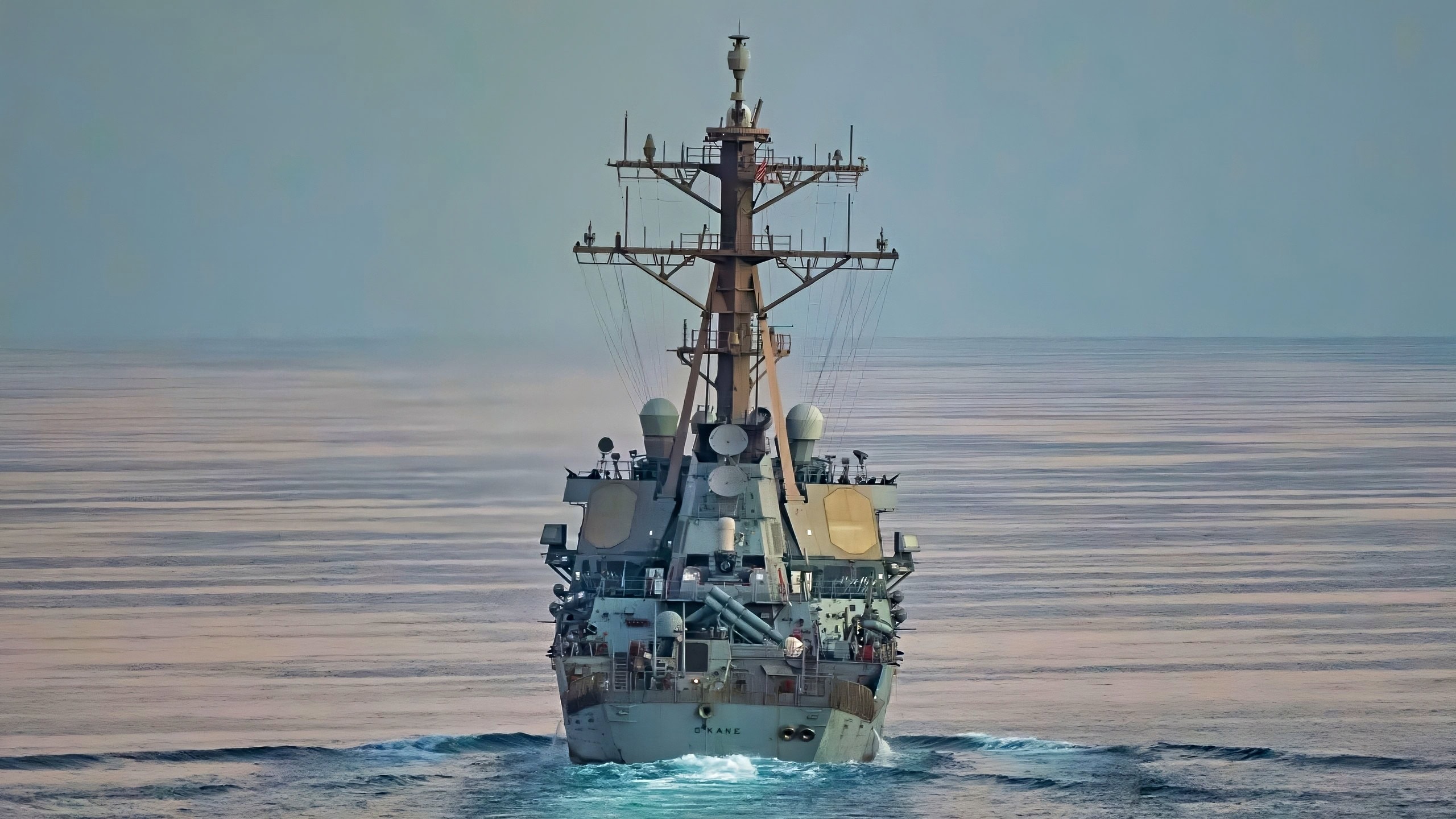
Gulf News reports that the American blockade, resumed since July 14, targets the movement of ships entering and leaving Iranian ports, and that the USS Abraham Lincoln has continued its operations in the Arabian Sea in support of this mission. The National reported in its live update that diplomacy has moved in parallel, from Saudi-American communications to a second round for Iranian Foreign Minister Abbas Araghchi with Saudi and Pakistani officials within 24 hours. Meanwhile, UKMTO reported an explosion near a tanker about 20 nautical miles northeast of Khasab in Oman, with the crew and the ship remaining safe. These small details are important as they practically explain why the Strait of Hormuz is no longer just a geographical strait but a low-intensity military friction zone.
The problem with the blockade is not that the U.S. Navy is capable of stopping ships. This is a known capability for those who possess aircraft carriers, destroyers, maritime patrol aircraft, F-35C jets, and a wide command and control network. The problem is that every ship being diverted creates a legal and political question for Gulf states before Iran. Is it an enforcement of sanctions, a war blockade, or a negotiating pressure? The answer matters to Saudi Arabia, the UAE, Qatar, Kuwait, and Oman because these countries benefit from the security of the corridor itself but pay the price of its disruption in insurance, energy, ports, and the reputation of stability.
Iran Does Not Need a Complete Closure to Confuse Calculations
From my military experience in the region, the most dangerous aspect of the Strait of Hormuz is not the scenario of a complete closure that headlines often focus on, but the management of disruption at a level that does not immediately lead to a full-scale war nor allows for a normal return to trade. Iran understands this gray area very well. When it says it is seeking with Oman an acceptable route that respects sovereignty and security interests, it is not just offering a technical solution but reminding that it has the capability to make the maritime route itself a subject of daily negotiation.
Iran can use three layers of pressure. The first is political by linking the opening of the route to Washington's commitment to the June memorandum or the Islamabad agreement with its fourteen points. The second is maritime through boats, potential mines, coastal drones, radar surveillance, and the indirect threat to tankers. The third is economic by pushing the market to price the risk even if most ships continue to transit. Therefore, diverting 35 ships is not a simple administrative number. The figure tells shipping companies that the decision to sail is no longer just commercial, and it tells Gulf capitals that energy security is still tied to the rhythm of a crisis between Washington and Tehran.
The Gulf Between American Protection and Hosting Costs
Saudi Arabia, the UAE, Bahrain, Qatar, and Kuwait all want to protect navigation, but they do not want their backyards to become part of the blockade's engineering. Here lies the contradiction that Western analyses rarely state openly. The American presence is a necessary deterrent, but it is not a free service. The more maritime pressure on Iran increases, the greater the chances that Tehran will respond to bases, radars, fuel depots, ports, or energy facilities within the Gulf. Previous weeks of conflict have shown that Iran no longer always distinguishes between the American target and the Arab environment that target uses.
The communication between the Saudi Crown Prince and the American President, as reported by Gulf News, should be read in this context. Riyadh is not just discussing oil prices or the course of negotiations; it is trying to prevent the Gulf from becoming an open theater for the implementation of Washington's decisions. Practically, any commander who has served in the region knows that defending a port or base does not stop at purchasing Patriot or THAAD systems. The real capability is a triangle of equipment, training, and institution. If the operations room does not have a clear political mandate, and if the exchange of alerts between countries is slow, then the most expensive missiles become a leaky umbrella.
The Aircraft Carrier Is Not a Substitute for Regional Engineering
The presence of the USS Abraham Lincoln in the Arabian Sea gives Washington firepower, reconnaissance, and continuous launch capability. The F-35C adds penetration and situational awareness, and the destroyers can enforce maritime surveillance on specific routes. However, this should not be overstated. The carrier is excellent for pressure, deterrence, and strikes, but it is not a maritime police force for every ship passing between the Gulf of Oman and the Indian Ocean. The longer the operation lasts, the greater the need for maritime intelligence, inspection teams, convoy escorts, and information from ports and shipping companies. All of these are areas that cannot be resolved by a single platform, no matter how advanced.
Here, Oman gains weight beyond its military size. Muscat does not possess carriers or a large fleet, but it has geography, channels of trust, and experience in managing files that others do not want to touch publicly. If an Omani-Iranian understanding regarding a new route in Hormuz succeeds, it will be an acknowledgment that the security of the strait is not only made in the command of the Fifth Fleet or on the deck of an aircraft carrier, but in a mix of mediation, local sovereignty, and precise navigation arrangements.
Military Summary
The American blockade that diverts dozens of ships pressures Iran, but it also strains the nerves of the Gulf. And when Tehran negotiates a new maritime route, it does not act merely as a besieged power but as a party that wants to turn the global need for energy into a political card. Gulf states find themselves in the same old paradox, wanting American protection from Iran while fearing that this very protection could be the reason for an Iranian retaliatory round on their territories and waters.
In my estimation, the next question is not whether the United States can continue the blockade. It can. The more important question is how many days Gulf capitals can bear the cost of the blockade before demanding that Washington translate power into a settlement rather than a longer display. At sea, as old officers say, it is not enough to have the gun; you must know when not to fire it.
Sources
- Gulf News, updates on August 2 and 3, 2026, regarding the American blockade, USS Abraham Lincoln, and Hormuz negotiations.
- The National, coverage of the Iran crisis and diplomatic movements on August 3, 2026.
- Al Jazeera, background on the resumption of the American blockade on Iranian ports on July 15, 2026.
- UKMTO as reported by Gulf News regarding the tanker incident near Khasab in Oman.
U.S. naval operations on August 3, 2026, forced 35 commercial ships to change course in the Hormuz Strait. Iran is negotiating with Oman for a new maritime route, while the USS Abraham Lincoln continues its operations in the Arabian Sea. An explosion occurred near a tanker in Oman, but no casualties were reported. The ongoing U.S. blockade is impacting shipping routes to Iranian ports, raising tensions in the region.
- U.S. naval operations forced 35 commercial ships to change course.
- Iran is negotiating with Oman for a new maritime route in the Hormuz Strait.
- USS Abraham Lincoln is conducting operations in the Arabian Sea.
- An explosion was reported near a tanker in Oman, but the crew and ship are safe.
- The U.S. blockade is affecting shipping routes to and from Iranian ports.