
The Army wants soldiers to travel less for training, do more in virtual reality

Source: Task & Purpose
Loading...Strong SignalCredibility: 90%
Report Content
Soldiers will travel less for training and do more virtually, Army leaders said Tuesday.
The Army is planning to have soldiers “train differently” with more remote learning and other more innovative courses that use augmented reality and virtual reality, called AR and VR, respectively. The programs would work in lieu of having soldiers travel to schoolhouses and training centers across the United States, Army Chief of Staff Gen. Randy George said at a virtual town hall at Fort Drum, New York.
The Army’s goal is to cut down on temporary duty assignments, TDY, or short-term moves where soldiers leave their permanent duty station for training that can last from several days to months. Instead, the Army wants them to do courses and trainings “at your local home station,” George said at the town hall, which covered topics affecting soldiers, from quality of life to training.
The Army is looking at revamping “everything from individual training when you first come in through your specialized technical training” for enlisted soldiers and junior officers, “all the way through the most senior courses that we have for our general officers,” David Dworak, provost of Army University, told Task & Purpose.
The Army is looking at a range of courses and lessons, like those available at civilian universities. At the same time, the service will not outsource skilled training on weapon systems or battlefield tactics, officials told Task & Purpose.
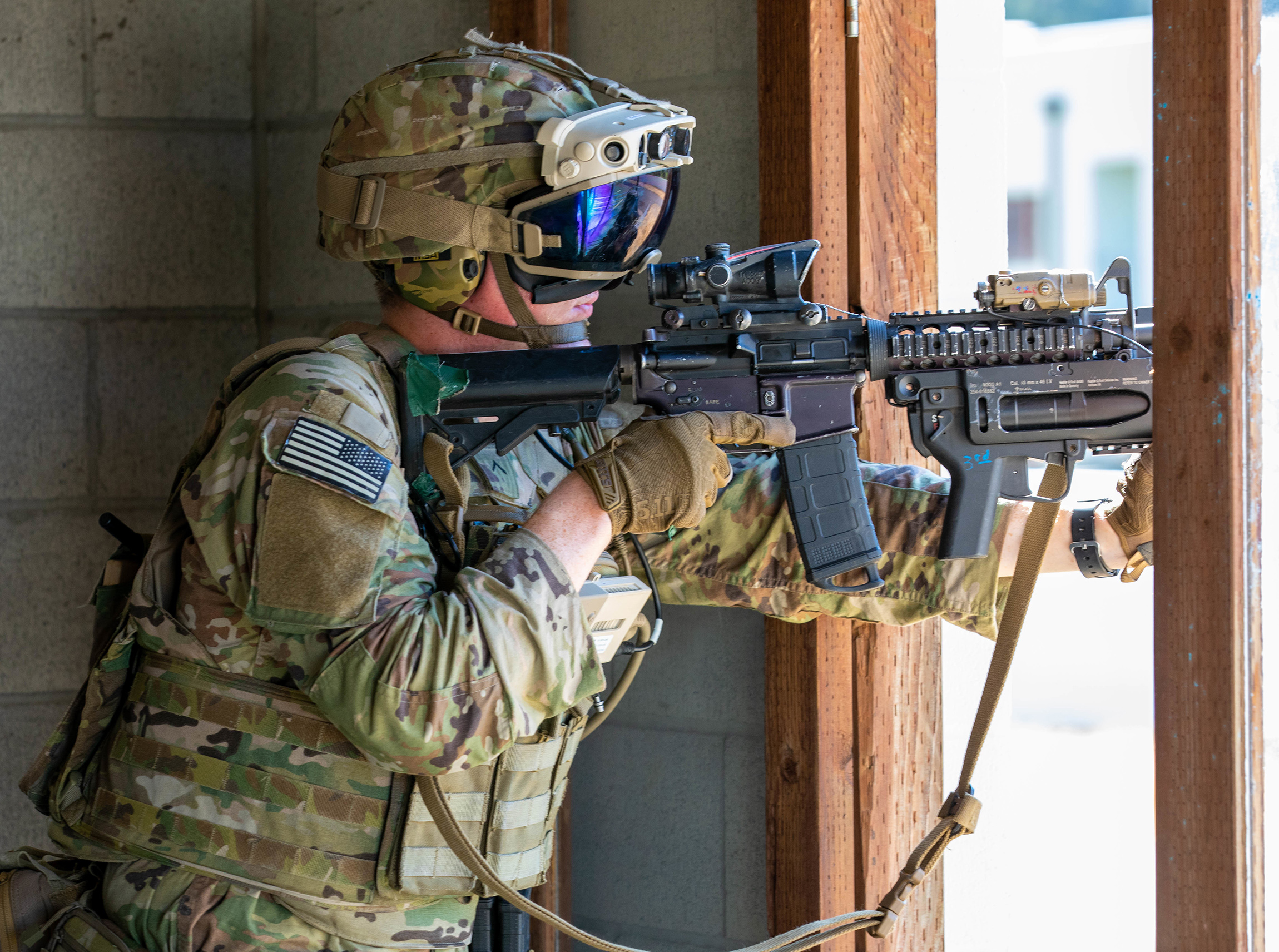 Service officials said that the push toward augmented and virtual reality training would not replace field training or be used in lieu of combat training on weapon systems or tactics. Army photo by Spc. Chandler Coats.
“What can be done in a virtual setting that really replicates the environment that you’re gonna be working in and what needs personal interaction?” Dworak asked. “I really have a hard time seeing the future where we get rid of all in-person interaction because there’s a professional element to it that requires human interaction. But that’s not to say that there isn’t a role for the online element.”
Beyond simple courses that soldiers can do by watching videos or learning in a remote classroom, the Army is also exploring VR and AR courses that universities already use, such as training in virtual medical cadaver labs, which could be useful for combat medics and those in similar fields.
The education overhaul comes as the service is trying to move faster and make its training system more flexible — a critique of military education that others have noted in reference to how fast the battlefield is evolving in places like Ukraine.
Dworak said that Army training has been “kind of stagnant” and “takes a long time to change,” but now the service is looking into new authorities that allow course directors and school commandants to make more decisions about the types of training that soldiers need.
“You really lose credibility with the students when something happens out there in the operating environment and the schools don’t react to it,” Dworak said. “Drones is a great example of that. Autonomous warfare, where is that going? What does it mean? We can’t have a system that takes one year or two years to get a curriculum approved and get it back out to the field and then you’re delivering it three years after you’ve realized that there’s a change that’s just not gonna work anymore.”
Top Stories This Week
Leaders also said that the slashes to TDY and moves to remote training would also help reduce the stress put on soldiers to move frequently — a quality of life issue long flagged by troops and identified by the Pentagon last year as a major policy initiative for the military services.
In addition to more virtual training that keeps soldiers at home, Army Secretary Dan Driscoll acknowledged that the service is trying to improve deployment-to-dwell ratios. Driscoll said that the “world is a dynamic place” and acknowledged that the military’s major operations, like the Pentagon’s mission at the U.S.-Mexico border, can have an impact on soldiers.
“For every month you are gone, we want to try to give you three months back at home,” Driscoll said, adding that this balance during Middle East combat rotations in the early 2000s was “not what was achieved,” but that leaders are aiming for it.
The post The Army wants soldiers to travel less for training, do more in virtual reality appeared first on Task & Purpose.
Classification
Analytical Domain
Strategic
Primary Category
Political-Military
SALUTE Report
Size
Not specified
Activity
The Army is shifting training methods to reduce travel and increase the use of virtual reality for soldier training.
Location
United States (implied)
Unit
U.S. Army
Time
Current
Equipment
virtual reality technology
Summary
The U.S. Army is implementing a new training strategy that focuses on reducing travel for soldiers and increasing the use of virtual reality technology. This shift aims to enhance training efficiency and adapt to modern training needs. The initiative reflects a broader trend in military training practices.
Key Facts
- The Army aims to reduce travel for training.
- Increased use of virtual reality technology is planned for soldier training.
- This change is part of a broader strategy to enhance training efficiency.