
The establishment of the JCT in 2026 will change the crisis response of the U.S. Forces in Japan and the Self-Defense Forces Joint Operations Command.
 Tanaka Takashi
The Launch of the JCT in 2026 Will Change Crisis Response for U.S. Forces in Japan and the Self-Defense Forces' Joint Operations Command
In a contribution from U.S. Forces Japan Commander Lieutenant General Stephen Jost, what caught my attention the most was not the grand slogan, but the establishment of a small organization called the "Joint Command Team" or JCT. According to the announcement, this team will be based in Tokyo and will be responsible for daily face-to-face cooperation and communication during crises between the two independent command structures of the U.S. Forces in Japan and the Self-Defense Forces' Joint Operations Command.
This is not flashy equipment news. It is not about new missiles or new escort ships. However, from a practical standpoint, this type of communication organization can sometimes hold more weight for deterrence in the First Island Chain than the range of missiles. A crisis does not only begin at the moment a launch order is given. The outcome is partly determined during peacetime monitoring, the interpretation of alert status, reporting to political decision-makers, and the initial response to joint actions.
The Small JCT Indicates a Significant Change
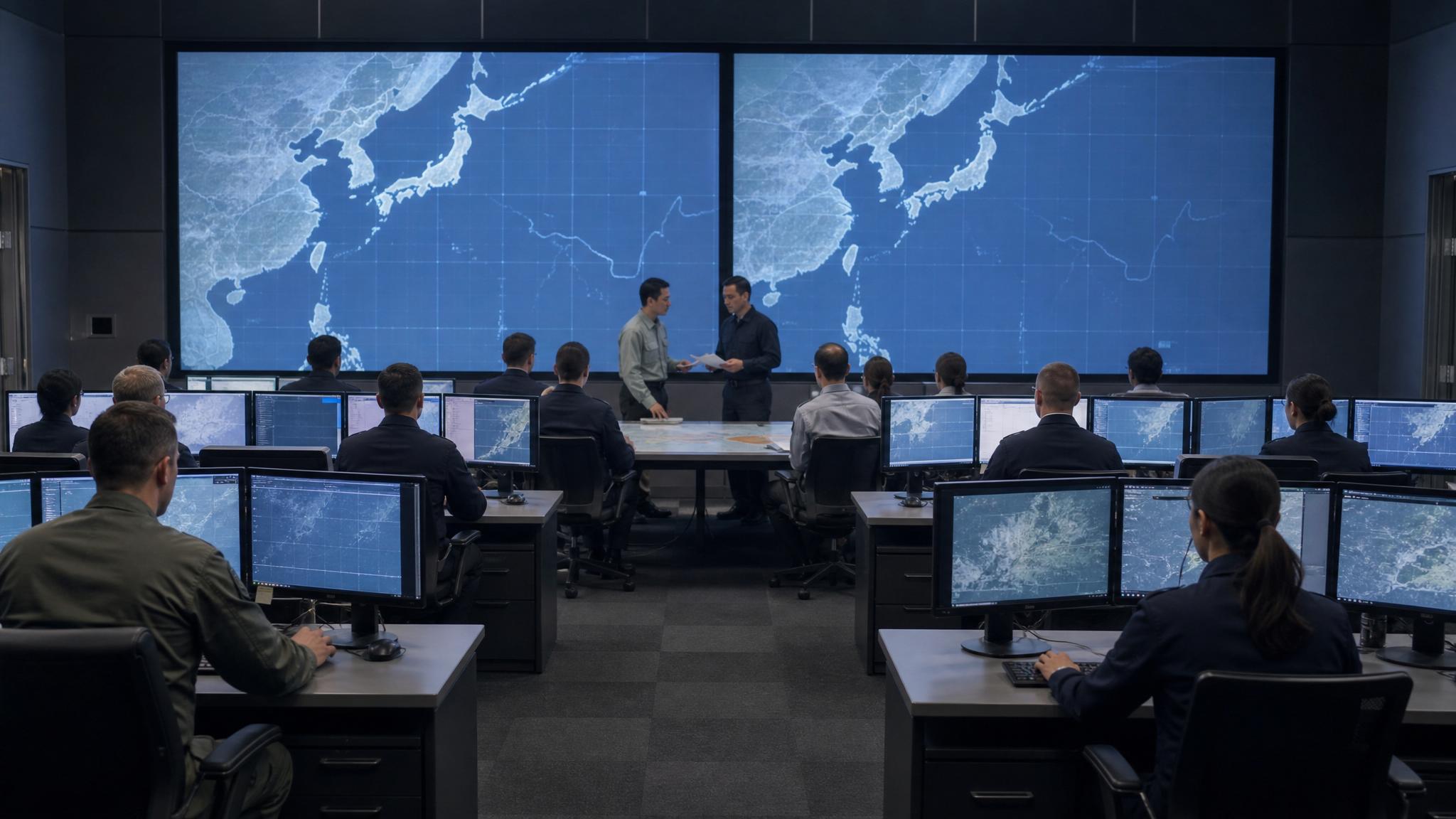
Conceptual diagram. It does not represent actual JCT facilities or operation rooms.
According to the U.S. Forces in Japan, the JCT is currently still small in scale. However, as command reforms progress, it is positioned as the "first concrete step" to expand its scale and role, thereby enhancing the U.S.-Japan response capabilities to crises or unforeseen events. Importantly, the JCT is depicted not merely as a ceremonial point of contact but as a permanent link to enhance the operational synergy between the two commands.
On the Japanese side, the Self-Defense Forces' Joint Operations Command will take on a more centralized role in the operational command of the Ground, Maritime, and Air Self-Defense Forces. The U.S. Forces in Japan are also indicating a shift from a command focused on traditional alliance management to a more integrated command function that synchronizes humanitarian assistance, disaster relief, and armed conflict in the future. In other words, both Japan and the U.S. are simultaneously changing their respective commands and placing the JCT as the junction between them.
During the Cold War, the U.S.-Japan alliance had relatively clear divisions of responsibility: the U.S. military's strike capability, Japan's provision of bases, and the defense of maritime shipping routes. Today, around the southwestern islands, Taiwan, and the East China Sea, that division is not so simple. The Air Self-Defense Force's alert monitoring, the Maritime Self-Defense Force's anti-submarine and surface monitoring, the Ground Self-Defense Force's island defense units, and the U.S. military's strike capabilities and ISR (Intelligence, Surveillance, and Reconnaissance) must be interconnected on an hourly basis.
Command Reforms Must Not Lag Behind Equipment Procurement
Recently, the Associated Press reported that Japan is significantly increasing its defense budget to respond to China's military pressure, moving from a traditional "defensive defense" posture to a more proactive capability development. This is generally correct. However, looking only at the number of pieces of equipment could lead to a misreading of Japan's changes. While equipment such as counterstrike capabilities, long-range missiles, drones, and Aegis-equipped ships are prominent, the question of which command will use them, based on what information and under what political judgment during the initial stages of a crisis, is a more understated issue.
The contribution from the U.S. Forces in Japan also mentions that during the defense ministerial talks in Tokyo, U.S. Secretary of Defense Pete Hegseth and former Defense Minister Gen Nakatani reaffirmed the necessity for alliance transformation. The expression "creating dilemmas for the enemy" used here is military in nature, but from the Japanese perspective, careful annotation of the same words may be necessary. To create a dilemma for the opponent, our judgments must neither be too late nor too early. A speed that avoids escalation due to misjudgment while not allowing for the establishment of facts is required.
This speed is created not by individual pieces of equipment, but by the authority of the command, the presence of liaison officers, common situational maps, information security rules, and reporting routes to the political level. Whether the JCT truly holds value should be measured not by the number of ceremonial meetings but by how many minutes or tens of minutes the judgments of both Japan and the U.S. are shortened during gray zone situations.
The Synchronization of Initial Actions is Key Around the Southwestern Islands
The most challenging aspect around the southwestern islands is not full-scale war, but the stage just before it. In scenarios where Chinese Coast Guard vessels, naval ships, drones, electronic warfare aircraft, and civilian vessels overlap, the very identification of military threats becomes a political judgment. When an aircraft approaches the airspace, is it a show of force, electronic reconnaissance, or operational preparation? When a vessel passes through the Miyako Strait, is it normal training or part of a combined operation? Such judgments must be shared almost simultaneously between Tokyo, Yokota, the Indo-Pacific Command, and each Self-Defense Force command.
From my experience in the Maritime Self-Defense Force, the most precarious aspect of joint operations is not when there is no information. It is when there is information, but there is no consensus on which information can be used for operational judgment. The information held by U.S. military sensors, the information from Japan's coastal surveillance and air alert, and the political context held by diplomatic authorities must be placed on the same timetable; otherwise, the initial response can easily become misaligned.
The JCT will not completely eliminate that misalignment. Rather, it should be viewed as a device that makes those misalignments visible on a daily basis. Which information can be shared, and which information takes time to share? Which authorities can be handled at the command level, and which require political judgment? Without this understated verification work, even the latest missiles and maritime traffic defense will remain mere capabilities on paper.
The Weakness of Deterrence is Revealed in Communication Lines
This announcement from the U.S. Forces in Japan indicates that the U.S.-Japan alliance is shifting its focus from "management" to "operations." However, there is one unresolved risk here. The stronger the connection between Japan's Joint Operations Command and the U.S. Forces in Japan, the more the question arises as to how quickly authority can flow between the U.S. Indo-Pacific Command, political judgments in the U.S. mainland, and Japan's National Security Council.
The strength of the alliance is revealed not in the wording of joint statements but in the first hour of a crisis. If the JCT is successful, it will not be because Japan and the U.S. are looking at the same map. It will be determined by how quickly two countries with different political systems can converge on the same actions after looking at the same map.
The real challenge is not to add one more command post. It is to reduce the delays in decision-making that connect Tokyo, Yokota, Hawaii, and Washington as much as possible during peacetime.
Key References
- U.S. Forces Japan, “Advancing the Alliance: USFJ, JSDF transform future of Indo-Pacific Security,” May 2026.
- Associated Press, “Pacifist Japan has slowly transformed from exclusively self-defense to a military buildup,” May 2026.
The Japan Cooperation Team (JCT) was established to enhance crisis response coordination between U.S. Forces Japan and the Japan Self-Defense Forces, based in Tokyo. This initiative aims to improve daily cooperation and communication during crises, marking a significant step in military collaboration. The JCT is intended to facilitate timely decision-making and information sharing to address security challenges in the region effectively.
- The Japan Cooperation Team (JCT) is established to enhance crisis response coordination between U.S. Forces Japan and the Japan Self-Defense Forces.
- The JCT will be based in Tokyo and facilitate daily cooperation and communication during crises.
- The JCT is seen as a significant step in improving Japan-U.S. military collaboration amid evolving security challenges in the region.
- The report highlights the need for timely decision-making and information sharing between the two forces to address potential threats effectively.
- The establishment of the JCT reflects a shift from managing the alliance to operationalizing it.