
The first flight of Long March 10 B completed with first-stage recovery, China's reusable rocket fills the 16-ton orbital gap.
 Li Minghui
Long March 10B's Maiden Flight Completes First Stage Recovery, China’s Reusable Rocket Addresses 16-Ton Orbital Shortfall
On July 10, a scene that could easily be underestimated appeared at the Wenchang Hainan commercial space launch site: after the Long March 10B sent its payload into the designated orbit during its maiden flight, the first stage did not fall into a pre-set sea area as traditionally done, but instead returned and was caught by the net capture system of a sea platform. According to a report by Xinhua News Agency reprinted by the China Military Network, this marks China’s first successful controlled recovery of a launch vehicle's first stage.
This event may seem like commercial space news, but I believe its significance for China’s military space lies not in the three words "reusable" themselves, but in three more substantial aspects: launch cadence, cost curve, and rapid replenishment capability. In simple terms, if a rocket can only be used once, its launch capability is akin to disposable ammunition; only with stable recovery and reuse does it begin to approach the level of reusable equipment.
63-Meter Rocket and 16-Ton Low Orbit Capability
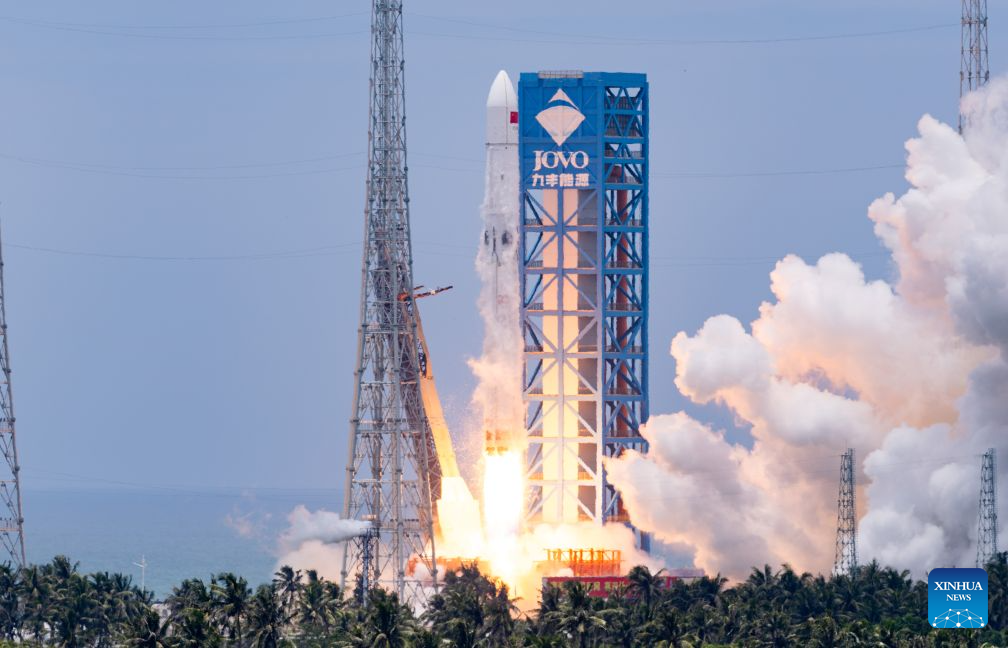
The publicly available parameters are sufficient to illustrate the issue. The Long March 10B is a reusable liquid commercial launch vehicle, approximately 63 meters tall, with a diameter of 5 meters, a launch thrust of about 890 tons, a launch mass of about 760 tons, and a near-Earth orbit payload capacity of about 16 tons in its reusable configuration. This figure cannot be simply compared to that of a disposable configuration rocket, as reuse requires reserving propellant and structural margins for the recovery phase, but the 16-ton low orbit capability already meets a considerable number of remote sensing, communication, and reconnaissance constellation deployment needs.
What’s even more interesting is the recovery method. The Xinhua report mentions that the first stage was captured by a sea platform using a net capture system after returning. This is not entirely the same as the vertical landing approach used by SpaceX. The net capture scheme may reduce some burdens on landing legs and terminal attitude control, but it also shifts challenges to the sea platform's positioning, net structure strength, recovery window control, and rocket re-inspection. In engineering, there is no free lunch; it merely reallocates risks to different links.
The Military Value Is Not Turning Rockets into Missiles
It is important to clarify the boundaries: the Long March 10B is not a weapon and should not be described as some kind of "new missile." Its direct use remains space launch. However, modern militaries increasingly rely on low orbit systems, with space infrastructure supporting communication relays, maritime surveillance, electronic reconnaissance, meteorological support, and battle damage replacement. The military spillover of rocket recovery capability mainly reflects whether satellites can be launched more cheaply and frequently.
The U.S. Space Force has repeatedly emphasized "tactical responsive space" over the past few years, and the underlying logic is simple: once satellites are interfered with, damaged, or fail during a conflict, whoever can quickly replace them will have a stronger system recovery capability. China now has a relatively dense experience with the Long March series launches and has commercial space companies conducting small reusable experiments. The difference with the Long March 10B is that it pushes the concept of reusability closer to a mid-to-large scale low orbit deployment level.
Shortcomings Remain in Reuse Frequency and Turnaround Cycle
However, the first controlled recovery does not equate to forming reusable launch capacity. The real focus should not be on whether it was caught this time, but whether it can be relaunched at low cost after being caught. After recovery, the rocket must be inspected for engine turbine pumps, tanks, pipelines, thermal protection, structural fatigue, and sea salt corrosion. If major disassembly and repairs are required after each recovery, the cost advantage will be significantly diminished; only if standardized inspections and quick part replacements can be achieved will it be considered a mature stage.
From a supply chain perspective, any one of the 5-meter class rocket body, liquid oxygen-kerosene or liquid oxygen-methane engines, sea recovery platforms, measurement and control links, and launch site support capabilities could become a bottleneck in rhythm. China's aerospace industry has historically excelled in mass organization and high-reliability processes, but its shortcomings often lie in high-frequency commercial operations, transparent cost accounting, and cross-enterprise collaboration. Reusable rockets will precisely expose these shortcomings.
The True Implications for PLA Modernization
If the Long March 10B can prove its reuse frequency and turnaround cycle in the next two to three years, the constraints on China’s low orbit constellation construction will change significantly. For the PLA, this means that the space-based communication, remote sensing, and electronic support needed for maritime and aerial operations can be expanded more quickly; for adversaries, it means that knocking out a few satellites does not simply weaken the system, unless they simultaneously suppress the launch sites, measurement and control networks, and manufacturing chains.
However, I do not agree with framing this maiden flight as "catching up to SpaceX." China has just completed its first controlled recovery, while the U.S. has already turned first stage reuse into high-frequency commercial operations, which involves a gap in engineering statistical samples and operational experience. What truly deserves attention about the Long March 10B is whether it can transform from a single successful recovery into a replicable, producible, and fault-tolerant industrial process. The timing of the next relaunch will be more indicative than the visuals of this launch.
Main sources: China Military Network reprinted Xinhua's report on July 10; publicly available space launch data; public statements from the U.S. Space Force regarding tactical responsive space.
The Long March 10B rocket successfully completed its first flight and controlled recovery on July 10 at the Wenchang launch site in Hainan. This marks China's first achievement in controlled rocket stage recovery, enhancing its capabilities for deploying satellites to low Earth orbit. The rocket can carry 16 tons, which is significant for military applications in satellite communications and reconnaissance.
- The Long March 10B successfully completed its first flight on July 10.
- The rocket is capable of carrying 16 tons to low Earth orbit.
- This is China's first controlled recovery of a rocket stage.
- The recovery method involves a net capture system on a sea platform.
- The development enhances China's military satellite deployment capabilities.