
The Japan Air Self-Defense Force Demonstrates Its Indo-Pacific Deployment Capability with the Initial Operation of the F-2A in India in 2026
 Tanaka Takashi
Japan Air Self-Defense Force Demonstrates Indo-Pacific Deployment Capability with First Operation of F-2A in India in 2026
On the runway in Jodhpur, Rajasthan, India, the Japan Air Self-Defense Force's F-2A entered the same airspace as the Indian Air Force's Tejas, Su-30MKI, and Rafale. This marked the first time Japanese fighter jets operated from within Indian territory during "Veer Guardian 2026," which took place from September 9 to 22. Rather than a photo-worthy inaugural flight, it was an opportunity for the Japan Air Self-Defense Force to test how far they could establish maintenance, command, and supply outside of their home territory.
Challenges Heavier than the F-2A Airframe
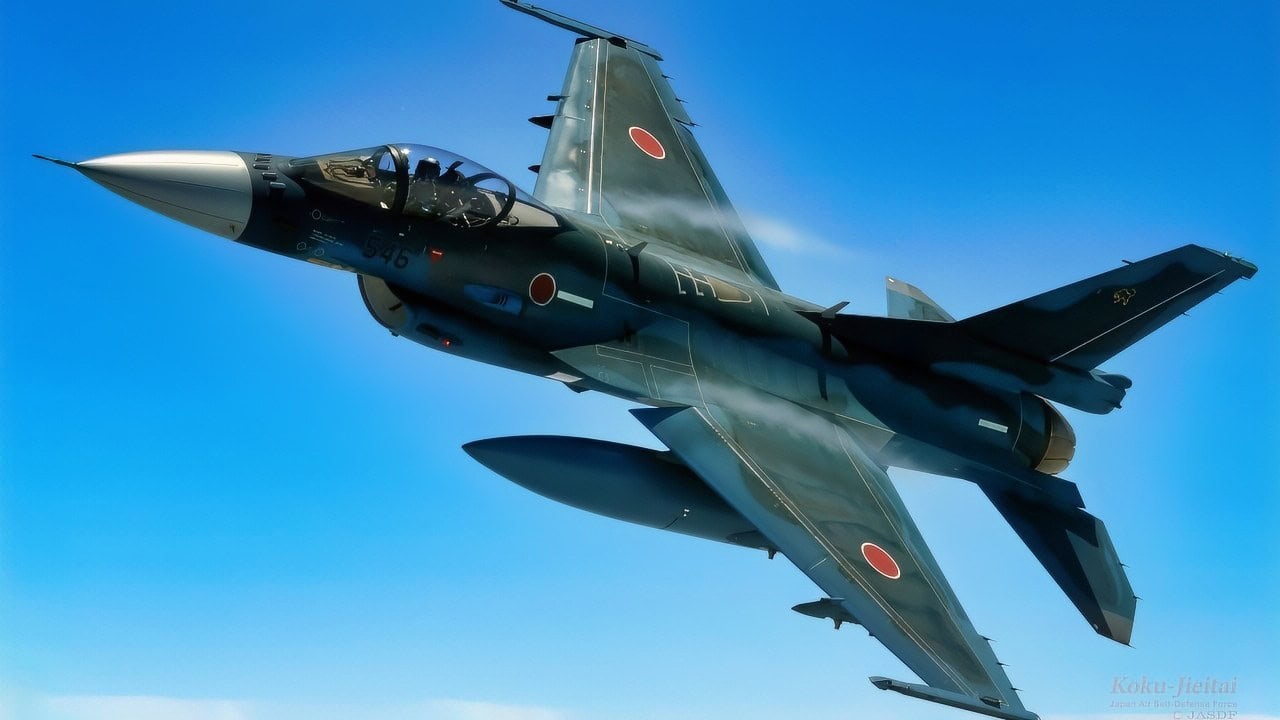
The F-2A is a single-seat multirole fighter that has been enlarged through Japan-U.S. joint development, based on the F-16. It is designed for long-range air-to-ground and air-to-ship missions, including anti-ship attacks, and incorporates unique Japanese equipment such as the domestically produced J/APG-1 radar. The fact that it is not a dedicated air defense aircraft is significant when considering the protection of sea lines of communication (SLOC).
However, the value confirmed in Jodhpur was not based on catalog performance. According to statements from the Chief of Staff of the Air Self-Defense Force and the Chief of Air Staff of the Indian Air Force, this training included specialized exchanges covering operational planning, maintenance, aviation safety, and operations close to real missions. In remote deployments, the continuity is determined more by parts, maintenance personnel, communication procedures, and coordination with local bases than by the aircraft's range.
From "Arrival" to "Sustainability" in Japan-India Cooperation
For India, accepting Japanese fighter jets allows for the accumulation of practical air force cooperation connecting the Indian Ocean and the Western Pacific. For Japan, it serves as training to maintain air operations from bases far removed from the southwestern islands. With the range of the Chinese Navy's activities extending from the East China Sea to the Indian Ocean, Japan-India cooperation is expanding to include not only naval vessels but also the deployment of aircraft, base acceptance, and information sharing for the protection of SLOC.
However, it is premature to call this achievement a joint operational capability. The F-2A, Tejas, Su-30MKI, and Rafale have different communication systems, logistics, and tactical data links. Even if joint flights are successful, it does not guarantee that they can share the same situational picture during a crisis or align target identification and rules of engagement. Furthermore, the F-2 is in a transitional phase to the successor F-35A/B, and it is necessary to design a system that ensures this experience does not end as a one-time event.
Japan's Choices Questioned Outside the Alliance
For Japan, which is centered on the Japan-U.S. alliance, deepening bilateral air cooperation with India does not create an alternative to the United States. Rather, it serves as a supplementary line to buy time until U.S. military support arrives and to disperse regional bases and air power. In the author's view, the true challenge lies not in how many F-2s can be dispatched, but in whether Japan and India can create a maintenance and supply system that allows the same units to be accepted again. In the next phase, the speed of rear support and information sharing between bases will likely be evaluated more than the number of participating fighter jets.
Sources
- Telangana Today, September 20, 2026
- Reports from local press conferences of the Indian Air Force and Japan Air Self-Defense Force (statements from both air force leaders published in the same article)
Japan's Air Self-Defense Force (JASDF) deployed F-2A aircraft in Jodhpur, Rajasthan, from September 9 to September 22, 2026, marking the first operational use of Japanese fighter jets in India. The exercise involved collaboration with Indian Air Force aircraft, focusing on operational planning and maintenance. This deployment signifies a strengthening of military cooperation between Japan and India, particularly in the context of regional security concerns.
- Japan's Air Self-Defense Force deployed F-2A aircraft in India for the first time.
- The operation took place in Jodhpur, Rajasthan, from September 9 to September 22, 2026.
- The exercise involved collaboration with Indian Air Force aircraft including Tejas, Su-30MKI, and Rafale.
- The focus was on operational planning, maintenance, and air safety during the training.
- The collaboration aims to enhance air force cooperation between India and Japan.