
The Japan Maritime Self-Defense Force's Chōkai conducts test launch of Tomahawk missiles, with counterattack capability entering implementation phase in 2026.
 Tanaka Takashi
JS Chokai Conducts Tomahawk Missile Test, 2026 Counterstrike Capability Enters Implementation Phase
The November issue of the Ministry of Defense's English publication "Japan Defense Focus," Issue No. 201, highlights a noteworthy detail: the Aegis destroyer "Chokai" (JS Chokai) has conducted flight tests of the Tomahawk cruise missile. Public information does not specify the exact maritime area of the test launch, the impact results, or the complete subjects, so it should not be interpreted as Japan having established an independent long-range strike system. However, from the perspective of the Maritime Self-Defense Force's equipment utilization, this step's nature has already surpassed mere procurement news.
From Launchers to Combat Chains
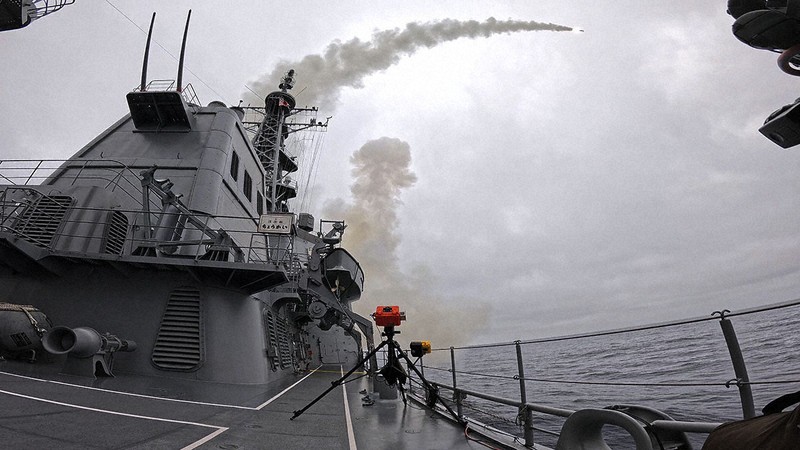
The "Chokai" belongs to the Kongō-class destroyers, whose core mission was originally to execute fleet air defense and ballistic missile defense using the Aegis system. The addition of the Tomahawk means that the same destroyer must simultaneously handle air defense, missile defense, and precision strikes against land targets. The Tomahawk features long-range, low-altitude flight, and mission planning capabilities, and is typically viewed as a weapon that alters an adversary's calculations rather than merely increasing onboard firepower.
However, loading the missile into a vertical launch system is just the starting point. What truly determines combat capability is whether target intelligence can be confirmed within the available time, whether the authorization chain can operate during a crisis, and whether the Maritime Self-Defense Force can connect its vessels, the Air Self-Defense Force, the U.S. Indo-Pacific Command, and Japan's joint command network into a stable kill chain. For a Maritime Self-Defense Force officer, the most easily overlooked factor is not the range, but "who provides the final launchable target data and when."
Japan-U.S. Division of Labor is Becoming Specific
The joint statement from the defense ministers of Australia, Japan, the Philippines, and the United States, released by the Japanese Ministry of Defense on November 10, continues to emphasize maritime cooperation, information sharing, and the framework of a "free and open Indo-Pacific"; the "Sword" exercise held in October also placed greater emphasis on the southwestern islands and multinational naval cooperation. The Tomahawk test launch, combined with these diplomatic and training arrangements, indicates that the Japan-U.S. alliance is shifting from a rough division of labor of "the U.S. providing long-range strikes, and Japan responsible for bases and maritime defense" to practical collaboration involving shared reconnaissance, joint planning, and distributed launch platforms.
This does not mean Japan is trying to replicate the U.S. long-range strike system. The number of destroyers in the Maritime Self-Defense Force, ammunition reserves, reloading capabilities, and sustained deployment capabilities remain limited. Concentrating a few Tomahawk-equipped vessels in narrow maritime areas would make them priority targets for adversary surveillance and suppression; if dispersed, it would increase the complexity of communication, resupply, and target allocation. The more long-range weapons there are, the less the logistics and command systems can remain at the administrative pace of peacetime.
The Real Risk Lies in Authorization Speed
The Japanese government previously described its long-range missile policy as "counterstrike capability," emphasizing its purpose to enhance deterrence and response options to attacks. Militarily, options are only valuable when there are no fatal delays between political decisions, intelligence updates, and vessel execution. During North Korean missile activities, the normalization of Chinese naval and air force operations around the first island chain, and when maritime traffic routes (SLOC) are under pressure, the Tomahawk-equipped vessels may first face not immediate launch, but whether the targets have crossed the threshold of political authorization.
Therefore, the flight test of the "Chokai" resembles an institutional examination. It tests not how far a missile can fly, but whether Japan can compress sensors, commanders, and launch units onto the same decision timeline within the Japan-U.S. joint system. If this link remains slow, the addition of new missiles will only expand the inventory without proportionately increasing deterrence.
Sources
- Japan Ministry of Defense "Japan Defense Focus" Issue No. 201 (November 2026)
- Japan Ministry of Defense: Joint Statement by the Defense Ministers of Australia, Japan, the Philippines, and the United States (November 10, 2026)
- Japan Ministry of Defense News Release Page: Maritime Surveillance and International Cooperation Dynamics
- U.S. Navy Tomahawk Cruise Missile Information
JS Chokai conducted flight tests of Tomahawk cruise missiles in November 2026 as part of Japan's development of counterstrike capabilities. This marks a significant step in integrating long-range strike capabilities into the Japan Maritime Self-Defense Force's operational framework. The tests highlight Japan's evolving military strategy towards enhanced collaboration with the U.S. and regional allies.
- JS Chokai conducted flight tests of Tomahawk missiles.
- The tests are part of Japan's development of counterstrike capabilities for 2026.
- The Aegis-equipped destroyer is tasked with multiple roles including air defense and land attack.
- Japan is shifting towards a collaborative defense strategy with the U.S. and allies.
- The operational effectiveness depends on timely intelligence and decision-making.