
The Monitoring Burden of Southwest Defense in 2026 Shown by China's Navy 052D Destroyer and 796 Intelligence Gathering Ship
 Tanaka Takashi
Monitoring Burden of Southwest Defense in 2026 as Indicated by China's Navy 052D Destroyer and 796 Information Gathering Ship
What caught attention in the June 12 announcement from the Joint Staff Office was not the ship names but the track. The Chinese Navy's Jiangkai II-class frigate 515 and the Luyang III-class destroyer 155, equivalent to the 052D class, were confirmed on June 6 about 70 kilometers southeast of Okinawa Island, lingering east of Kikaijima from June 8 to 9, and returning to the East China Sea on the 10th between Amami Oshima and Yokodato Island.
Three Overlapping Movements in the Southwest Islands
On the same day, June 10, the Dongdiao-class information gathering ship 796 was observed moving northeast about 80 kilometers west of Kuchinoerabujima, passing through the Osumi Strait and heading into the Pacific Ocean. The Joint Staff Office states that the Japan Maritime Self-Defense Force monitored these movements, but the names of the units used for monitoring are limited in the public documents. When overlaying this with the June 12 report from USNI News about the Y-9 electronic reconnaissance aircraft and TB-001 reconnaissance attack drone flying in the East China Sea, it is more natural to view this as an activity measuring the maritime and aerial sensor network around the Southwest Islands rather than just a passage of vessels.
Combination of 052D and Dongdiao-class
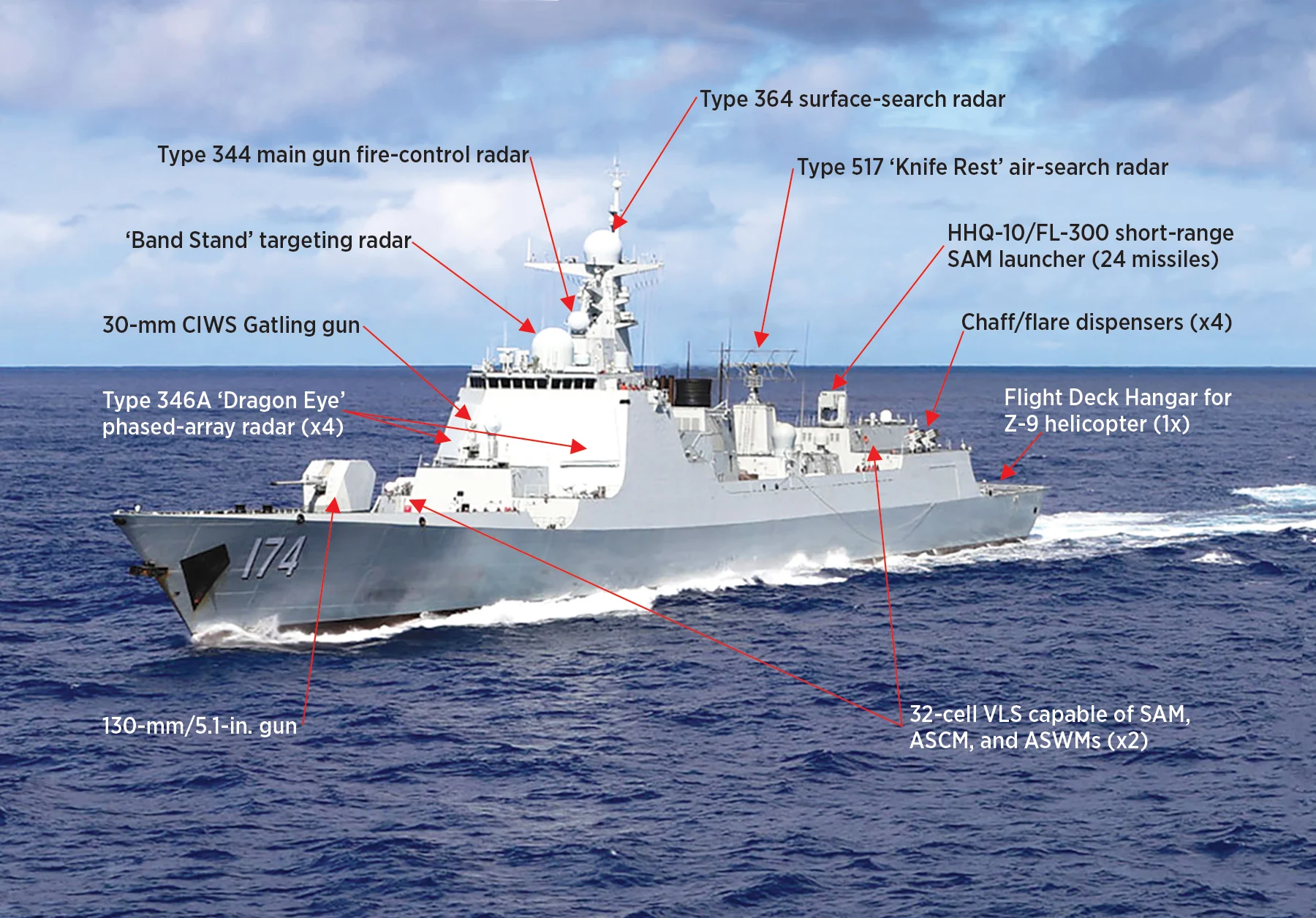
The 052D-class destroyer is a mainstay ship of the Chinese Navy equipped with phased array radar and vertical launch systems, capable of integrating air defense, anti-surface, and anti-submarine operations. On the other hand, the Dongdiao-class AGI is not a combat ship but is used for collecting communication and electronic information. The fact that both were confirmed in the same week around Okinawa, Amami, and the Osumi Strait holds value in observing how Japan responds in terms of frequency, air bases, and vessels during the passage through the strait, rather than the fleet's combat capability itself.
In the author's view, the focus this time is not on territorial waters intrusion. Rather, it lies in continuously exhausting the response procedures of the Japan Maritime Self-Defense Force and Air Self-Defense Force in the gray areas of the air defense identification zone and international waters. In the fiscal year 2025, the Air Self-Defense Force had 595 emergency scrambles, with Chinese aircraft accounting for 366, and 348 of those from the Southwest Air Defense Force alone. While the number is lower than past peaks, if the simultaneous operation of drones, reconnaissance aircraft, and vessels increases, the decision-making burden per incident will not lessen.
Implications for the Japan-U.S. Alliance
During the same period, the JMSDF destroyer Kongo was heading to RIMPAC 2026, while the Izumo, Fuyuzuki, and Mashu were also participating in IPD26 as the 2nd Surface Unit. Overseas deployment is necessary for alliance operations, but when the presence of Chinese vessels and the advancement of information gathering ships into the Pacific overlap in the southwest front, issues regarding the allocation of domestic vigilance and distant deployment become apparent. Unlike the Cold War era's monitoring of the Soya and Tsushima, there is not just one strait now.
The Joint Staff Office documents state simply that they "monitored." However, the practical issue is not whether monitoring was possible, but how many days simultaneous monitoring can be sustained.
The weakness of southwest defense cannot be measured solely by missile range or the number of vessels. What truly needs to be considered is how much of the peacetime information gathering activities have been built up as a prelude to emergencies, and when the political sphere will grant the Self-Defense Forces additional authority and reserve forces. If that delineation remains ambiguous, it is not the ships that will be the first to wear out, but the decision-makers' capacity.
Main Sources
- Ministry of Defense Joint Staff Office, June 12, 2026, announcement of activities of Chinese Navy vessels 515 and 155
- Ministry of Defense Joint Staff Office, June 12, 2026, announcement of the passage of Chinese Navy Dongdiao-class 796 through the Osumi Strait
- USNI News Western Pacific Pulse, June 12, 2026
- Ministry of Defense Joint Staff Office, FY2025 emergency scramble implementation status, April 17, 2026
Chinese Navy's 052D destroyer and 796 AGI conducted monitoring operations near Okinawa and Amami Oshima from June 6 to 10, 2026. The Japan Maritime Self-Defense Force observed these vessels, which were involved in intelligence gathering activities. This operation indicates a strategic focus on assessing Japan's response to naval movements in the region.
- Chinese Navy's 052D destroyer and 796 AGI were active in the southwestern defense area.
- The vessels were monitored by the Japan Maritime Self-Defense Force.
- The 052D destroyer is equipped for integrated air defense, anti-surface, and anti-submarine operations.
- The 796 AGI is used for communication and electronic intelligence gathering.
- The activities suggest a focus on testing Japan's response capabilities.