
The MQ-9B candidate early warning drone will change Pacific surveillance in Japan by 2027.
 Tanaka Takashi
MQ-9B Candidate Early Warning Drone to Change Japan's Pacific Surveillance by 2027
Deploying vehicle-mounted warning control radar on Iwo Jima and Chichijima, and flying drones equipped with early warning radar. The core of the government’s proposal reported by Yomiuri Shimbun on May 18 is not merely about purchasing new drones. It is an attempt to push Japan's air defense surveillance line not only across the southwestern islands but also towards the second island chain extending from the Izu Islands to Guam.
Deployment to Fill the Gap on the Pacific Side
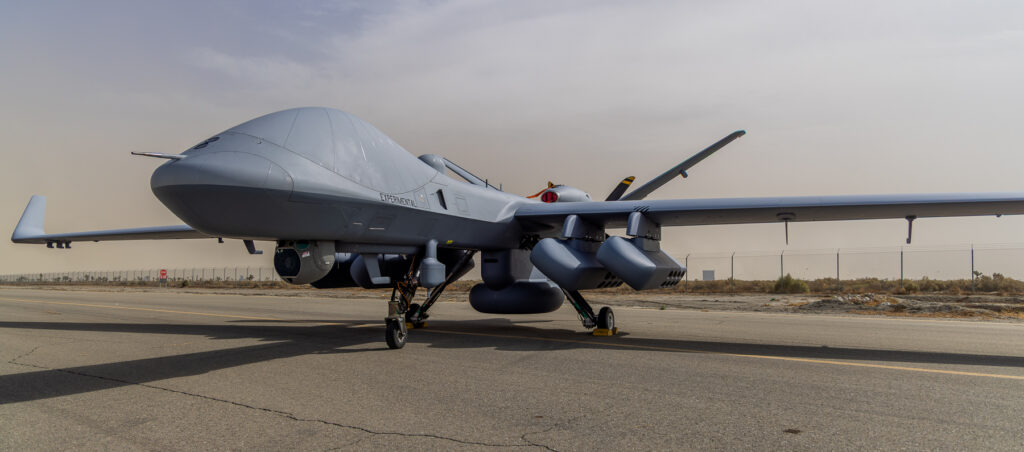
According to reports, the government is planning to include the strengthening of the Pacific surveillance system in three documents, including the defense capability development plan, which will be revised within the year. Research for the deployment of mobile radar on Chichijima is set to begin this fiscal year, and there are plans to replace the existing fixed radar on Iwo Jima with mobile systems. The use of runways on Iwo Jima and Minami-Torishima for drone takeoffs and landings is also anticipated.
One candidate being considered is the MQ-9B SeaGuardian from General Atomics. The Japan Maritime Self-Defense Force plans to introduce this aircraft in fiscal year 2027, and according to the company's materials, the SeaGuardian can stay airborne for over 30 hours, operate beyond the line of sight via satellite communication, and combine wide-area maritime radar, AIS, electronic support measures, and anti-submarine mission kits. It is also explained that the SkyGuardian series can be configured for airborne early warning missions, making it a focal point for Japan to decide what capabilities to equip.
The Horizon Problem Cannot Be Solved by Vessels Alone
Ground-based radar and the radar on escort ships are limited by the curvature of the Earth, which affects the horizon. Low-flying approaching aircraft, cruise missiles, or small targets near the sea surface are determined not only by radar performance but also by their placement. By elevating radar into the air, this limitation can be significantly alleviated. This is why the manned E-2D early warning aircraft is referred to as a "flying radar site."
However, it is not easy to keep the E-2D constantly deployed widely on the Pacific side. The number of aircraft, crew, maintenance, and base protection all impose constraints. Drones are not a substitute for the E-2D, but they can serve as auxiliary lines to increase surveillance density from peacetime to gray zone situations. In my view, the value of this concept lies not in the fact that "drones are cheaper," but in their ability to continuously monitor the same maritime and aerial areas for extended periods without exhausting personnel.
A Quiet Response to Chinese Aircraft Carrier Operations
It is natural for Japan to position this concept from the perspective of deterring China. In June of last year, two Chinese Navy aircraft carriers were reported to be operating simultaneously in the Pacific, and in December, there was an incident where a Chinese carrier-based aircraft illuminated a Self-Defense Force aircraft with radar waves. If the Chinese military attempts to hinder the approach of U.S. forces within the second island chain during a Taiwan contingency, the surveillance value of the Ogasawara Islands, Iwo Jima, and Minami-Torishima will rapidly increase.
What is important here is not the old notion of viewing islands as "unsinkable aircraft carriers." Rather, it is about using the islands as nodes for radar, communication, runways, and drone operations, and how quickly information from the Japan Maritime Self-Defense Force, Japan Air Self-Defense Force, and U.S. military can be integrated into the same operational picture. Long-endurance platforms like the MQ-9B not only detect vessels but also continuously record what is coming from which direction, speeding up subsequent decision-making.
Two Remaining Weaknesses in Implementation
The first weakness is communication. To relay the information seen by the drones to the mainland, the southwestern islands, U.S. forces in Japan, and possibly Guam without delay, redundancy in satellite and ground-based communication is necessary. Even if the aircraft is purchased, a single-line communication network would be vulnerable in wartime.
The second weakness is the rules of operation during peacetime. The Pacific side is vast, but it overlaps with civilian air routes, fishing activities, and the living areas of remote island municipalities. The MQ-9B is designed with integration into civilian airspace in mind, but for continuous operation in Japan, it is necessary to finalize air traffic control, accident response, and explanations to residents around bases. Even if the deployment is correct from a defense perspective, if it is politically handled carelessly, it could conversely narrow operational flexibility.
Sources and Confirmation Items
- Yomiuri Shimbun, May 18, 2026 "Japan Mulls Introducing Early-Warning Drones to Strengthen Pacific Surveillance"
- General Atomics, Official Materials for MQ-9B SeaGuardian
- Northrop Grumman, Official Materials for E-2D Advanced Hawkeye
- Naval News, March 2026 report on JMSDF and U.S. MDA SPY-7/ASEV integrated testing
This concept may not stand out as much as discussions about flashy counterattack capabilities. However, what is first questioned in an actual crisis is not "Can we shoot?" but "When, where, and what did we see?" What is lacking in Japan's Pacific surveillance is continuous visibility rather than weapon names. The true success or failure of early warning drones will depend not on the introduction of the aircraft in 2027, but on how quickly that visibility can be relayed to U.S.-Japan decision-making.
Japan plans to enhance its Pacific surveillance capabilities by introducing MQ-9B SeaGuardian drones and mobile radar systems on Iwo Jima and Chichijima by 2027. This initiative aims to fill surveillance gaps and respond to increasing Chinese naval activities. The Japan Self-Defense Forces will utilize these systems to improve monitoring of air and maritime threats, while addressing operational challenges related to communication and civilian airspace integration.
- Japan plans to deploy MQ-9B SeaGuardian drones by 2027.
- Mobile radar systems will be installed on Iwo Jima and Chichijima.
- The initiative aims to enhance surveillance capabilities in the Pacific.
- The deployment is partly a response to Chinese naval activities.
- Operational challenges include communication and integration with civilian airspace.