

Summary and Key Points: Christian D. Orr argues the 24 Essex-class aircraft carriers, from USS Essex (CV-9), commissioned December 1942, to USS Philippine Sea (CV-47) in May 1946, were the best carrier class ever: 888 feet, 36,960 tons, 33 knots, 90 aircraft, 3,100 crew, special-treatment steel armor, and zero losses to enemy action, with USS Franklin’s crew earning 392 decorations including two Medals of Honor. Eleven fought in Korea, 13 in Vietnam; Yorktown, Intrepid, Hornet, and Lexington are museums.
Essex-Class Aircraft Carriers: Military History Like Nothing Else
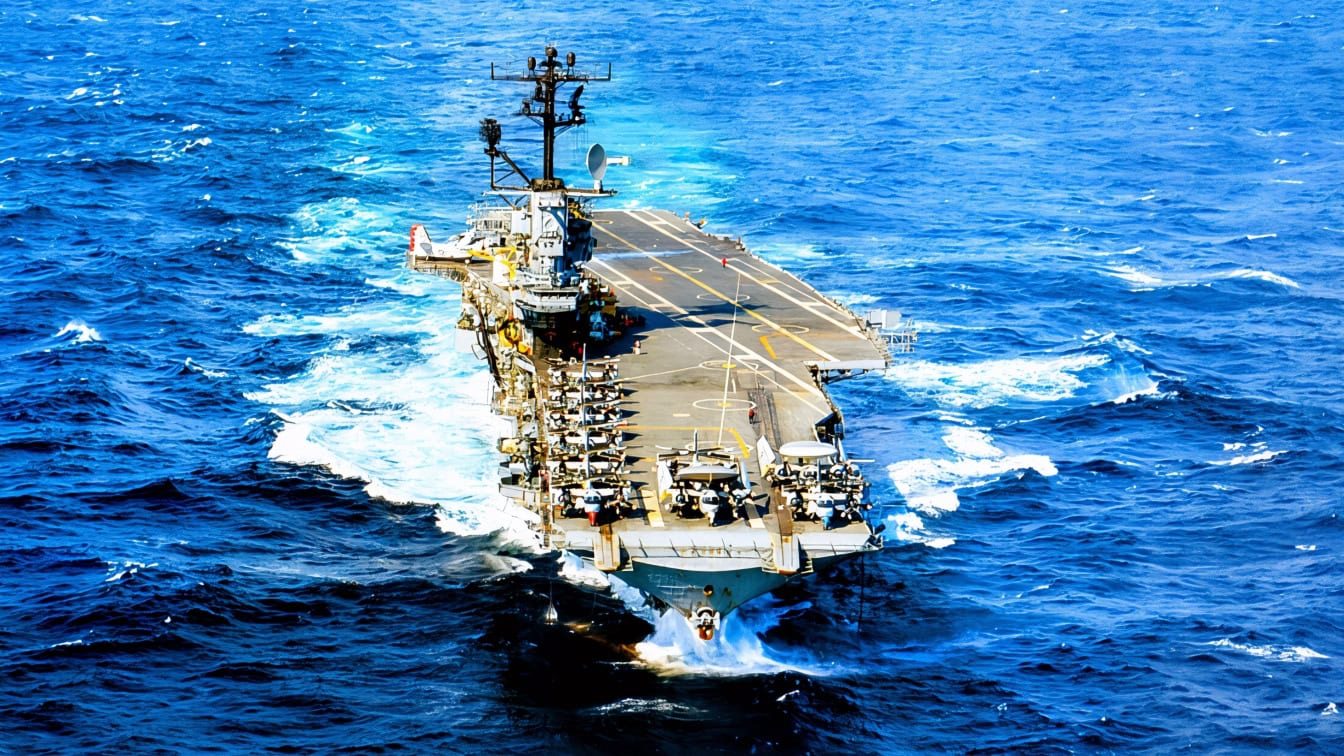
USS Intrepid Aircraft Carrier US Navy Photo
America’s Essex County is in the Commonwealth of Massachusetts, a state that prides itself on being the “Spirit of America,” so it’s fitting that multiple United States Navy vessels bear the USS Essex name. Indeed, in Essex’s case, the name went beyond individual ships, being bestowed on an entire class of warships: the Essex-class aircraft carriers, the backbone of the USN WWII fleet.
But the story goes on. Like the Iowa-class battleships, the Essex-class “flattops” underwent multiple upgrades and improvements that kept them in service for decades after WWII, making them arguably the best carrier class of all time.
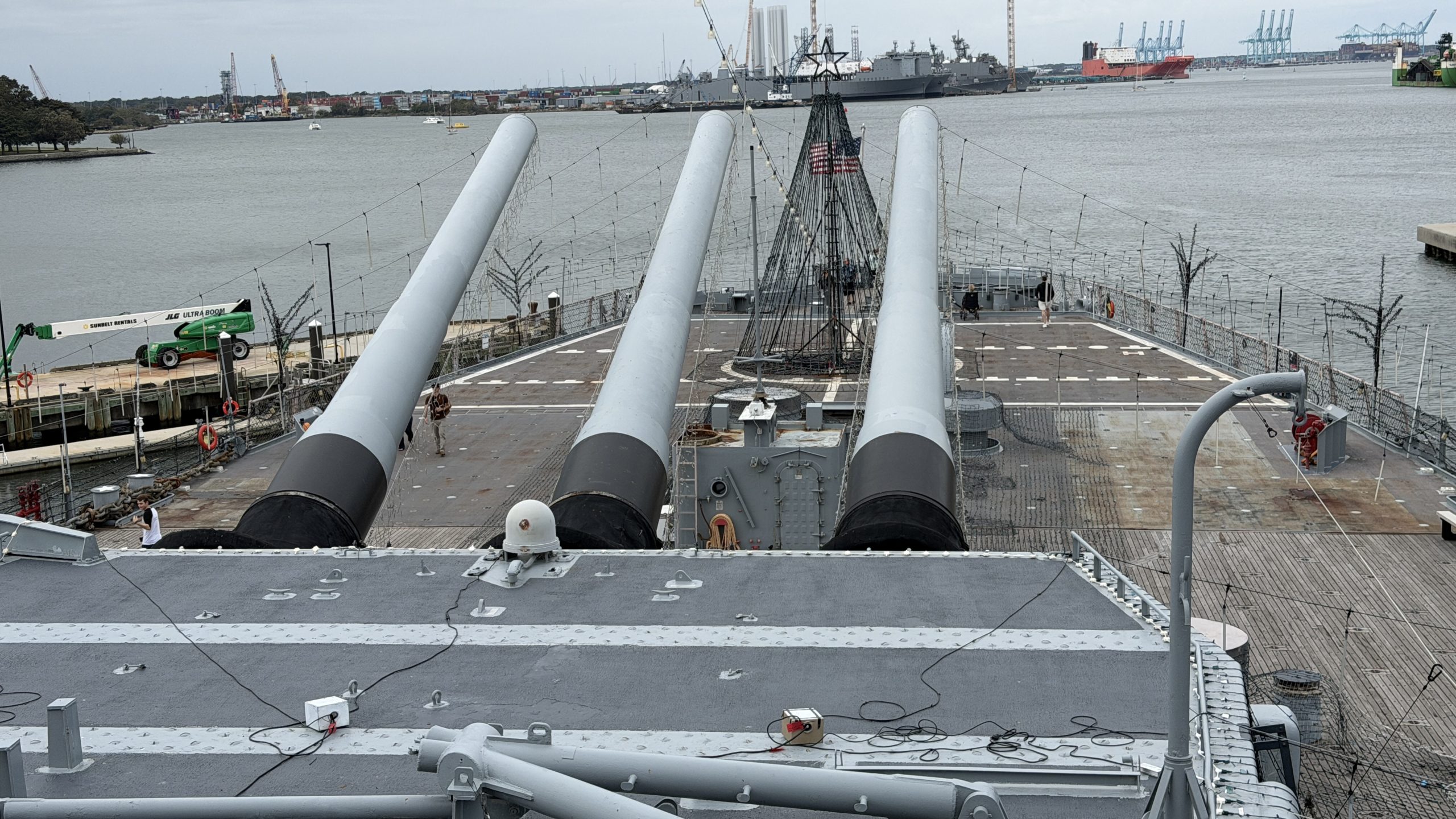
USS Wisconsin Iowa-Class Battleship Tour. Photo by 19FortyFive Reporter Christian D. Orr.
Essex-Class Initial History, Premise, and Tech Specs
A total of 24 Essex-class carriers were completed, making them the 20th century’s most numerous class of capital ships; by the philosophy that “Quantity has a quality all of its own,” that factoid alone arguably qualifies them for the title of best carrier class ever. They came in both “short-hull” and “long-hull” versions.
The first ship of the class was, appropriately enough, the USS Essex (CV-9), which was laid down in April 1941, launched in July 1942, and commissioned in December 1942. The 24th and final member of the class was the USS Philippine Sea (CV-47), laid down in June 1943, launched in September 1945, and commissioned in May 1946, missing WWII action. Fittingly, four of the flattops were named for predecessors sunk earlier in the war: USS Yorktown, Lexington, Hornet, and Wasp.
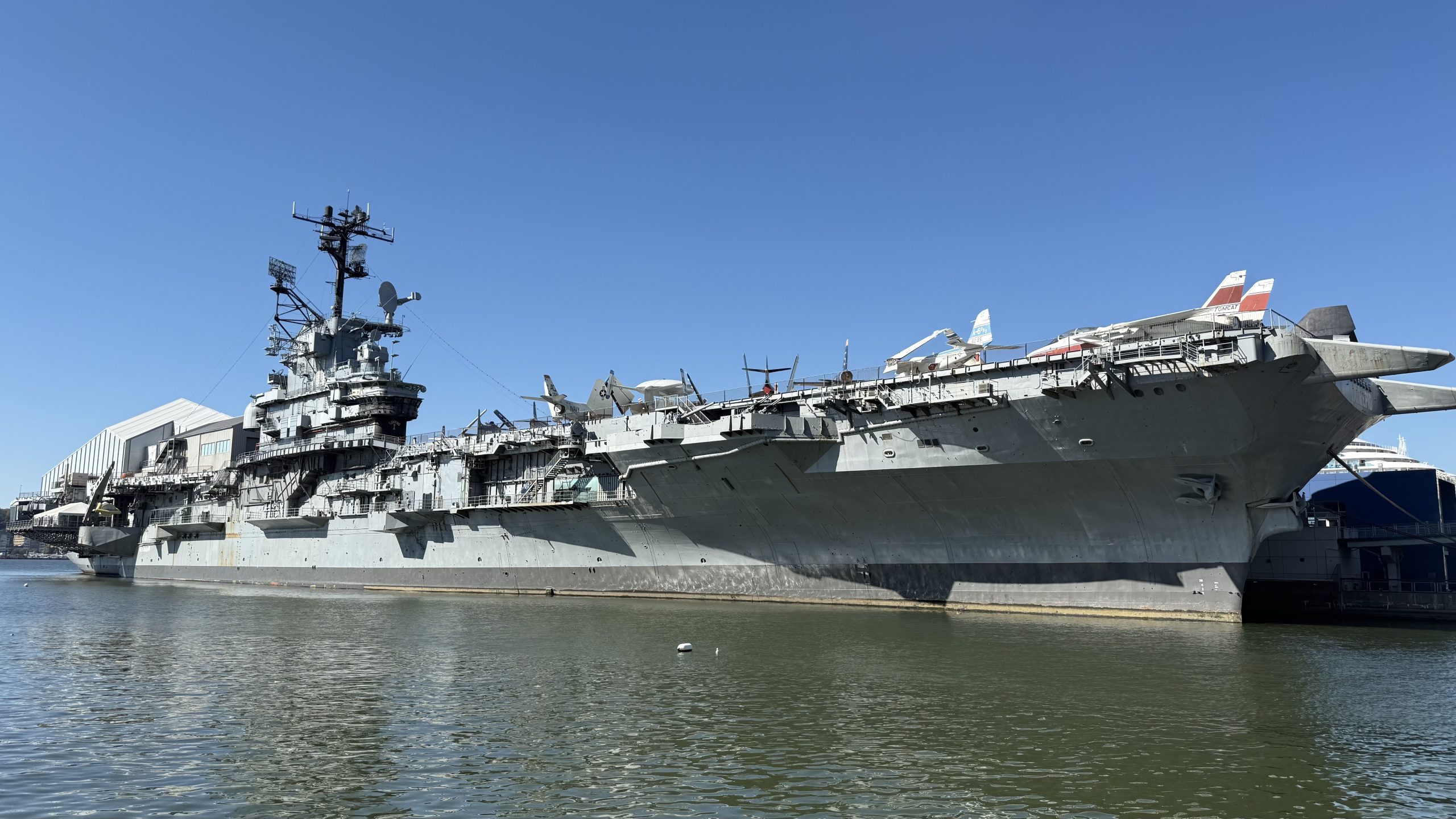
Essex-Class Aircraft Carrier USS Intrepid Tour from 2025. 19FortyFive Original Image.
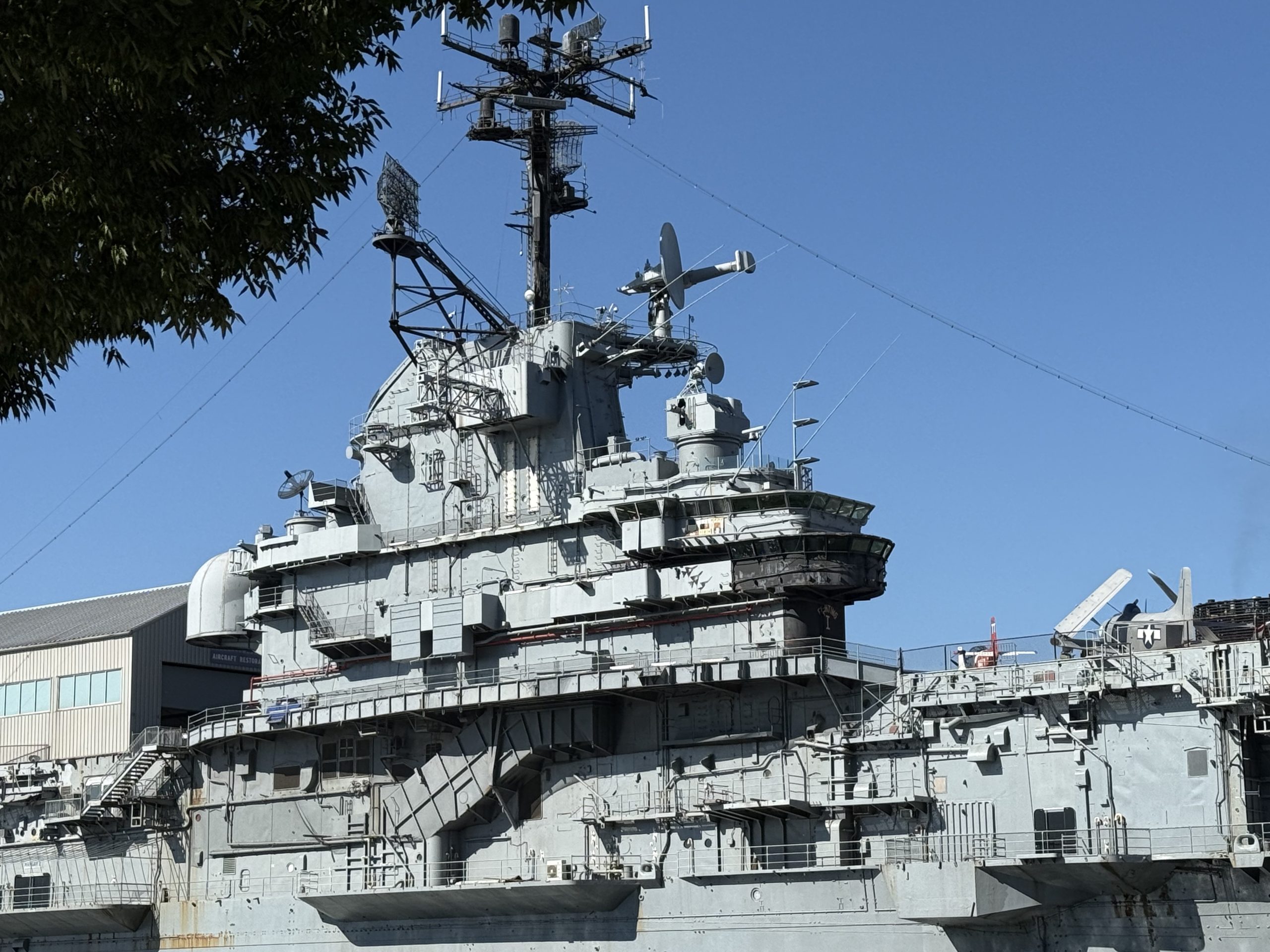
Essex-Class Aircraft Carrier USS Intrepid Tour from 2025. 19FortyFive Original Image.
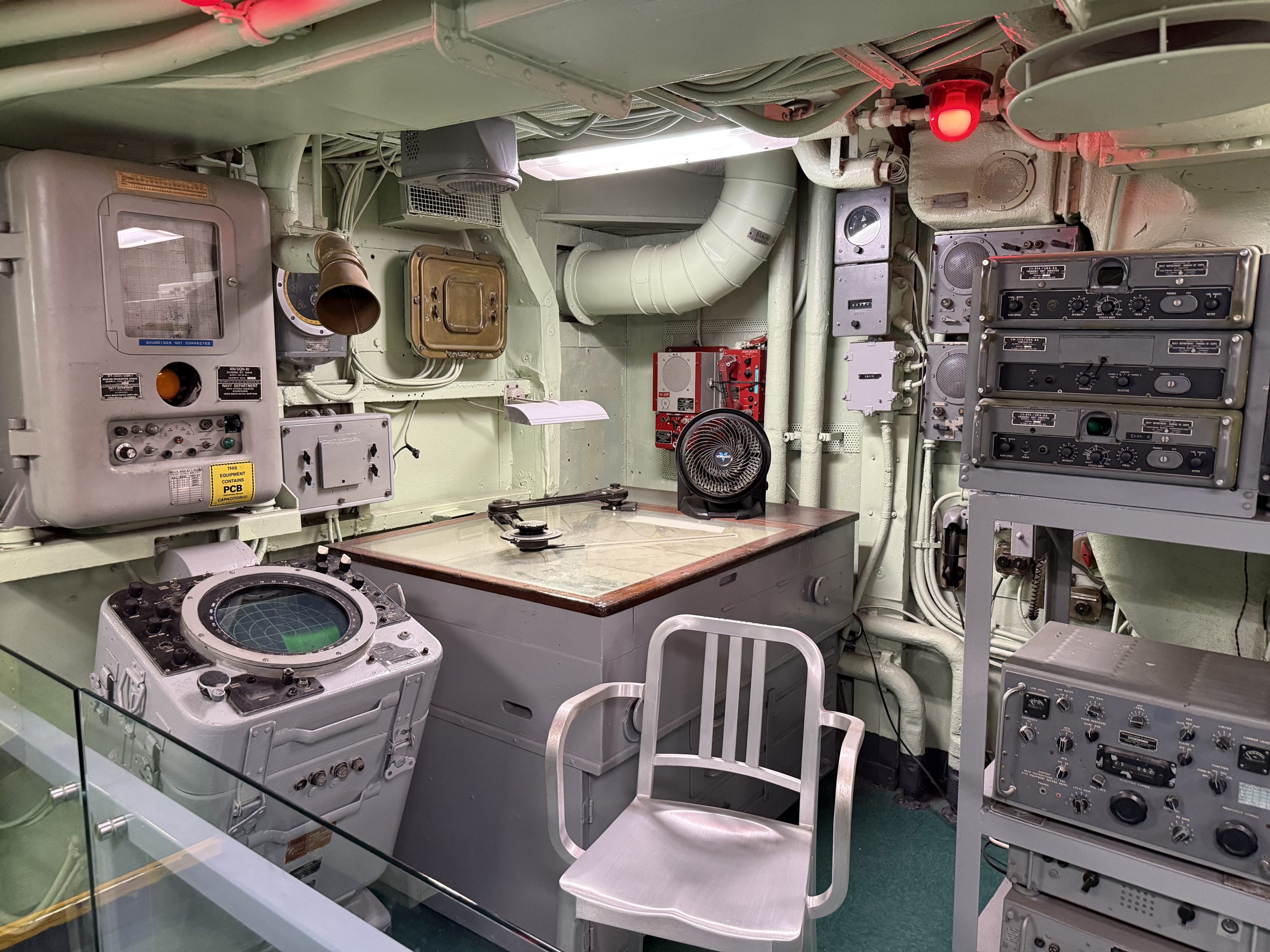
Essex-Class Aircraft Carrier USS Intrepid Tour from 2025. 19FortyFive Original Image.
32 hulls were originally ordered; however, as the Second World War wound down, six were canceled before construction, and two were canceled after construction had already commenced. Designated as the successors to the Yorktown-class carriers, they were devised to follow five main rules:
-Able to carry four squadrons of 18 planes, plus another squadron in reserve
-Able to launch and recover planes faster than usual
-Able to carry 25% spares for its planes, since US carriers were expected to stay at sea longer than their counterparts.
-Able to survive severe combat damage and serve a long life.
-Able to easily accommodate upgrades.
Regarding item #4, the most significant construction factor that ultimately boosted the Essexes’ survivability was armor protection, which was far greater than that of the Yorktown class. Essex-class armor protection incorporated extensive use of flat, straight metal pieces and special-treatment steel, a nickel-chrome alloy that provided the same protective qualities as Class B armor plate but was fully structural. The then-proverbial new kids on the shipyard block also benefited from improved ammunition-handling facilities and more effective damage-control equipment.
As initially designed, the Essex-class flattops sported a hull length of 888 feet for the long-hull units and 872 feet for the short-hull sister ship, a beam width of 147.5 feet, a draft of 34 feet 2 inches, and a fully laden displacement of 36,960 tons. The crew complement was 3,100 commissioned officers and enlisted seamen, and the aircraft-carrying capacity—the raison d’être for this type of warship after all—was 36 fighter planes, 36 dive bombers, and 18 torpedo bombers. For self-defense, the flattops carried four twin and four single five-inch gun turrets, plus sixty 20mm Oerlikon cannons and seventeen quad-barrel 40mm Bofors anti-aircraft (AA) guns. Max speed was 33 knots.
Essex-Class Combat History in Brief
Going back to the survivability requirement, seaforces.org sums it up accordingly: “No Essex-class ships were lost to enemy action, despite several vessels sustaining very heavy damage. The Essex-class carriers were the backbone of the U.S. Navy’s combat strength during World War II from mid-1943 on, and, along with the addition of the three Midway-class carriers just after the war, continued to be the heart of U.S. Naval strength until the supercarriers began to come into the fleet in numbers during the 1960s and 1970s.”
The Essex-class carrier that suffered the most severe damage and came perilously close to sinking was the USS Franklin (CV-13). You can read the harrowing details about “Big Ben’s” ordeal HERE; suffice it to say for now that that long-suffering ship’s crew became THE most decorated crew for a single action in U.S. Navy history, with 392 decorations awarded, including 2 Medals of Honor, 20 Navy Crosses, and 22 Silver Stars.
In exchange for those heavily damaged carriers, planes from the Essex-class carriers were responsible for the decimation of Japanese air units in the Marianas, the Philippines, Formosa, and eventually Imperial Japan itself.
Regarding the venerable warships’ post-WWII combat record:
-11 of them participated in the Korean War; missions included attacks on all types of ground targets, air superiority, and anti-submarine patrols
-13 took part in the Vietnam War; perhaps most significantly, warbirds from USS Ticonderoga (CV-14) fired at North Vietnamese torpedo boats that had attacked a U.S. destroyer in the controversial Gulf of Tonkin Incident of 1964
USS Lexington was the last Essex-class ship to retire from active service, decommissioned as a training carrier in 1991, ending her service life much more peacefully than her immediate predecessor.
Where Are They Now?
The Good, Happy News: A total of four Essex-class flattops survive today, preserved for posterity as floating museums, namely:
-USS Yorktown (CVS-10), at Patriot’s Point, Mount Pleasant, South Carolina
–USS Intrepid (CVS-11), in New York City
–USS Hornet (CVS-12), in Alameda, California
–USS Lexington (AVT-16), in Corpus Christi, Texas
The Bad, Sad News: Despite her incredible survival story, the USS Franklin didn’t survive the scrapyard consignment, and not a smidgeon of her survives today. Such a damn shame.
Christian D. Orr, Defense Expert
Christian D. Orr is a Senior Defense Editor. He is a former Air Force Security Forces officer, Federal law enforcement officer, and private military contractor (with assignments worked in Iraq, the United Arab Emirates, Kosovo, Japan, Germany, and the Pentagon). Chris holds a B.A. in International Relations from the University of Southern California (USC) and an M.A. in Intelligence Studies (with a concentration in Terrorism Studies) from American Military University (AMU). He is also the author of “Five Decades of a Fabulous Firearm: Celebrating the 50th Anniversary of the Beretta 92 Pistol Series,” whose second edition was recently published.