
The New Factory Plan for the US-2 Seaplane Indicates the Maritime Self-Defense Force's Island Rescue and Maritime Traffic Routes
 Tanaka Takashi
New Factory Plan for US-2 Amphibious Aircraft Indicates JMSDF's Island Rescue and Maritime Traffic Routes
It has been reported that ShinMaywa Industries plans to construct a new factory for the US-2 rescue amphibious aircraft by 2029. What is noteworthy in the November 8 report is that it goes beyond merely updating production facilities and delves into establishing an industrial base to maintain the special aviation capabilities that the Japan Maritime Self-Defense Force (JMSDF) will operate for the long term.
US-2 is More Than Just an "Aircraft"
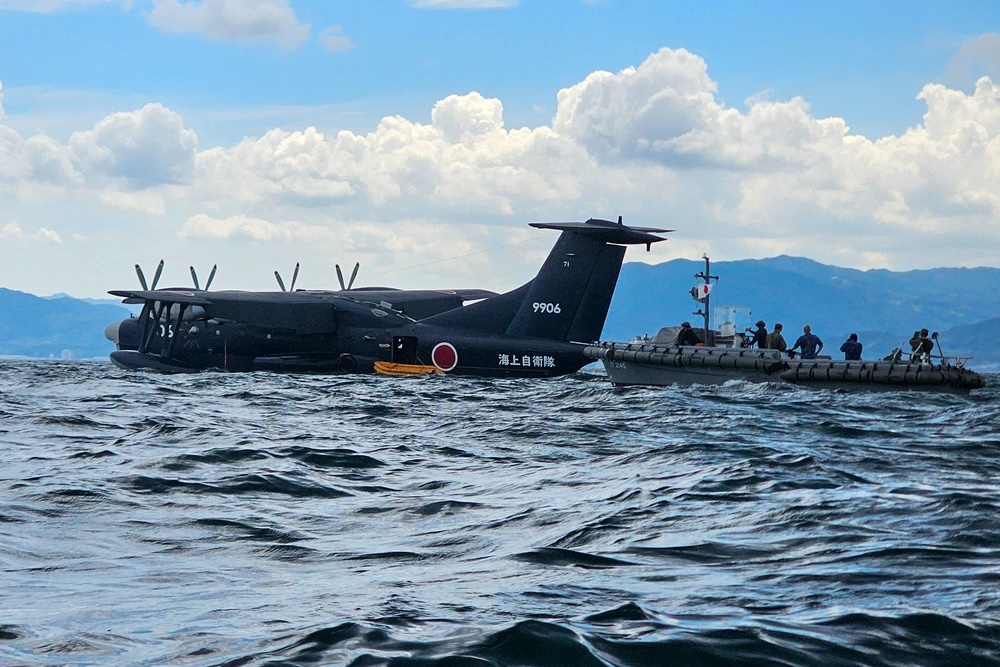
The US-2 is a STOL (Short Takeoff and Landing) amphibious aircraft capable of taking off from the water at short distances, with specifications indicating a length of approximately 33.5 meters, a maximum takeoff weight of about 47.7 tons, and a range of approximately 4,700 kilometers. It enables low-speed flight even in rough weather through boundary layer control, undertaking missions such as rescue operations at sea, emergency patient transport, and approaching isolated islands—tasks that are difficult to replace with conventional fixed-wing aircraft or helicopters.
The number of aircraft owned by the JMSDF is limited. Therefore, the operational rate of each aircraft, the supply of parts, and the skills of maintenance personnel significantly influence the overall effectiveness of the unit. The significance of the new factory lies not in a rapid increase in the number of aircraft but in avoiding the risk of production interruptions and securing the option to continue using existing aircraft into the 2030s.
Practical Value in Defending the Southwestern Islands
As tensions rise around the Taiwan Strait and the southwestern islands, the value of transportation and rescue means that do not rely on runways and ports increases. While the US-2 is not an armed aircraft, it can recover injured personnel from isolated islands and naval vessels and rescue civilians during disasters. This capability supports deterrence as a "force outside of combat power" and serves as a human foundation for maintaining the safety of SLOCs (Sea Lines of Communication).
On the other hand, relying solely on amphibious aircraft does not resolve the sustainability of operations in emergencies. Without coordination on sea conditions, weather, forward maintenance bases, and information sharing with escort ships and aircraft, the range figures do not directly translate into effective mission outcomes. It is necessary to consider investments in the new factory alongside training airspace, spare parts, and securing crew members as a cohesive strategy.
Implications for the Alliance
The US military does not have equivalent aircraft, and the US-2 represents a unique capability that Japan provides within the Japan-U.S. alliance. If it can connect with the U.S. military's ISR (Intelligence, Surveillance, and Reconnaissance) and transportation networks and rescue information, crisis response in the southwestern region will be strengthened. However, if this capability is positioned solely as a supplement to U.S. military support, it will wear down the JMSDF's valuable aircraft. In the author's view, the real challenge for the US-2 lies not in its performance but in the operational design of how to switch between peacetime rescue and sustained support in emergencies.
Reference Information
ShinMaywa Industries plans to construct a new factory for US-2 amphibious aircraft in Japan by 2029. This initiative aims to maintain the operational capability of the Japan Maritime Self-Defense Force's limited fleet of US-2s, which are essential for disaster response and maritime operations. The factory will help avoid production interruptions and ensure the aircraft remain in service into the 2030s.
- New factory for US-2 aircraft planned by ShinMaywa Industries by 2029.
- US-2 aircraft are vital for disaster response and maritime operations.
- The factory aims to ensure the operational capability of existing aircraft into the 2030s.
- US-2 aircraft are not armed but play a crucial role in rescue operations.
- The report highlights the importance of logistics and training for effective operations.