
The New Pressure the Confirmation of China's Type 076 Sichuan Electromagnetic Catapult Poses on the Defense of the Southwestern Islands
 Tanaka Takashi
Confirmation of China's Type 076 Sichuan Electromagnetic Catapult Poses New Pressure on Southwestern Islands Defense
On the deck of the Type 076 amphibious assault ship "Sichuan," reportedly photographed near Shanghai, distinct lines are visible that clearly differ from conventional helicopter operation vessels. These include a sloped deck, landing arrestor system, and an electromagnetic catapult. Army Recognition reported on July 17 that the ship is likely to become the world's first amphibious assault ship capable of launching and recovering fixed-wing combat drones. This is not merely news about a new ship in the Chinese Navy. It is a discussion about how drones will push forward the Japan Maritime Self-Defense Force's (JMSDF) timelines for anti-submarine, air defense, and anti-ship operations in the southwestern islands.
The Type 076 is Not Just a Larger Version of the Type 075
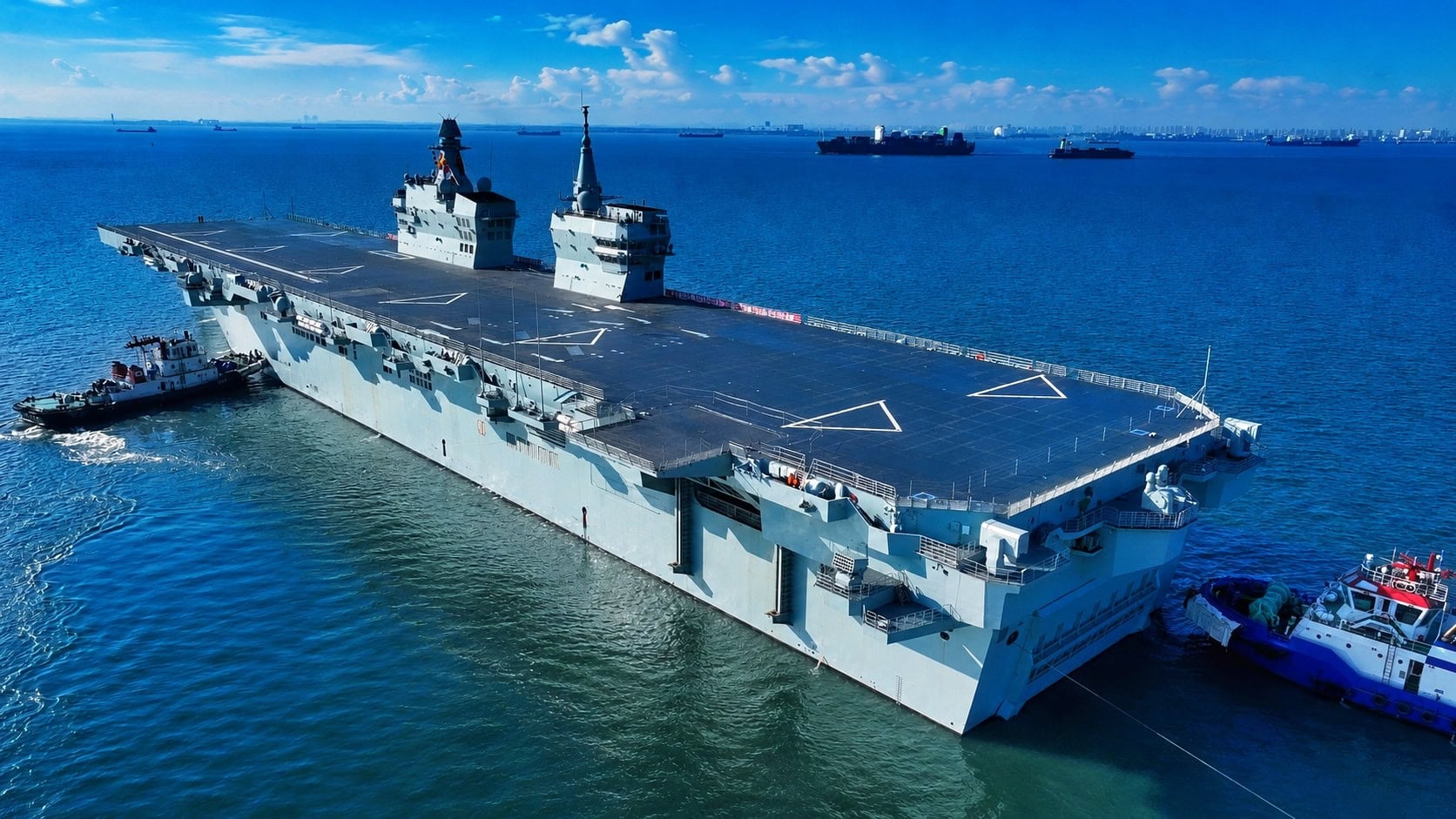
The Type 076 is often treated as a successor to the Type 075 amphibious assault ship, but I have reservations about that view. The Type 075 is fundamentally a mothership for amphibious operations that combines helicopters and landing craft. In contrast, the Sichuan is estimated to be around 50,000 tons and is equipped with an electromagnetic catapult and arrestor system. This means that while it is an amphibious ship, it also functions as a limited unmanned aircraft carrier.
According to reports, potential onboard candidates include stealth unmanned combat aircraft like the GJ-11 "Sword" or its shipborne variants. However, the Chinese side has not officially clarified the composition of the air wing. This point requires confirmation. Nevertheless, it cannot be overlooked that the deck design appears aimed at the repeated operation of fixed-wing unmanned aircraft, rather than merely leaving room for future possibilities.
For Japan, the Issue is Detection Range Rather than Landing Capability
In discussions in Japan regarding a Taiwan contingency and the defense of the southwestern islands, the number of Chinese landing troops, the number of amphibious assault ships, and missile ranges often take center stage. Of course, these are necessary figures. However, the problem with the Type 076 is not so much its ability to transport Marines, but rather that drones will extend the detection range of surface forces.
If fixed-wing unmanned aircraft can sustain ISR (Intelligence, Surveillance, Reconnaissance) missions for several hours, the Chinese Navy's surface fleet will be able to search for JMSDF escort ships, supply ships, and land-based anti-ship missile units from a greater distance than helicopter-centric amphibious assault ships. The terrain of the southwestern islands provides advantages for the defending side in terms of dispersion, but once detected, the supply routes are narrow. For those defending the SLOC (Sea Lines of Communication), this represents a different kind of pressure compared to the Cold War-era defense of the Soya and Tsushima Straits.
A Different Concept from U.S. Navy-Style Small Aircraft Carriers
The U.S. Navy's America-class amphibious assault ships are designed around aircraft such as the F-35B, MV-22, and CH-53K. While the individual aircraft have high performance, they operate in a STOVL (Short Takeoff and Vertical Landing) mode and are not ships that repeatedly handle unmanned combat aircraft launched from catapults. Turkey's TCG Anadolu is also gaining attention for its unmanned aircraft operations, but it is based on a short takeoff concept, which differs from the CATOBAR (Catapult Assisted Take-Off But Arrested Recovery) concept of the Type 076.
China's aim is not to catch up to the U.S. Navy in terms of the quality of each individual aircraft, but rather to increase the density of detection, electronic warfare, and target designation by spreading unmanned aircraft in front of surface combat groups. If the Type 076, Type 055 destroyers, and Type 003 aircraft carrier "Fujian" are interconnected in a single operational area, there is a possibility of forming a multi-layered sensor network in waters extending from around Taiwan to the Miyako Strait and Bashi Channel.
Integration of JMSDF and Ground Self-Defense Force Missile Units is Crucial
Japan is enhancing its counterattack capabilities with the improved Type 12 surface-to-ship guided missile, Tomahawk, and F-35 armaments. However, the challenge posed by the Type 076 is not a simple competition over how many kilometers its range is. It is about how quickly mobile launchers, patrol aircraft, escort ships, submarines, and U.S. military space and air sensors can share the same target image.
Especially as the JMSDF escort fleet enters a reorganization phase, and the integration with Ground Self-Defense Force missile units increases in the southwestern region, operations and deception based on continuous monitoring by unmanned aircraft will become necessary. Simply strengthening base air defense will not suffice; if the movements of supply ships and ammunition transport are predictable, operational continuity will decline.
The Type 076 "Sichuan" should be viewed not as a larger landing ship, but as a sign that the Chinese Navy is attempting to standardize unmanned aviation in surface operations.
Political Timing Often Overlooked
To rush to a conclusion, a single Type 076 will not overturn Japan's defense posture. There are still uncertainties regarding testing, onboard unmanned aircraft, control personnel, maintenance, and data links. However, what is often overlooked here is not technology, but political timing. If Japan's decision-making regarding the use of counterattack capabilities lags behind the speed at which China visualizes the situation with unmanned aircraft, even possessing weapons with a range of 1,000 kilometers will have a diminished deterrent effect. The true challenge lies not in the number of new missiles, but in whether Japan and the U.S. can shift to the same judgment the moment they are detected.
The Type 076 Sichuan amphibious assault ship, confirmed near Shanghai, features an electromagnetic catapult and is expected to launch fixed-wing combat drones. This development represents a significant enhancement in the Chinese Navy's capabilities, potentially impacting Japan's defense strategies in the southwestern islands. The ship's design allows for extended operational reach, posing new challenges for regional security.
- The Type 076 Sichuan is likely the world's first amphibious assault ship capable of launching fixed-wing combat drones.
- The ship features an electromagnetic catapult and arrestor wires, distinguishing it from traditional helicopter carriers.
- The introduction of this ship could extend the operational range of the Chinese Navy's surface forces.
- The report highlights the strategic implications for Japan's defense posture in the southwestern islands.