
The normalization of the Chinese Navy's Type 055 and 054A approach towards Japan, with maritime surveillance pressure entering a new phase in autumn 2026.
 Tanaka Takashi
The Regular Approach of China's Navy Type 055 and 054A to Japan Becomes the Norm, and the Maritime Surveillance Burden in Autumn 2026 Enters a New Phase
When looking solely at the number of vessels passing through the Soya Strait and the Miyako Strait, it may seem like a typical show of force. However, when tracking the types of ships, the picture changes slightly. From the end of summer to early autumn 2026, what stands out around Japan is not a single passage, but rather the Chinese Navy's more routine and repeated deployment of formations, including large surface combatants, into the open sea. This is not a one-time intimidation but is becoming an operation to measure the Japan Maritime Self-Defense Force's surveillance endurance.
What They Want to Show is Not Exercises but the Frequency of Approaches
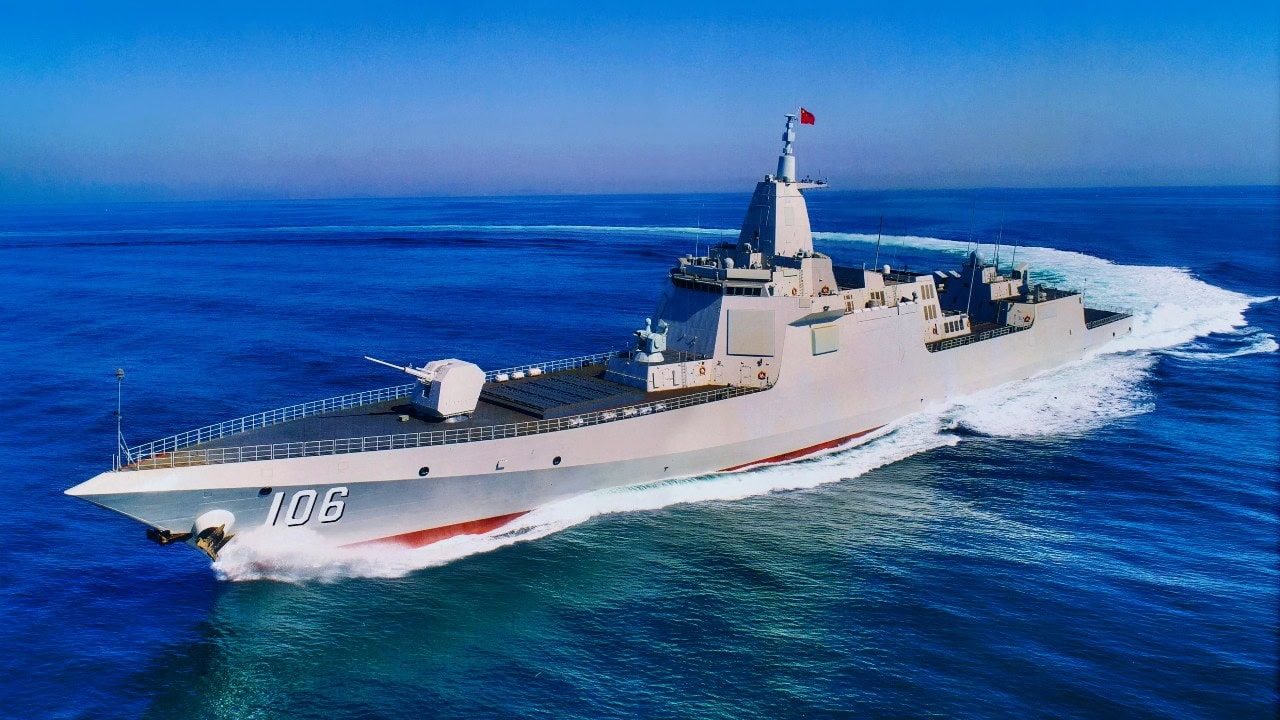
The approach of Chinese vessels towards Japan reported by the Wall Street Journal on September 4 should not be read as an isolated event. When combined with the actions of vessels and aircraft disclosed by the Ministry of Defense and the Joint Staff Office this summer, and further evaluations reported by Reuters on August 31 regarding China's strengthening of maritime and aerial control east of Taiwan, a continuous operational space emerges from the southwestern part of the Japanese archipelago to the east of Taiwan. What China aims for is likely to normalize the passage through the straits rather than the passage itself.
This type of behavior may appear, tactically, to be normal open-sea activities involving radio silence and formation changes. However, the operational significance is different. If Japan must continuously deploy P-1 patrol aircraft, escort ships, fixed radar, electronic intelligence collection at the same density each time, it is not the side that is coming out that will exhaust its resources first, but the side that is watching. According to Tanaka, the issue has shifted from "Can we find them?" to "Can we keep watching them?"
The Significance of Type 055 Taking the Lead Lies in Operational Formation, Not Symbolism
- The Type 055 destroyer is generally considered to be around 12,000 tons and is easy to use as a long-range air defense and command ship for the Chinese Navy.
- The 054A frigate is suitable for anti-submarine and escort missions, making it convenient as a supporting role when normalizing the open-sea operations of large ships.
- The repeated appearance of this combination in the waters near Japan indicates that it is not merely a display of a single ship, but rather solidifying standard operations of deploying in formation and returning in formation.
What is important here is that the Chinese Navy does not need to deploy an aircraft carrier every time. Rather, having relatively easy-to-use ships like the Type 055 and 054A shuttle back and forth in the waters around Japan is more efficient as a peacetime pressure tactic. Without having to wield expensive symbolic forces, they can gradually increase the burden on the Japan Maritime Self-Defense Force's watch, maintenance, anti-submarine patrol, and command decision-making speed.
The Core for the Japan Maritime Self-Defense Force is Not the Number of Weapons but the Duty Roster
In Japan's security discussions, the debate often focuses on counterattack capabilities and long-range missiles. Of course, these are important in themselves. However, in a situation where the approach of Chinese vessels has become the norm, what is questioned first is not the arsenal but the duty roster. Tracking vessels requires the crew, maintenance personnel, air units, supplies, and the duty cycle of the command center. Even if the Japan Maritime Self-Defense Force maintains a qualitative advantage, if the tempo of deployment is dragged down to the standards intended by the opponent, that advantage will quietly diminish.
Moreover, it is not sufficient to only look at the southwestern region. In the Soya area, activities of the Russian Pacific Fleet continue, and Japan simultaneously bears different surveillance burdens in the north and south. This is reminiscent of the defense of maritime traffic routes during the Cold War, but unlike then, the current situation has less personnel flexibility. As the reorganization of the Japan Maritime Self-Defense Force progresses, it cannot be said that the rapid response personnel are sufficient in light of the increasing surveillance targets.
It Has Become Difficult to Separate the Eastern Side of Taiwan and the Southwestern Islands
According to evaluations from Taiwan reported by Reuters, China is strengthening its control in surrounding maritime and aerial areas in a more unpredictable manner. This is not just a matter for Japan's opposite shore. From the line of Yonaguni, Ishigaki, and Miyako, the increase in maritime and aerial activities east of Taiwan directly adds pressure to Japan's surveillance lines. For China, it is likely more beneficial to observe the opponent's reactions in a broader maritime and aerial area that includes Japan's southwestern front rather than treating the Taiwan front as an independent theater.
In this sense, the recent approaches towards Japan are not merely political messages. They should be seen as gradually integrating peacetime navigation, information gathering, fleet operations, and aerial activities, thereby incrementally enhancing pre-crisis maritime and aerial management capabilities. While lacking in flashiness, such accumulation is more dangerous.
What is Needed for the Japan-U.S. Alliance is a Redesign of Surveillance Responsibilities Rather than Grand Statements
In this situation, what is required of the Japan-U.S. alliance is not an abstract confirmation of deterrence, but practical details on which maritime areas will be monitored by whom, how frequently, and with which sensors. As the proximity of Chinese vessels increases, not only the forward-deployed forces of the U.S. Navy but also Japan's anti-submarine patrols, coastal surveillance, and data fusion accuracy will be put to the test. In other words, deterrence cannot be established solely by missile range; it is supported by the continuity of surveillance.
In the author's view, the true challenge lies not in the approach of Chinese vessels themselves but in the political habituation to handling it as "again." The more normalized the passage becomes, the more blurred the boundary between dangerous behavior and normal behavior becomes. At that time, it is not the sensor's response that is delayed, but the political judgment to recognize the qualitative change in the situation. What is occurring in the waters around Japan in autumn 2026 seems to be precisely that rewriting of the boundary line.
Chinese naval vessels, including Type 055 destroyers and 054A frigates, are increasingly approaching Japan through the Soya and Miyako Straits, indicating a shift towards regular naval operations. This pattern is expected to escalate by autumn 2026, placing pressure on Japan's Self-Defense Forces to maintain surveillance and readiness in response to these activities. The operational focus is on normalizing these approaches rather than conducting isolated demonstrations.
- Chinese naval vessels are regularly approaching Japan.
- Type 055 and 054A ships are involved in these operations.
- The frequency of these approaches is increasing, indicating a shift in operational strategy.
- Japan's Self-Defense Forces are under pressure to maintain surveillance and readiness.
- The situation reflects a broader strategic context involving Taiwan and regional security.