
The PLA's Four-Month Absorption of Ukrainian Drone Warfare Experience: Low-Cost Swarms and Anti-Drone Systems Accelerate Formation
 Li Minghui
PLA Absorbs Ukrainian Drone Warfare Experience in Four Months: Low-Cost Swarms and Counter-Drone Systems Accelerate Formation
A joint study released on October 7 by China and the U.S. quantifies the speed at which the PLA has observed the drone warfare in the Russia-Ukraine conflict: from the emergence of new tactics on the battlefield to systematic discussions in Chinese military publications, it takes an average of about four months. This figure is more noteworthy than the performance of a specific drone, as it reflects not just the imitation of individual equipment, but a learning chain that spans battlefield information, military industrial institutions, training, and procurement.
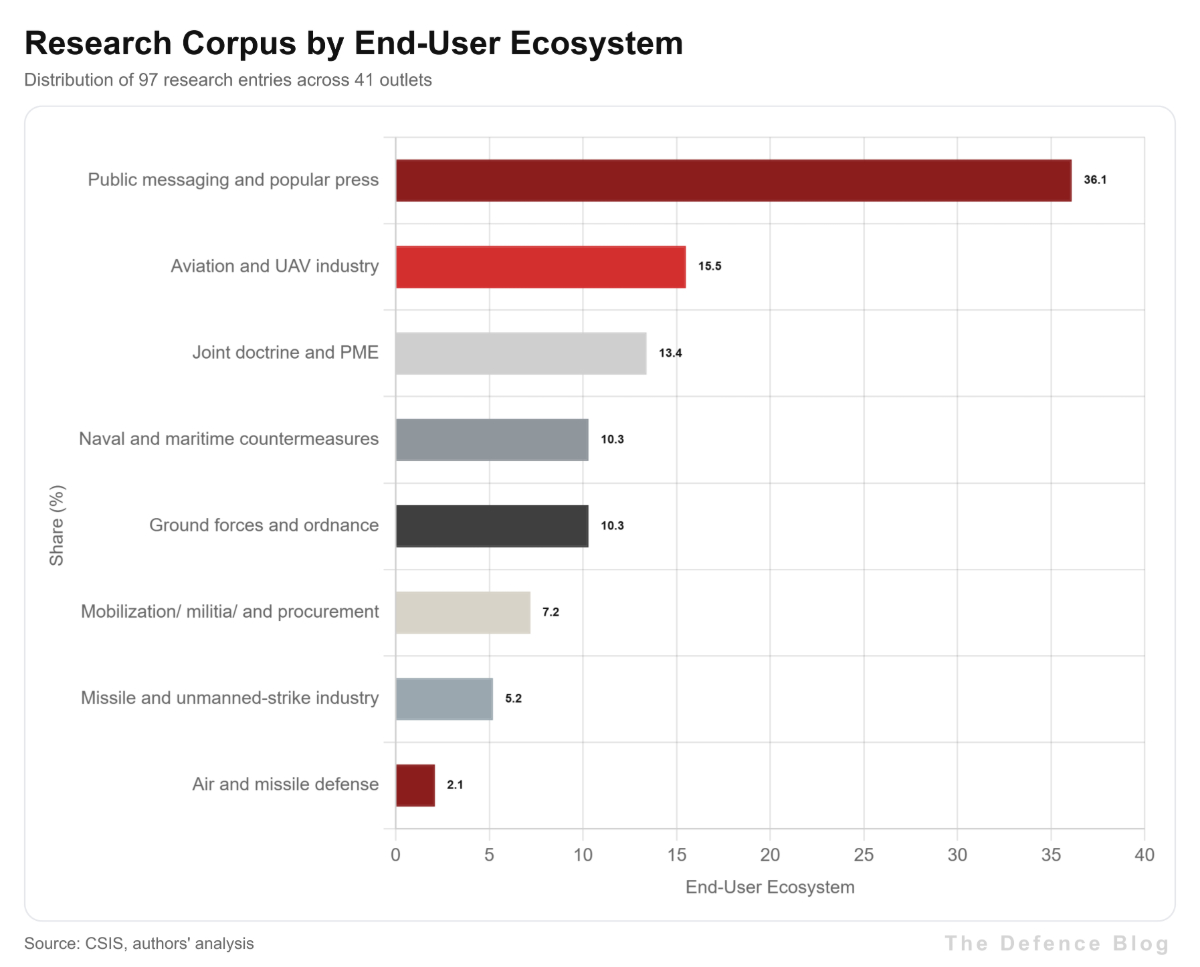
Researchers from CSIS and the Taiwan Institute for Democracy, Society, and Emerging Technologies analyzed over 90 Chinese-language materials from 45 media outlets between July 2022 and August 2026. Nearly half of the materials came from publications hosted by military and defense industrial institutions, indicating that the experiences from the Russia-Ukraine battlefield have entered the Chinese military industrial system, rather than being merely news commentary.
The PLA's First Lessons: Cost and Speed
The conclusion frequently cited in Chinese military publications is straightforward: the cost of a reconnaissance strike drone may be less than 1% of that of a modern fighter jet, yet it can cover over 90% of the battlefield area. This ratio is a rough estimate and should not be taken as a procurement bill, but it explains why the PLA views drones as a consumable system rather than as accessories to a few expensive platforms.
Another key point is the speed of the kill chain. Researchers from the National Defense University of China summarized the Russian military's experience, stating that the time from target detection to strike can be as short as 3 to 5 minutes, with the Orlan-10 reconnaissance drone providing target designation for the "Lancet" and "KUB" loitering munitions. What is truly being learned is not a specific Russian model, but the connections between reconnaissance, communication, firepower, and command networks.
The spread of fiber-optic FPV drones also illustrates this point. The Russia-Ukraine battlefield has demonstrated that fiber-optic control can bypass traditional radio jamming; Chinese military media began discussing this technology in May 2024, and in April 2025, CCTV footage showed armed police training with FPV drones and researching fiber-optic models. The technology transitioned from battlefield reporting to troop training in about a year.
Defense Priority Over Swarm Fantasies
The most densely packed content in the research is not about "drone swarms winning battles," but rather how to defend against low-cost attacks. Researchers from the Naval Engineering University of China compiled statistics on Ukraine's attacks on Russian naval vessels, ports, and the Kerch Bridge, concluding that counter-unmanned vessels cannot rely on a single weapon and must organize detection, electronic jamming, fire interception, and manned platforms into a system.
This has already been reflected in PLA training. In October 2025, a unit practiced intercepting a drone attack group composed of over 20 operators, using radio frequency detection equipment and comparing it with a database containing over 800 commercial models. In April 2026, a certain frigate formation from the Eastern Theater Command organized live-fire training against unmanned vessels; in July and August, army drones conducted missile strikes against high-speed unmanned vessel targets during exercises. Public reports cannot prove that these trainings have formed mature tactics, but the direction is quite clear.
Equipment demonstrations are also keeping pace. The Sky Shield system, microwave weapons, and the LW-60 laser system have appeared in airshow and parade reports, indicating that the development and deployment speed of counter-drone weapons may be faster than that of actual swarm operations. The reason is not mysterious: defense needs are more easily translated by military industrial enterprises into specific products such as radars, jammers, lasers, and short-range firepower.
Can Military Industrial Advantages Be Translated into Battlefield Advantages?
China's advantages in drone production capacity, civilian supply chains, and the fiber-optic industry are undeniable, and the research also mentions that China holds a significant share of global fiber-optic and cable shipments. The PLA procurement announcements have even included demands for DJI Matrice enterprise-level drones and automated hangars, which subtly contrasts with Beijing's official stance against the militarization of civilian drones. In simple terms, it means that whatever the battlefield needs, the procurement system will seek out.
However, production capacity is not everything. The CSIS study points out that Chinese military publications still have doubts about swarm operations, as flight control, communication, onboard intelligence, energy, and payload have not been fully validated by the Russia-Ukraine war. A larger shortcoming is frontline feedback. China can observe wars, review tactics, and quickly arrange experiments, but it cannot fully replicate the process of grassroots troops adjusting tactics under the pressure of artillery fire.
For the Taiwan Strait, this means that the PLA is more likely to first expand the scale of low-cost drones, counter-drone systems, and unmanned vessels, and then wait for a truly mature swarm doctrine. Taiwan's airports, ports, and vessels will face more intense reconnaissance and attrition pressure, while the PLA must also prove that its command chain will not be overwhelmed by a large number of cheap platforms in a high-interference environment.
What is truly worth tracking is not which new drone appears at the next exhibition, but whether these platforms can be integrated into a firepower network, allowing grassroots commanders to complete detection, judgment, and strikes within minutes. The PLA can understand others' battlefields in four months, but how long will it take to prove that it can continuously improve on the battlefield?
References
The People's Liberation Army (PLA) has rapidly integrated lessons from Ukraine's drone warfare, emphasizing low-cost drone tactics and anti-drone systems. In October 2023, it was reported that the PLA can adapt new military strategies within four months, focusing on cost-effective reconnaissance drones and comprehensive anti-drone measures. Training exercises have been conducted to enhance interception capabilities, reflecting a strategic shift in military operations.
- The PLA has learned from the Ukraine conflict, adapting drone warfare tactics within four months.
- The cost of reconnaissance drones is less than 1% of modern fighter jets, covering over 90% of battlefield areas.
- The PLA is focusing on anti-drone systems rather than solely on swarm tactics.
- Training exercises have been conducted to intercept drone attacks using advanced detection systems.
- China's military publications express skepticism about swarm tactics, indicating a cautious approach to implementation.