
The Real Issue Behind the J-10's Direct Flight to Singapore is the Production of the Y-20 Tanker
 Li Minghui
Seven J-10s Fly Directly to Singapore: The Real Issue is the Production of Y-20 Tankers
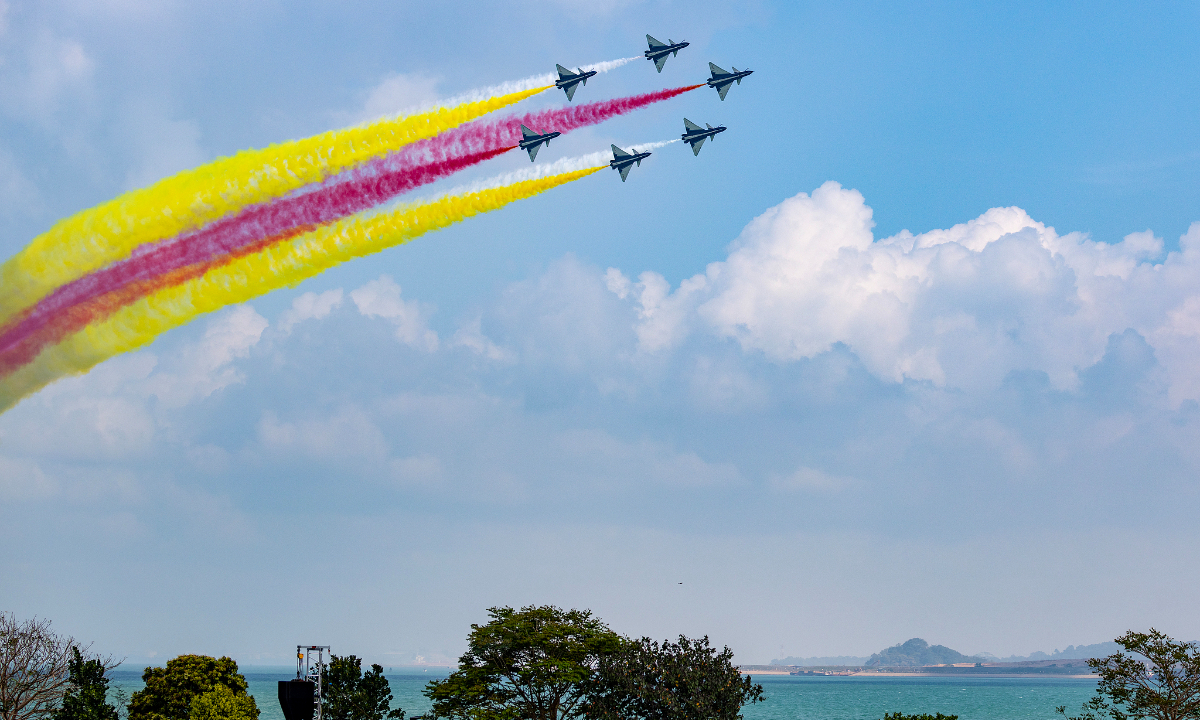
On the morning of February 17, after completing their mission at the Singapore Airshow, the Bayi Aerobatic Team of the PLA Air Force took off from Changi Airport in Singapore and flew directly back to China with the support of Y-20 tankers. The entire process was covered live by CCTV's military channel, showing seven J-10 series fighter jets completing a single refueling mission over a distance of over 4,000 kilometers.
Media reports focused on the word "first"—the first time participating in an overseas airshow in combat formation, the first time implementing non-stop aerial refueling over the South China Sea, and so on. These are indeed facts. However, I am concerned about another question: how many Y-20 tankers were involved in supporting the seven J-10s flying non-stop to Singapore? How many of these aircraft does China currently have?
The Real Numbers Behind the Tankers
The Y-20 tanker variant (officially designated YY-20, sometimes referred to as Y-20U) is a large aerial refueling aircraft modified from the Y-20B platform, featuring a "dual-door hose" design similar to the European A330MRTT, capable of refueling multiple aircraft simultaneously. The issue with this aircraft is not its performance, but its quantity.
According to an assessment by Aviation Week in 2023, the annual production capacity of the Y-20B production line at Xi'an Aircraft Industrial Group is about six aircraft, and based on current market forecasts, this production line is expected to continue until 2032, at which point the total number of tankers may reach 75. Note that this is a 2023 forecast, an optimistic estimate, and a figure that will only be realized by 2032.
And now it is early 2026.
Public satellite images show that by the end of 2024, the confirmed number of operational Y-20 tankers is around 15, with some analysts estimating it to be no more than 20. The PLA Air Force's current large tanker fleet also includes about 12 aging Il-78s and over ten H-6 modified tankers. Combined, these three systems total around 40 aircraft.
In contrast, the U.S. Air Force has over 400 active KC-135 and KC-46 tankers. This is not just a gap in numbers; it is a difference in magnitude.
What the Mission of Seven J-10s Means in Wartime
The Singapore Airshow is a peacetime demonstration mission, with ample time, a defined flight path, and carefully arranged support. The Y-20 can be specifically prepared for these seven J-10s.
However, if this scenario were to change to a real combat strike in the Taiwan Strait, the situation would be completely different.
The J-20 has a maximum range of about 2,000 kilometers without external stores, and its combat radius with weapons is around 1,100 kilometers. The distance from the Eastern Theater Command's forward bases to the airspace over Taiwan is not an issue and does not require refueling. But if the mission target is deep within the first island chain—towards Okinawa, Kadena, or Guam—or if long-duration air suppression of air defense systems is needed in a Taiwan conflict, the role of tankers becomes indispensable.
It is worth noting that currently, there are still few publicly available cases of the Chinese Air Force's practical refueling training in the island chain direction. In December 2025, during the "Falcon Shield-2025" joint exercise between China and the UAE, the combination of J-10s and Y-20s appeared for the first time in an external training scenario, marking a technical validation point that indicates this combination has operational support capabilities. However, validating capabilities and providing bulk operational support are two different issues.
Production Capacity is the Strategic Boundary
The strategic value of military equipment is not determined by a single sample but by how many can be produced and how long they can be sustained.
The current production rate of the Y-20 tanker variant is about six aircraft per year. At this rate, by the end of 2028, there could be around 30 aircraft in service. In simple terms, in the coming years, the PLA Air Force will still be in a phase of "precious resources" rather than "mass tools" for long-range refueling support. Once Y-20 tankers need to be deployed in multiple directions—air support for South China Sea islands, anti-access in the East China Sea, potential Taiwan missions—the question of how many operational directions 15 to 20 aircraft can simultaneously support becomes very real.
Those with an engineering background find it hard not to calculate these numbers when looking at military equipment. The direct flight of seven J-10s to Singapore showcases a technical capability in a single scenario. It looks impressive, but the true boundary of strategic air power is defined by the refueling capacity of tankers, not by the flight paths of the demonstration team.
Can Xi'an Aircraft Industrial increase the annual production capacity of the Y-20B from six to ten or even higher? This depends on engine deliveries (the production capacity of the WS-20 is another topic), the supply chain for aluminum alloy composite materials, and the timeline for factory production line expansions. These numbers are more worth watching than the flight demonstrations at airshows.
The Unasked Question
After the Singapore Airshow, there has been an overwhelming amount of analysis regarding China's participation, mostly focusing on the technical specifications of the J-35A and the export potential of the J-10CE. However, no one has directly asked the question: how many large tankers does the PLA Air Force currently have that can support long-range operations, and when will this number reach a true level of bulk operational support?
In my view, this number speaks more to how far the Chinese Air Force is from becoming a "strategic air force" than any flight demonstration.
Source references: Aviation Week's 2023 assessment of the Y-20 series; CCTV military channel's report on the J-10's participation in the Singapore Airshow (January-February 2026); Reuters' report on the Singapore Airshow (February 2026); public reports on the "Falcon Shield-2025" joint exercise
On February 17, 2026, seven J-10 aircraft from the People's Liberation Army Air Force flew non-stop from Singapore to China, supported by Y-20 tankers. The operation showcased the PLAAF's aerial refueling capabilities, which are currently limited by the number of operational tankers. The report highlights the strategic implications of these capabilities in potential conflict scenarios, particularly in the Taiwan Strait region.
- 7 J-10 aircraft participated in the Singapore Airshow and flew back to China non-stop with Y-20 tanker support.
- The Y-20 tanker is capable of refueling multiple aircraft simultaneously.
- Current production capacity for Y-20 tankers is approximately 6 per year, with a projected total of 30 by 2028.
- The U.S. Air Force has over 400 operational tankers, highlighting a significant capability gap with China.
- The report emphasizes the strategic importance of aerial refueling capabilities for long-range operations.