
The Russian army resumed strikes on Kyiv after a pause — 160 drones and a signal to Washington in 2026
 Dmitri Volkov
The Russian army resumed strikes on Kyiv after a pause — 160 drones and a signal to Washington in 2026
The pause ended just as diplomacy did
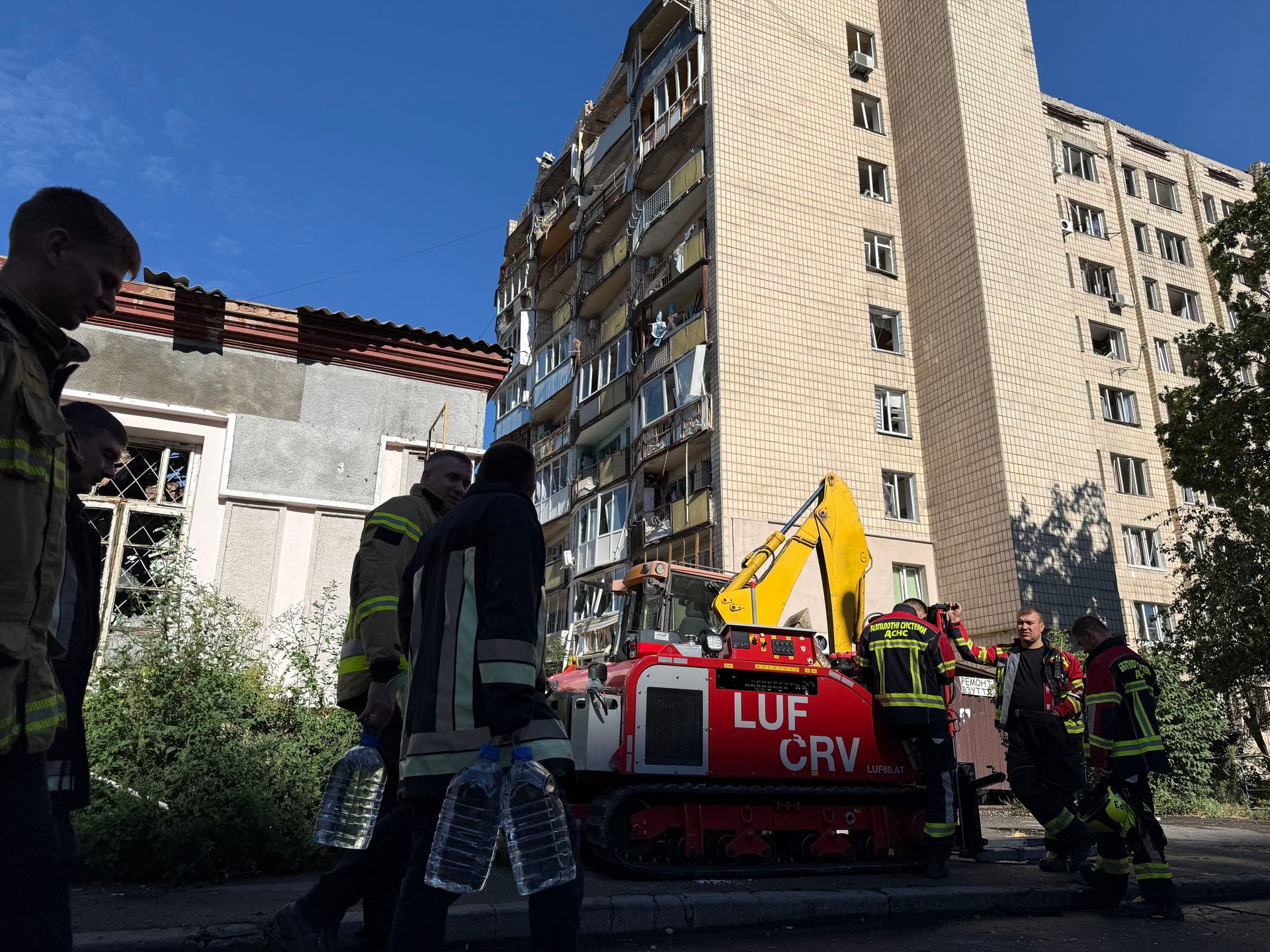
Five dead and 35 injured in Kyiv — this is the preliminary human toll of the Russian attack on September 8, following a brief pause in strikes. According to reports from Reuters, Al Jazeera, and Ukrainian authorities, Russian forces used dozens of missiles and more than 160 strike drones. The number is not the only important factor. The strike occurred just hours after the departure of American representatives who were discussing the resumption of negotiations, making it appear as a military message aimed simultaneously at Kyiv and Washington.
In Moscow, this will likely be described as a routine operation targeting military facilities. However, in modern warfare, the sequence of events sometimes speaks louder than the official wording. If the diplomatic window opens with the presence of American mediators and closes with a missile barrage, then the Kremlin demonstrates its own understanding of negotiations: it is not a process of mutual concessions, but a mechanism of pressure, where the intensity of fire should improve Russia's starting position.
What has changed on the battlefield
The Institute for the Study of War, in its assessment for September 8, presents inconvenient numbers for Russian rhetoric. From May 20 to November 20, 2025, Russian troops achieved a net advance of approximately 2,403.77 square kilometers, considering only confirmed occupation of territory. A completely different result is observed from March 8 to September 8, 2026: Russian forces lost 195.19 square kilometers of previously occupied territory, while the net advance amounted to 361.47 square kilometers when including infiltrations.
This does not mean that the front suddenly collapsed in favor of Ukraine. The Russian army retains numerical superiority, firepower, and the ability to replenish losses. However, the previous formula of continuous Russian offensives is no longer confirmed by the map. Ukraine's spring-summer counteroffensive operation in Alexandrovka, according to ISW estimates, liberated 26 settlements and over 745 square kilometers in the Donetsk, Dnipropetrovsk, and Zaporizhzhia regions. The Russian command still has not been able to capture Sloviansk, Kramatorsk, and Druzhkivka — nodes of the Ukrainian Fortress Belt.
It is this gap between statement and reality that explains the current intensity of strikes. When the ground army cannot quickly create a new reality, long-range weapons become a substitute for operational success. A drone is cheaper than a missile, but in mass use, it overloads air defense, forces the expenditure of expensive interceptors, and makes civilian infrastructure live in a state of constant anticipation.
Operational goal and political calculation
On the night of September 8, Russian missiles and drones targeted not only individual objects but also the rhythm of the capital's functioning. The strike on the building of a Ukrainian television channel, reported by the Committee to Protect Journalists, shows that information infrastructure is also included in the Russian understanding of military objectives. This does not necessarily mean preparation for an immediate ground operation. Rather, it is about gradually increasing the cost of Ukrainian governance, communication, transport, and urban life.
There is a second layer. On the same day, Vladimir Putin spoke with Donald Trump, and the Kremlin claimed that the Russian president presented an objective picture of the front and confirmed the absence of aggressive intentions towards Europe. The incompatibility of these two messages is striking. A state that launches a massive strike on the capital of a neighboring country just hours after diplomatic contact suggests that partners should separate words from actions. For negotiation tactics, this is not a mistake but a calculation: to publicly maintain a language of peace while proving militarily that the cost of rejecting Russian terms will increase.
A pause in fire for the Kremlin is not an obligation but a service that can be terminated the moment the mediator leaves the negotiating table.
This scheme resembles Soviet negotiation practices in wartime, but with an important caveat. The USSR had industrial depth and a more stable command structure. The Russian system of 2026 is forced to compensate for limitations with a mass of drones, imported components, and the adaptation of commercial technologies. The more frequently cheap drones are used in conjunction with a limited stock of ballistic missiles, the stronger the dependence of the outcome on the state of Ukrainian air defense and Western supplies.
Why frontline statistics are more important than Kremlin optimism
ISW notes that Russian officials continue to speak of Ukraine's deteriorating situation and the possible tightening of peace conditions. But if over six months Russia achieves only limited advances while simultaneously losing previously occupied areas, then the demand for Ukrainian capitulation is not a consequence of military inevitability. It is a political bet that Washington will accept the Russian version of the front faster than independent maps can refute it.
Ukraine, on the other hand, continues to insist on a trilateral format involving the US and Russia as early as September or October. The Kremlin has previously delayed such meetings, offered a lower level of representation, or returned the conversation to the initial demands of 2021-2022. This is the strategic crossroads. Kyiv is trying to turn negotiations into a mechanism for verifying real conditions, while Moscow seeks to use it as a channel for legitimizing results that it has not yet been able to achieve on the battlefield.
Forecast
In the coming weeks, continued strikes on Ukrainian cities should be expected, especially at moments when American diplomacy transitions from visits to specific dates for negotiations. The Russian army has not abandoned its offensive in Donbas, but its long-range campaign now serves a dual function — exhausting Ukrainian defenses and creating a sense of urgency for mediators. If the US does not link the negotiation calendar to a verifiable ceasefire and independent monitoring, each new pause will remain just an interval for the next barrage. The Russian military machine will retain the ability to deliver painful strikes, but this does not yet prove its ability to impose a political outcome on Ukraine in the war.
Sources: Reuters, September 8, 2026; Al Jazeera, September 8, 2026; Institute for the Study of War, Russian Offensive Campaign Assessment, September 8, 2026; Committee to Protect Journalists, September 8, 2026.
Russian forces resumed airstrikes on Kyiv on September 8, 2026, utilizing over 160 drones and dozens of missiles, resulting in five fatalities and 35 injuries. This attack followed a brief pause in strikes and coincided with the departure of U.S. diplomats, indicating a strategic military message. The strikes targeted both military and civilian infrastructure, reflecting a dual operational goal of exerting pressure on Ukraine and signaling to the U.S.
- Russian forces resumed airstrikes on Kyiv on September 8, 2026.
- The attack involved over 160 drones and dozens of missiles.
- Five people were killed and 35 injured in the strikes.
- The strikes occurred shortly after U.S. diplomatic discussions ended.
- The operation is seen as a message to both Kyiv and Washington.