
The US Army's 2027 Taiwan Plan Still Cannot Move Enough Firepower
 Marcus Chen
The US Army's 2027 Taiwan Plan Still Cannot Move Enough Firepower
Fifty Chinese vessels operating across the western Pacific is the kind of number that changes a staff briefing. It does not prove an invasion is coming. It does prove that Taiwan, Japan, and the Philippines would have to track a large, distributed maritime problem before the first missile launch. That is why recent US Army Pacific planning for a possible 2027 China-Taiwan conflict matters. The plan is a readiness signal, not a war date. Its weakness is that it describes an operating concept faster than the United States can move the ammunition and launchers to execute it.
What the 2027 Planning Signal Actually Says
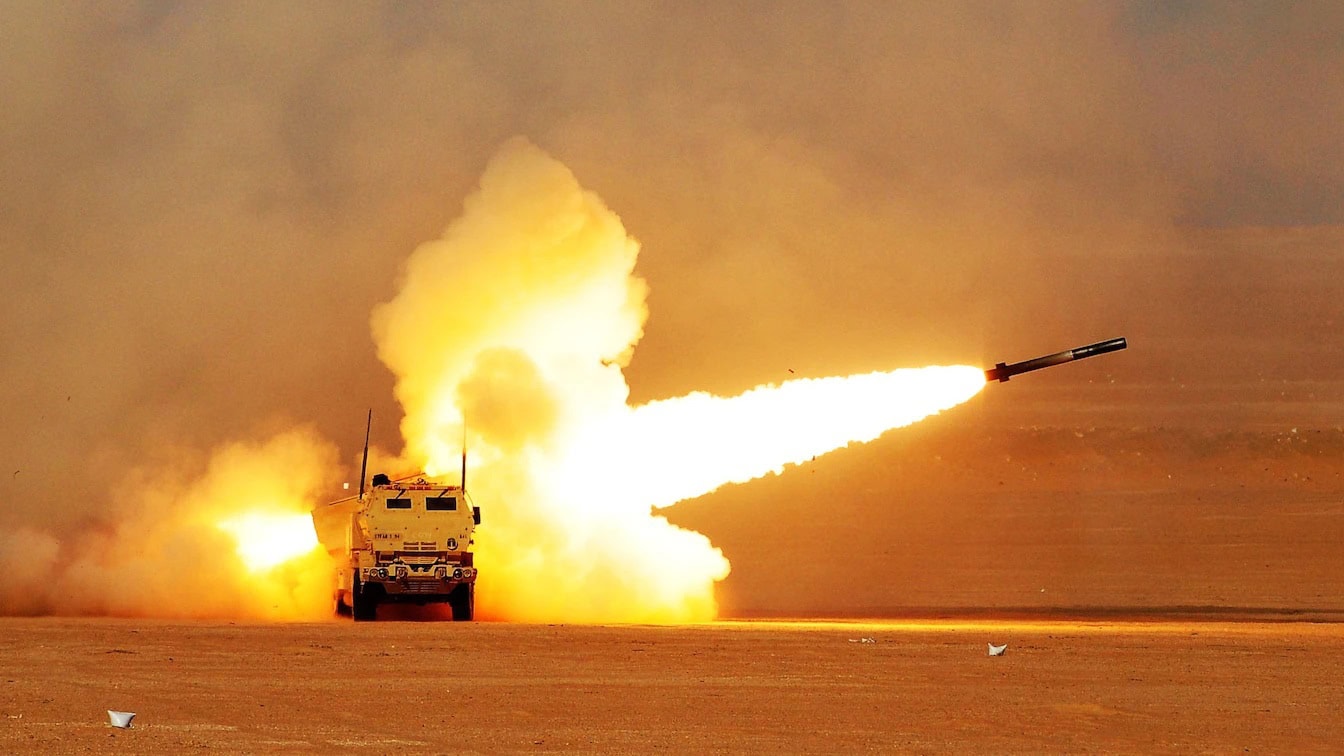
Taipei Times and Stars and Stripes reported in late October that Army Pacific was outlining deployments for the possibility of a 2027 conflict. Breaking Defense separately reported that the command still treats the 2027 window as valid. The important point is not that commanders have selected a launch date. It is that the Army is planning around a theater in which ports, airfields, and fixed headquarters could be attacked from the opening hours.
That pushes the Army toward distributed operations: smaller headquarters, mobile launchers, pre-positioned stocks, and units able to relocate after firing. The central tools are familiar. The M142 High Mobility Artillery Rocket System (HIMARS) can carry one Army Tactical Missile System (ATACMS) or a six-round Guided Multiple Launch Rocket System pod. The Precision Strike Missile (PrSM) is intended to extend ground-launched fires beyond ATACMS, with an advertised range above 400 kilometers in early increments. Those systems can threaten air-defense nodes, missile batteries, airfields, and ships inside a contested maritime zone.
Range Is Not the Same as Combat Power
A launcher with a 400-kilometer missile is only useful if the Army can find the target, transmit a valid firing solution, protect the launcher, and replace the round. In Taiwan contingencies, all four steps are difficult. Chinese aircraft, satellites, cyber units, and maritime militia could pressure the sensor network. A launcher operating from the Philippines would face political and geographic limits. A launcher on Taiwan would face immediate counterfire. The weapon's range is the easy number.
The harder calculation is magazine depth. A HIMARS battery may be able to fire rapidly, but its crew cannot reload without trucks, cranes, protected roads, and a functioning port or air bridge. PrSM production is expanding, yet the United States is also rebuilding stocks consumed by European support and preparing for other theaters. If Washington sends a small number of launchers but cannot sustain them for weeks, it has created a demonstration force rather than a denial network.
That distinction matters because Beijing does not have to destroy every American launcher. It only has to disrupt the fuel, reload, maintenance, and targeting chain long enough to make commanders conserve missiles. In a campaign measured in days, a force that can fire on day one but not day ten is a political signal with a short shelf life.
The Geography Makes the Concept More Expensive
Army Pacific's plan also runs into the first island chain's geography. Taiwan is close enough to China for rapid missile attack and far enough from the continental United States to make replenishment slow. The Philippines offers access and depth, but its islands do not automatically provide hardened storage, dispersed roads, or permissive rules for every firing mission. Japan brings better infrastructure and sensors, but any US use of Japanese territory would carry escalation and alliance-management costs.
The answer cannot be a single permanent base. It has to be a network of temporary positions, deception sites, commercial logistics, and allied magazines. That is expensive before a crisis and fragile during one. The Army's 2027 planning is therefore as much an industrial and diplomatic test as an operational one.
What Washington Should Measure Now
- Days of fire: how many HIMARS and PrSM rounds can reach a threatened unit after the first reload cycle?
- Targeting continuity: can allied sensors produce usable data after satellites, communications nodes, and airfields are attacked?
- Mobility: can launchers move between prepared sites without relying on one port, road, or runway?
- Alliance access: have Japan and the Philippines agreed in advance on storage, dispersal, and wartime replenishment?
Reuters' reporting on more than 50 Chinese vessels spread across regional waters showed why these questions cannot be reduced to a Taiwan-only map. A crisis would involve the Philippine Sea, the East China Sea, and the approaches to Japan at the same time. Every extra axis consumes missiles, tankers, escorts, and maintenance capacity.
The Readiness Deadline Is Real, But It Is Not 2027
The 2027 warning has value because it forces the Army to plan against a calendar rather than an abstraction. But the real deadline is earlier: the day when fuel, missiles, access agreements, and targeting links must already be in place. The United States can announce a distributed fires concept in an afternoon. It cannot manufacture years of missing stockpiles or negotiate access after the shooting starts.
Army Pacific is right to plan for 2027. The question is whether Washington is willing to fund the unglamorous parts of that plan: reloads, trucks, hardened storage, maintenance crews, and allied infrastructure. Without them, HIMARS and PrSM provide reach without endurance. In the western Pacific, that is not sea denial. It is a first salvo.
Sources: Reuters, October 29, 2026; Taipei Times, October 29, 2026; Stars and Stripes, October 28, 2026; Breaking Defense, October 29, 2026.
The U.S. Army is preparing for a potential conflict in Taiwan by 2027, focusing on operational readiness amid the presence of fifty Chinese vessels in the western Pacific. The Army's strategy emphasizes distributed operations and the use of systems like HIMARS and PrSM, but logistical challenges may hinder effective deployment. The geographical complexities of the region further complicate U.S. military operations, necessitating a network of temporary positions and allied cooperation.
- The U.S. Army is planning for a potential conflict in Taiwan by 2027.
- Fifty Chinese vessels are operating in the western Pacific.
- The U.S. Army's operational concept may exceed its logistical capabilities.
- The HIMARS and PrSM systems are central to U.S. military strategy in the region.
- Geographical challenges complicate U.S. military operations in the Pacific.