

The United States Navy designed the Constellation-class frigate to provide the fleet with a relatively affordable, modern surface combatant without requiring another multibillion-dollar destroyer.
The program was supposed to show the Navy had turned a corner in developing new warships.
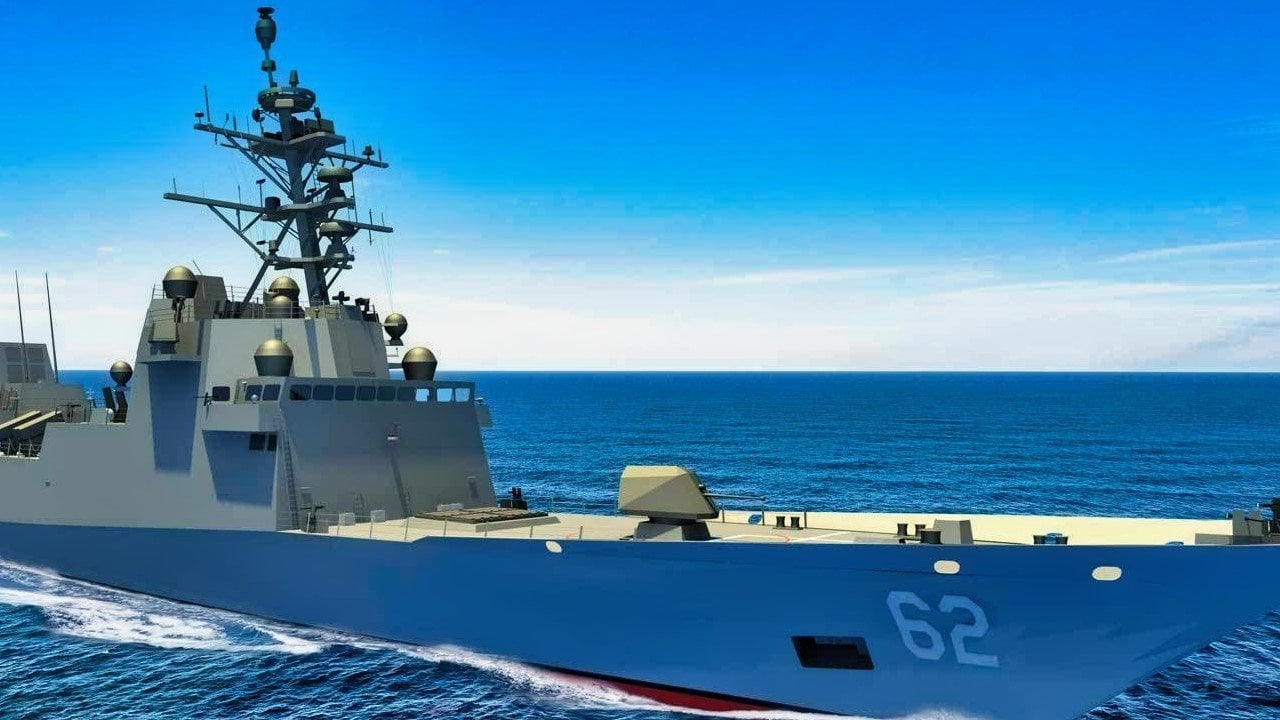
Constellation-Class Frigate. Image Credit: Creative Commons.
Yet, the program quickly became a dangerous reminder of how wasteful and inefficient the Pentagon’s acquisitions department has gotten.
The original plan for the Constellation-class frigate was blessedly simple.
The Navy planned to use the European Multi-Mission Frigate (FREMM) as the basis for its next Constellation-class frigate.
That design was already in use by the French and Italian navies.
So it would have been a cheap, efficient program.
Like Something Out of a Comedy
What started as an adaptation increasingly resembled a new shipbuilding project. The Navy changed the design.
The Navy then added displacement.
The Pentagon even authorized construction before engineers finished their work.
In fact, only 87 percent of the ship’s blueprints were completed. Despite that, the Navy ordered construction to begin.
The entire affair reads like a comedy.
Except it isn’t a comedy.
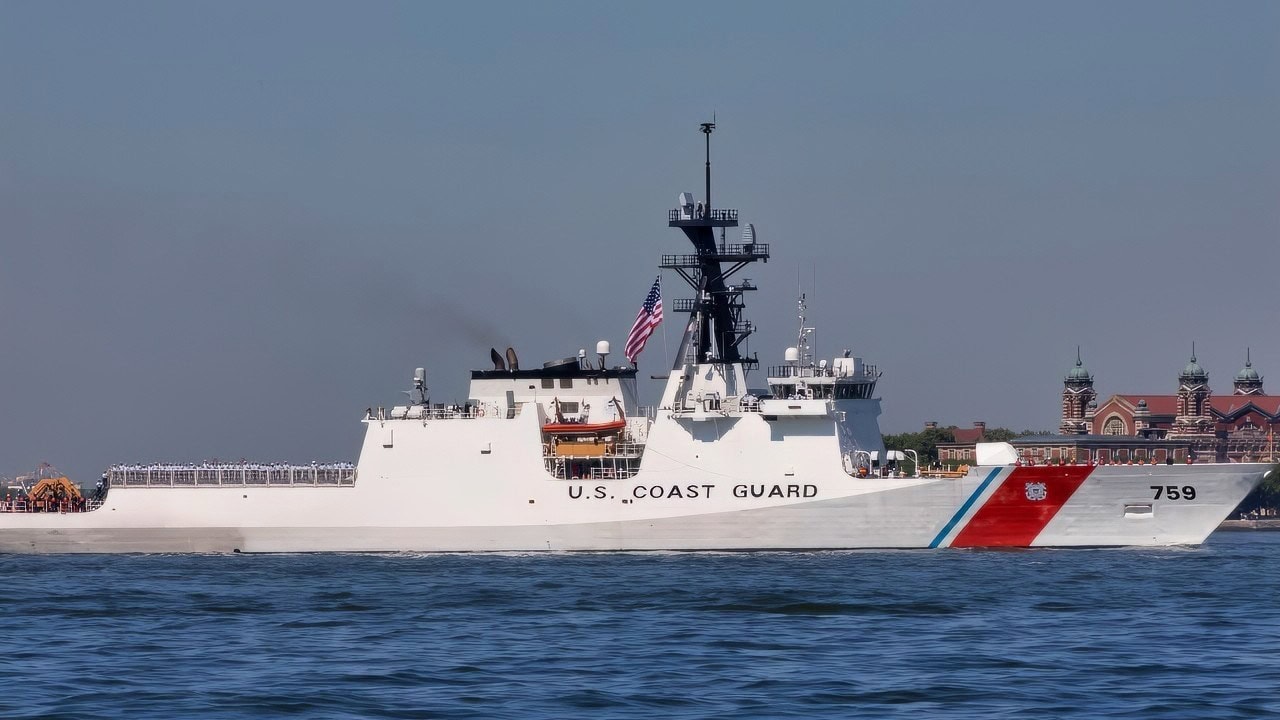
NEW YORK (May 22, 2024) The USCGC Calhoun (WMSL 759) sails in for Fleet Week New York, May 22. Navy and Coast Guard ships arrived in New York marking the beginning of Fleet Week New York. Fleet Week New York is a time-honored sea service celebration that allows citizens of New York City and the surrounding tri-state region to witness today’s maritime capabilities first-hand. The 2024 celebration will host nearly 3,000 Sailors, Marines, and Coast Guardsmen. (Mass Communication Specialist 3rd Class Leah Moore)
It’s very serious. The failure of the Constellation-class frigate stems entirely from the defense bureaucracy’s Byzantine inefficiency.
The program was ultimately canceled a year ago.
Because of that cancellation, the Navy is now scrambling to plug a very large (and growing) gap in its surface warfare fleet.
In the final months of the Trump administration’s first non-consecutive term, the Navy awarded Fincantieri Marinette Marine a contract to develop and build the Navy’s new, much-needed frigate.
The original acquisition program called for as many as 20 ships, with a combined projected cost exceeding $22 billion.
The goal was not only to cut costs by using a proven design, like the FREMM frigate, but also to increase interoperability between the US Navy and its European NATO partners by using a frigate with 85 percent commonality with the Italian FREMM, limiting modifications to around 15 percent.
But those numbers soon reversed, as the Navy couldn’t leave well enough alone.
The Navy went out of its way to impose so many changes on the overall design that it not only exceeded that 15 percent differential significantly, but the frigate basically became an entirely new warship.
These changes were not merely cosmetic.
Too Big to Float
The Navy wanted tougher survivability standards and better damage-control arrangements.
As a result, the Navy demanded that the warship’s internal spaces be redesigned, which in turn necessitated a fundamental redesign of the topside configuration.
That was on top of unique specifications for the American AN/SPY-6(V)3 Enterprise Air Surveillance Radar, the Aegis Baseline 10, and a 32-cell Mk 41 Vertical Launch System (VLS).
Here again, the Navy’s requirements, on top of the actual structural changes (that were never planned for), negatively impacted weight distribution, the structural engineering, electrical arrangements, and the ship’s overall dimensions.
What was supposed to be a relatively effortless plug-and-play program for the US Navy to quickly replace its aging frigate fleet with an Americanized European frigate became a complex redesign of a proven platform into a freakish hybrid of a European structure with massive American overlays.
In May 2024, the Government Accountability Office (GAO) determined that the ship was too big to function.
The GAO conducted follow-on investigations and determined that the Navy’s additions to the original design would have made the ship functionally unfeasible. Before the second Trump administration ultimately canceled the program last November, the Navy considered relaxing the weight growth limits.
A Slow-Rolling, Taxpayer-Funded Disaster
But that left little room for modernization over the Constellation-class frigate’s life.
Ultimately, that would have left the Navy saddled with a frigate that was, from an engineering perspective, unfeasible and, from a modernization angle, useless.
Now, the Navy is looking to replace the canceled Constellation-class with an upgraded variant of the Coast Guard Legend-class National Security Cutter.
Known as the FF(X) program, Huntington Ingalls Industries (HII) has already been contracted to build it.
The Navy has allocated $283 million for early work on the new system, and the design had already passed its critical design review earlier this month.
This would be an excellent change from what came before.
Of course, one cannot help but be saddened by how much taxpayer money was wasted on what was ultimately a dead end with the Constellation-class (not because it was technologically infeasible, but because the Pentagon mucked up its own desire for a relatively cheap, easy procurement project).
About the Author: Brandon J. Weichert
Brandon J. Weichert is the Senior National Security Editor at 19FortyFive.com. He also manages The Weichert Brief on Substack. Weichert also hosts “National Security Talk” on Rumble. He is the author of four bestselling national security books, most recently A Disaster of Our Own Making: How the West Lost Ukraine (Encounter Books). Follow him via Twitter/X @WeTheBrandon.