
Summary and Key Points: The USS Gerald R. Ford (CVN-78) is approaching a post-Vietnam record with a projected 300-day deployment as it moves to the Middle East to counter Iran.
-Following high-intensity exercises in the North Sea—where a Russian Yasen-class submarine carrying Zircon hypersonic missiles shadowed the strike group—and missions in the Caribbean against the Maduro regime, the supercarrier faces significant maintenance backlogs.
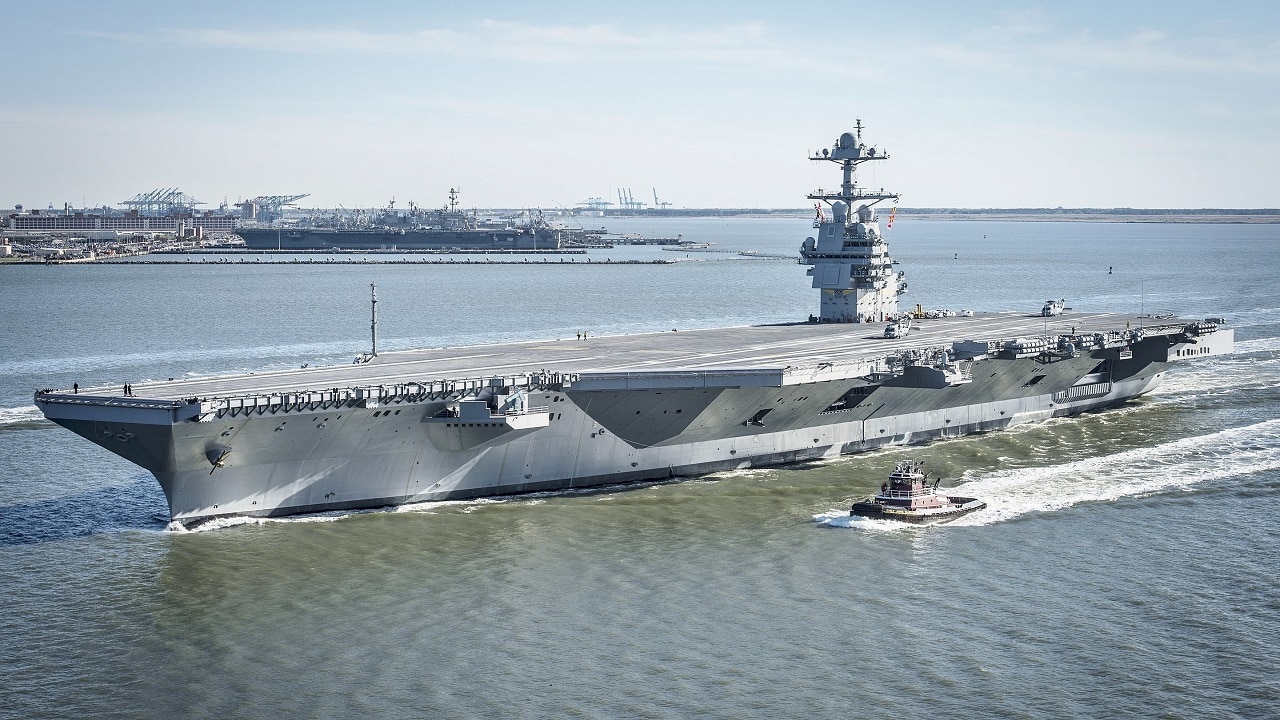
The U.S. Navy aircraft carrier USS Gerald R. Ford (CVN-78) underway under her own power for the first time while leaving Newport News Shipbuilding, Newport News, Virginia (USA), on 8 April 2017. The first-of-class ship – the first new U.S. aircraft carrier design in 40 years – spent several days conducting builder’s sea trials, a comprehensive test of many of the ship’s key systems and technologies. USS George Washington (CVN-73) and the amphibious assault ship USS Kearsarge (LHD-3) are visible in the background.
-A systemic shipbuilding crisis, exacerbated by the deactivation of the USS Nimitz before the arrival of the USS John F. Kennedy (CVN-79), leaves the U.S. Navy with a critical power projection gap during a period of escalating global instability.
Why the $13 Billion USS Gerald R. Ford Iran Deployment Is Unsustainable for the U.S. Navy
As the situation with the Islamic Republic of Iran drastically deteriorates, the Trump administration continues to deploy massive numbers of US forces into the Middle East, clearly preparing for any contingency once the talks between American and Iranian diplomats likely fail.
A Record Supercarrier Deployment—Or a Warning Sign?
One interesting statistic is that nearly one-third of the entire United States Navy’s force is now deployed to the Middle East against Iran.
Specifically, one major new platform introduced to this growing armada of US Navy warships is the USS Gerald R. Ford(CVN-78). But this isn’t just another deployment of the newest aircraft carrier in the American fleet. This marks the third-longest deployment of any US aircraft carrier ever.
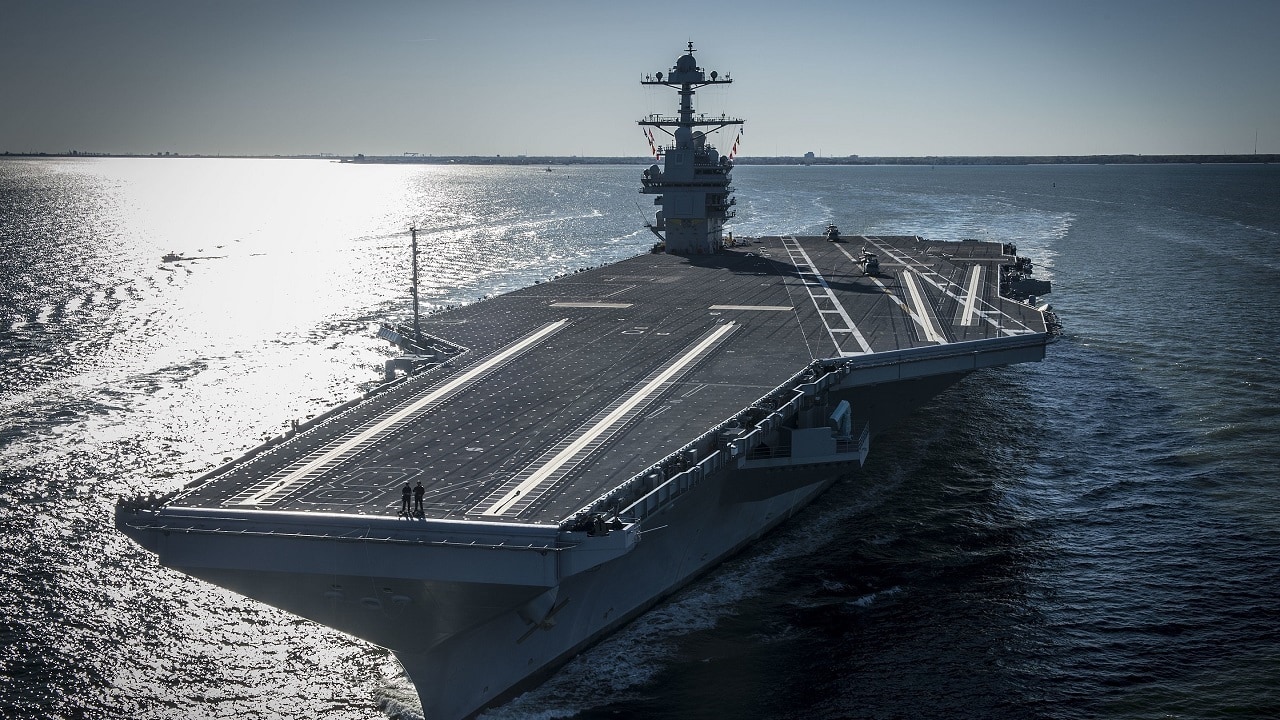
The U.S. Navy aircraft carrier USS Gerald R. Ford (CVN-78) underway on its own power for the first time. The first-of-class ship — the first new U.S. aircraft carrier design in 40 years — spent several days conducting builder’s sea trials, a comprehensive test of many of the ship’s key systems and technologies.
Fears now abound that the $13 billion USS Gerald R. Ford, having operated continuously since June 24, 2025 (around 238 days), could remain deployed until May (making it around 300 days underway), and is at risk of being stretched to its breaking point.
Writing in Forbes recently, Peter Suciu highlights that CVN-78’s record-breaking deployment could surpass most post-Cold War carrier deployments. This, at a time when the Navy is set to deactivate the USS Nimitz at least a year-and-a-half before its replacement, the USS John F. Kennedy (another carrier in the new Ford-class) is set to replace it.
At that time, the Navy will be facing major strain on its aircraft carrier fleet, its primary power projection platform for surface warfare, as it juggles these conflicts around the world with fewer systems available.
Since its deployment last summer, the Ford has been in the North Sea and the Mediterranean Sea, conducting intense training exercises (in the North Sea) which saw a Russian Yasen-class submarine armed with Zircon hypersonic cruise missiles get dangerously close to the carrier. In the Mediterranean, the new carrier conducted extended deterrence patrols.
Then, the Ford was sent over to the Caribbean, where it served as the flagship for the US military force that attacked Venezuela and ran constant drug interdiction missions as part of the Trump administration’s wider effort to destabilize the outlaw regime of Nicolas Maduro.
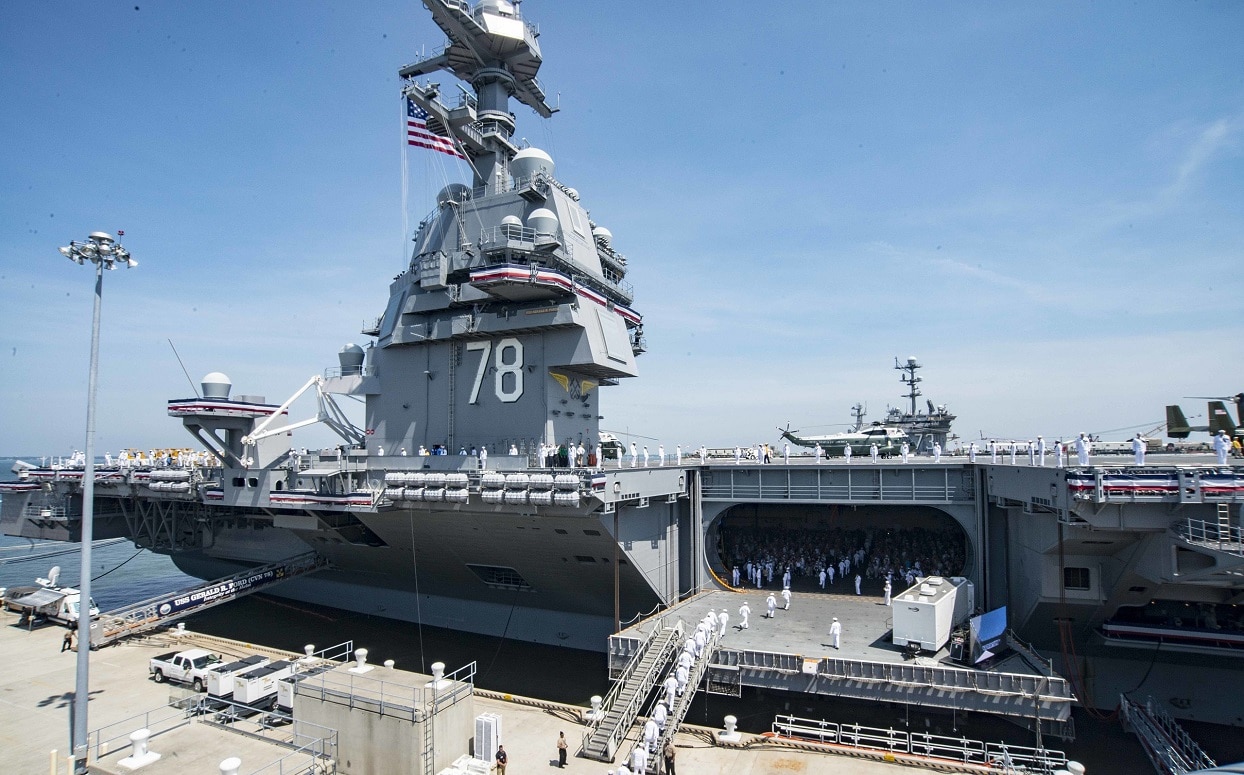
Gerald R. Ford-class. Image: Creative Commons.
Now, the technological leviathan is on its way to the Middle East, where it will support the pressure campaign against Tehran.
Too Few Ships, Too Many Crises for the U.S. Navy
The issue is that the Navy is using the Ford as a global crisis response asset because, as noted above, there aren’t enough available carriers. In other words, the US Navy is in a major shipbuilding crisis, at a time when those ships are needed more than at any other time since the end of the Cold War.
While the media is fixated on the Ford’s recent record-breaking deployment as being a rarity, the fact is that these extended deployments that put much wear-and-tear on these complex, expensive carriers, and strain their massive crews, is likely to become the new normal for the Navy until they can figure out how to make do with fewer ships in their fleet at a time when so many crises are supposedly demanding the presence of these ships globally.
We are rapidly approaching Vietnam War-era levels of deployment, which is problematic because the carriers and their crews then experienced significant maintenance issues and severe crew burnout.
This is entirely unsustainable, and the Navy seems preternaturally incapable of recognizing that its preference for big carriers is insufficient, given the very real constraints on the branch due to the declining state of America’s naval shipyards and overall defense industrial base.
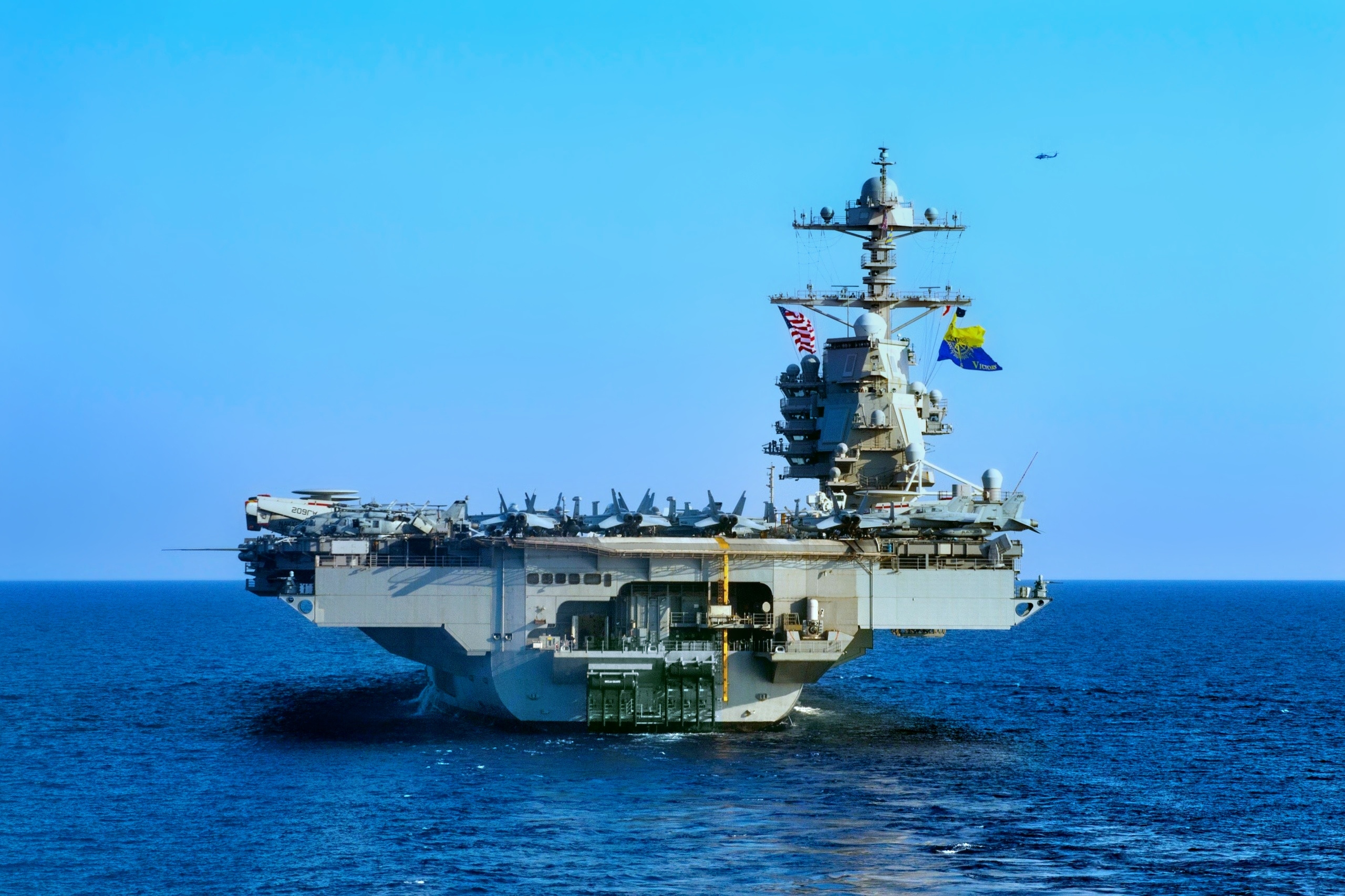
Ford-Class Aircraft Carrier. Image Credit: Creative Commons.
The Industrial Base is the Real Weak Link for the Supercarrier
The USS Gerald R. Ford isn’t just overworked in this specific instance. It’s evidence that the US has clearly entered a war footing without the fundamental industrial and military requirements to wage such a war successfully. And there is no way out of the current predicament we are in. These are systemic bottlenecks that cannot be overcome in the near term.
In other words, there are no real solutions to the problems of a stretched carrier force that is being undercut by the declining American defense industrial base and failing naval shipyards. And it will take too long to restore those industrial capabilities, especially with the international system buckling now.
America will lose the next major war it fights. Come to think of it, the US might very well lose an aircraft carrier—with no viable replacements in the offing anytime soon, thanks to advances in anti-ship missile capabilities and the proliferation of those systems to a variety of American rivals.
An America First Test the Navy Can Pass
Rather than throwing caution to the wind and hoping US militarism works out, and risking the vaunted, strained carrier force, the Trump administration should do what the forty-seventh president vowed to do on the campaign trail in 2024: drastically reduce America’s global military commitments.
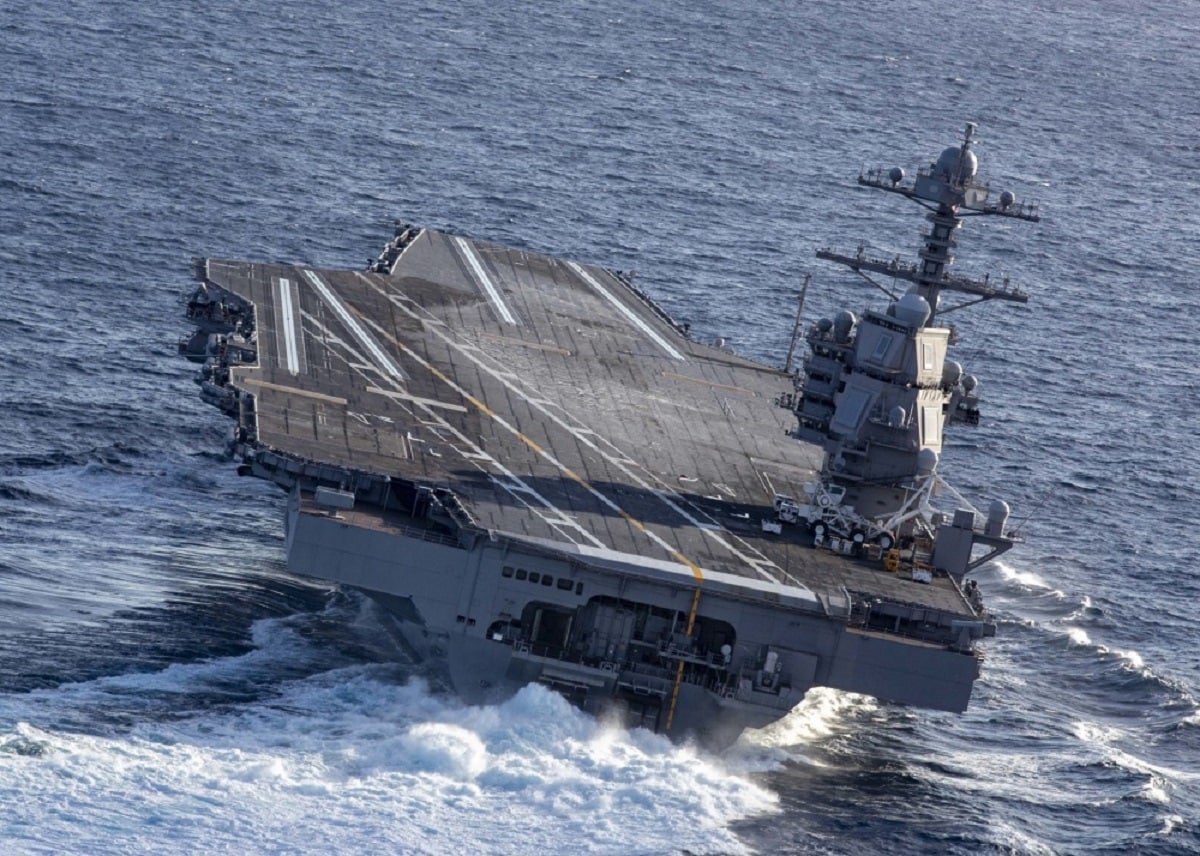
ATLANTIC OCEAN (Oct. 29, 2019) USS Gerald R. Ford (CVN 78) conducts high-speed turns in the Atlantic Ocean. Ford is at sea conducting sea trials following the in port portion of its 15 month post-shakedown availability. (U.S. Navy photo by Mass Communication Specialist 3rd Class Connor Loessin)
Why is it that the US military is effectively involved in an endless series of brush wars along the arc of distant Eurasia?
If America reduced its seemingly endless array of commitments built over the last century, that would provide relief for this overburdened and stretched force. It’s too bad the president doesn’t seem interested in keeping his campaign promise to put America First. Hopefully, the crew of the Ford or another carrier doesn’t pay the price for this failure.
About the Author: Brandon J. Weichert
Brandon J. Weichert is the Senior National Security Editor at 19FortyFive.com. He was previously the senior national security editor at The National Interest. Weichert is the host of The National Security Hour on iHeartRadio, where he discusses national security policy every Wednesday at 8 pm Eastern. He hosts a companion show on Rumble entitled “National Security Talk.” Weichert consults regularly with various government institutions and private organizations on geopolitical issues. His writings have appeared in numerous publications, among them Popular Mechanics, National Review, MSN, and The American Spectator. And his books include Winning Space: How America Remains a Superpower, Biohacked: China’s Race to Control Life, and The Shadow War: Iran’s Quest for Supremacy. Weichert’s newest book, A Disaster of Our Own Making: How the West Lost Ukraine, is available for purchase wherever books are sold. He can be followed via Twitter/X @WeTheBrandon.