
The U.S.-Saudi Nuclear Agreement Breaks the "Gold Standard" and Harbors Regional Nuclear Proliferation Risks
After the energy sectors of the United States and Saudi Arabia announced on the 22nd that the two countries had signed a cooperation agreement for the peaceful use of nuclear energy, doubts about this agreement have continued to arise within the United States. On the 23rd, President Trump stated that for this agreement to take effect, Saudi Arabia must join the "Abraham Accords" and normalize relations with Israel. As of the 24th, the Saudi side had not yet responded to Trump's temporary "sweetener."
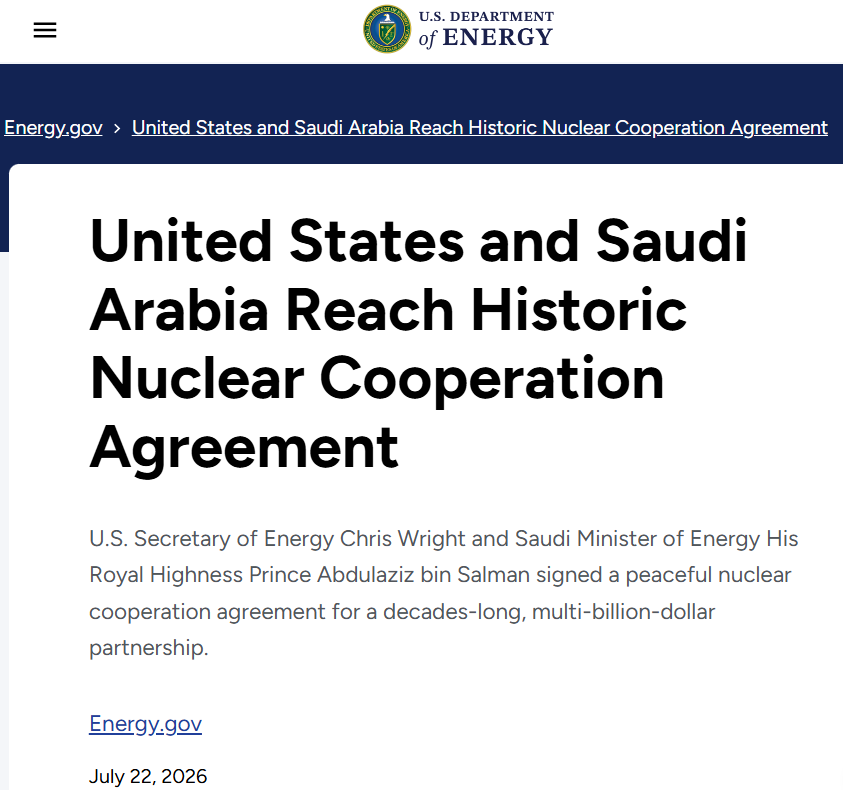
△ The United States and Saudi Arabia sign a nuclear cooperation agreement
However, from the widely reported content in the media, the agreement does not adhere to the "gold standard" established when the U.S. signed a nuclear cooperation agreement with the UAE in 2009, which means that the rules for U.S. nuclear cooperation in the Middle East are being redefined.
"Green light for Saudi Arabia to acquire uranium enrichment technology"
In 2009, when the U.S. cooperated with the UAE on nuclear energy, the UAE agreed to two conditions: first, to forgo domestic uranium enrichment and spent fuel reprocessing; second, to sign an Additional Protocol allowing the International Atomic Energy Agency (IAEA) to enhance safeguards and oversight. With these two layers of constraints, the nuclear energy agreement signed between the U.S. and the UAE was regarded as the "gold standard" for nuclear energy cooperation.
However, according to media reports, the nuclear energy cooperation agreement between the U.S. and Saudi Arabia lacks these two layers of constraints. Although the agreement has not been fully disclosed, U.S. media reports indicate that the agreement includes provisions allowing Saudi Arabia to conduct uranium enrichment activities domestically and leaves legal space for Saudi Arabia to develop nuclear fuel recycling in the future. Public opinion believes this "opens the door for Saudi Arabia to acquire uranium enrichment technology and engage in related activities," which may pose a risk of nuclear proliferation in the future.
What is even more concerning is that the agreement does not require Saudi Arabia to comply with the IAEA's Additional Protocol regarding verification, which means that the IAEA will find it difficult to implement comprehensive and effective oversight and verification of Saudi nuclear activities.
According to procedure, this agreement will be submitted to the U.S. Congress for review and approval.
U.S. commercial interests and strategic considerations
First, from a commercial interest perspective, Saudi Arabia's nuclear energy program involves reactors, nuclear fuel, components, operations and maintenance, safety standards, and talent training. Once U.S. technology is adopted, the nuclear industry system for the coming decades may be bound to the U.S. supply chain. The U.S. Department of Energy stated that this agreement will bring billions of dollars in economic benefits to the U.S. nuclear industry.
Secondly, from a strategic level, media and analysts point out that this agreement helps to further consolidate the U.S.-Saudi relationship, which has become tense due to the Iranian conflict, and strengthens Saudi Arabia's strategic dependence on the U.S. Analysts believe that through long-term deep technological integration in nuclear cooperation, the U.S. can maintain control over Saudi Arabia's nuclear program.
Finally, there are complex political considerations. The day after the agreement was signed, Trump stated that the U.S. would only continue to advance cooperation if Saudi Arabia joined the Abraham Accords and normalized relations with Israel. The nuclear non-proliferation standards are thus further instrumentalized: whether to grant sensitive nuclear capabilities seems to depend not only on proliferation risks but also on whether Saudi Arabia can meet U.S. diplomatic demands.
"Double standards" raise concerns about nuclear proliferation
Several Iranian media outlets quickly compared the U.S.-Saudi agreement with U.S. nuclear demands on Iran, arguing that this exposes Washington's double standards on nuclear non-proliferation issues.
Many former Israeli officials have publicly warned that uranium enrichment capabilities within Saudi Arabia could drive regional nuclear competition. UAE media have also made comparisons: the UAE clearly gave up domestic uranium enrichment and spent fuel reprocessing to obtain U.S. nuclear technology, while the conditions Saudi Arabia is receiving this time are clearly much more lenient.
Matthew Kroenig, a nuclear policy expert at the Atlantic Council, believes that allowing Saudi Arabia to acquire enrichment capabilities will weaken nuclear non-proliferation standards. The U.S.-Saudi nuclear cooperation agreement may not immediately trigger a nuclear arms race, but it could soon spark a competition over the "nuclear threshold." More and more countries are not directly manufacturing nuclear weapons but are competing to establish the technology, facilities, and talent reserves necessary to quickly cross that threshold when needed.
While the U.S. exchanges relaxed rules for commercial orders, strategic influence, and diplomatic leverage, it is also sending a dangerous signal to the entire Middle East: the red line of nuclear non-proliferation is not immutable; it depends on what conditions can be offered in exchange with the U.S.
When the rules are no longer applied equally to allies and adversaries, such an agreement resembles a move on the Middle Eastern nuclear chessboard, dropping a piece that has far-reaching implications and is full of uncertainties.
Reporter丨Wang Weiwei
The U.S. and Saudi Arabia signed a nuclear cooperation agreement on September 22, 2023, which permits Saudi Arabia to pursue uranium enrichment. This agreement has raised concerns about nuclear proliferation risks in the region, as it lacks the constraints found in previous U.S. nuclear agreements. President Trump indicated that Saudi Arabia must normalize relations with Israel for the agreement to advance.
- The U.S. and Saudi Arabia signed a nuclear cooperation agreement on September 22, 2023.
- The agreement lacks the 'gold standard' constraints established in previous U.S. nuclear agreements.
- The agreement allows Saudi Arabia to pursue uranium enrichment activities.
- President Trump stated that Saudi Arabia must normalize relations with Israel for the agreement to proceed.
- Concerns have been raised about potential nuclear proliferation risks in the region.