
TheMIS-Robots 2026 and Article 5 — Europe's Defense Industry Becomes a NATO Front
 Dr. Klaus Weber
THeMIS Robot 2026 and Article 5 — Europe's Defense Industry Becomes the NATO Front
When Estonia blamed the Russian intelligence service for an arson attack on Milrem Robotics at the end of September, it was not just about a damaged factory building in Tallinn. Milrem produces the unmanned ground robot THeMIS and supplies systems to the Ukrainian armed forces. A few days later, EU Defense Commissioner Andrius Kubilius stated that a Russian airstrike on a European defense factory could trigger a response under Article 5 of the NATO treaty. This sequence marks a turning point in security policy. Europe's defense industry is no longer merely part of the support for Ukraine. It is itself becoming a potential theater of war.
From Sabotage Case to Alliance Question
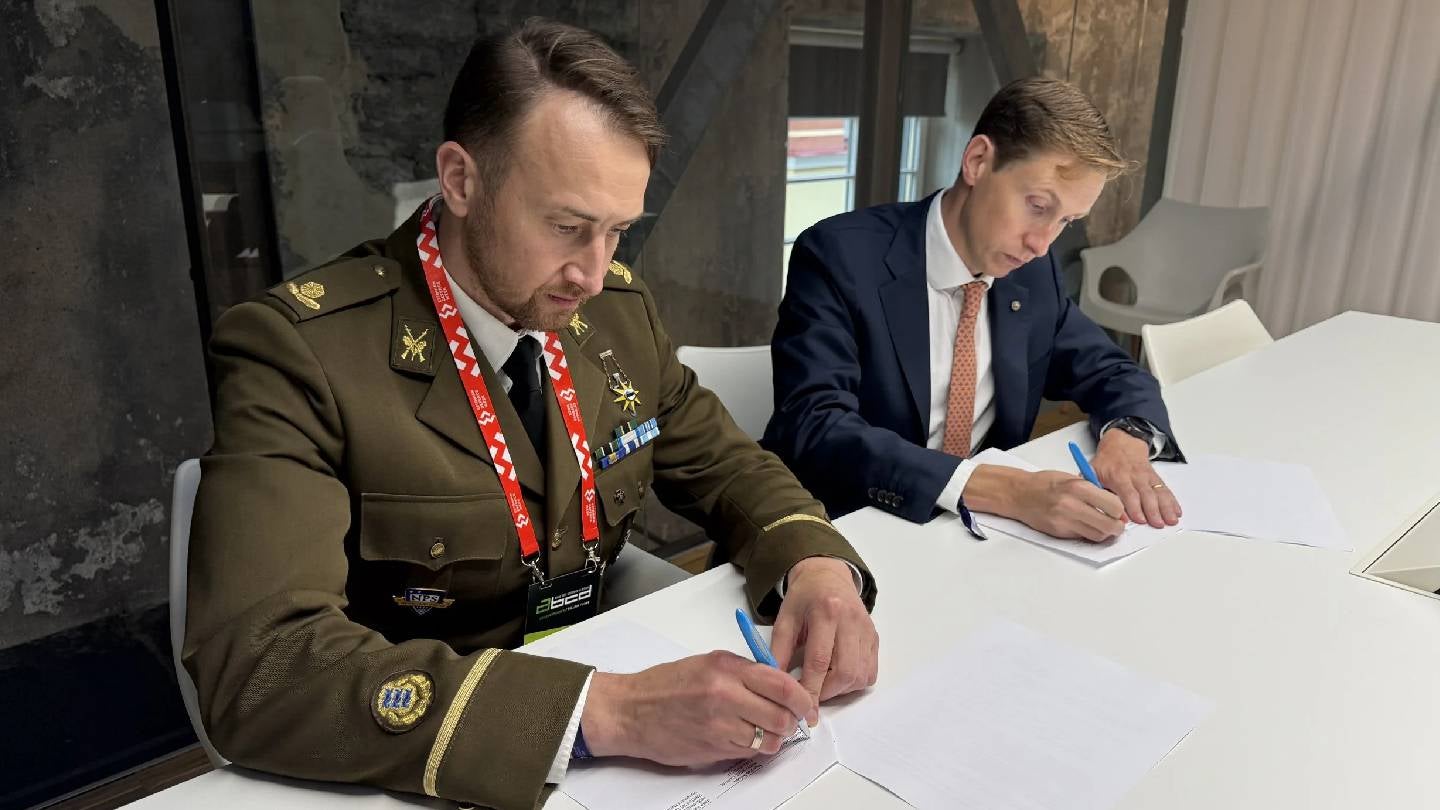
The Estonian authorities link the arson attack in August to Russian influence. Milrem Robotics was affected, a company whose THeMIS platform was developed for logistics, casualty transport, and armed reconnaissance. The public attribution is a political step, but not yet a judicial proof. For this reason, the debate should not be reduced to the question of whether Moscow actually issued the order. The crucial point is the new operational logic. An attack on a manufacturer can today weaken the Ukrainian front without Russian forces entering NATO territory with regular troops.
NATO Secretary General Mark Rutte warned in early October that the Russian hybrid campaign would continue and would not stop support for Ukraine. This is the right political message, but it does not answer the more difficult institutional question. When does a cyberattack, an arson attack, or an act of sabotage transition from a national criminal matter to an armed attack on the alliance? Article 5 is not an automatic war switch. It obligates allies to assist but leaves the nature and extent of that assistance open. This deliberately political construction creates deterrence as long as the adversary believes in a common response. However, it creates uncertainty when Europe publicly names its red line without defining procedures and capabilities.
Why the THeMIS Case is Strategically Larger
Milrem Robotics represents a part of the European defense industry that is easily overlooked in classic statistics. A THeMIS robot is not a Leopard 2 and not an air defense system. It does not carry the symbolism of a combat aircraft. Yet, such systems increasingly determine the sustainability of modern armed forces. Unmanned platforms reduce the risk to soldiers, extend the range of logistical operations, and can quickly relay targets to artillery in conjunction with drone reconnaissance. In Ukraine, it is not just the number of large weapon systems that matters, but the ability to permanently connect sensors, software, communication, and spare parts.
This also shifts the protection problem. A factory for robots, drones, or electronic components does not need to look like an air force base to be militarily relevant. Its vulnerability also lies not only in missile attacks. Sabotage, coercion of suppliers, disinformation, and digital interventions can disrupt production chains without immediately leaving a clear military signature. Europe's defense planning still too often treats hybrid threats as a separate chapter alongside conventional national defense. In reality, they now belong to the same value chain.
Article 5 as a Political Threat is Not Enough
Kubilius' statement serves an important function. It makes clear that an attack on the European defense base should not be dismissed as a problem of the affected company or the respective member state. However, the declaration remains incomplete as long as NATO does not formulate a common response logic. Would an arson attack in Tallinn reach the same political threshold as a cruise missile against a factory in Germany? What evidence would be required? Who would carry out the attribution? And how quickly could allies respond before the campaign moves on to the next company?
These questions are not legal trivialities. Deterrence only works if the potential aggressor can assess costs and response times. A completely open response can create flexibility but can also be interpreted as an invitation. Conversely, a completely precise red line would provide the adversary with guidance on how to remain below that threshold. Therefore, NATO and the EU need graduated instruments. These include joint forensic teams, a binding protection of critical defense sites, rapid sanctions against support networks, and the ability to compensate for production failures through redundant manufacturing in multiple member states.
The German Problem Lies in Implementation
For Germany, this debate is particularly uncomfortable. Berlin has been talking about higher defense spending and a capable European defense industry since the turning point. At the same time, approvals, procurement, and industrial scaling remain slow. Protecting a facility means not only financing a fence and additional guards. It means prioritizing power supply, cloud services, suppliers, transport routes, and spare capacities militarily. This is precisely where the gap between defense rhetoric and defense capability lies.
The European Union must also reassess its instruments. SAFE, the European Defense Fund, and PESCO can organize loans, research, and cooperation. However, they do not protect a production line and do not replace national security responsibility. The EU has financial instruments, while NATO has the more credible military deterrence. The THeMIS case shows that this separation no longer functions cleanly. A European factory can produce for Ukrainian defense, expand under EU funding, and still fall under NATO protection in the event of an alliance. Institutional responsibilities must no longer obscure this reality.
Europe's Paradoxical Front
The Russian strategy, if the Estonian attribution is correct, does not only target individual facilities. It tests Europe's political resilience. If a small arson attack does not trigger a response, the next operation can be planned more riskily. If every incident is immediately treated as an attack on NATO, Article 5 loses its strategic clarity. Europe thus faces a classic deterrence dilemma. It must treat its defense industry as part of collective defense without turning every uncertainty into an uncontrolled escalation.
The lesson from Estonia is therefore not that Europe should militarize every factory tomorrow. The lesson is that protection, attribution, and industrial redundancy must now be planned as a common defense problem. More money for weapons does not help if the production base remains unprotected. But even the strongest protective umbrella is of little use if European states do not decide in advance which attacks they want to respond to collectively. Europe's defense industry is becoming the NATO front. Whether it is credibly defended there will not be determined by the number of summit declarations, but by the speed of the first joint response.
Sources
- Defense News, September 29, 2026, on the Estonian attribution of the attack on Milrem Robotics.
- The Guardian, October 1, 2026, on the company's role as a supplier for Ukraine.
- Reuters, September 30, 2026, on Russian threats and tensions in the Baltic region.
- NATO, current statements from Secretary General Mark Rutte on the Russian hybrid campaign and support for Ukraine.
Milrem Robotics was attacked in Tallinn in September 2026, allegedly by Russian operatives, raising concerns about the security of European defense industries. This incident has implications for NATO's Article 5 response, as it blurs the lines between corporate security and military engagement. NATO Secretary General Mark Rutte warned of ongoing Russian hybrid campaigns, emphasizing the need for a unified response to such threats.
- Milrem Robotics was attacked, allegedly by Russian operatives.
- The attack raises questions about NATO's Article 5 response.
- The THeMIS robot is significant for logistics and military operations in Ukraine.
- NATO Secretary General warned about ongoing Russian hybrid campaigns.
- The report emphasizes the need for a unified NATO response to hybrid threats.