
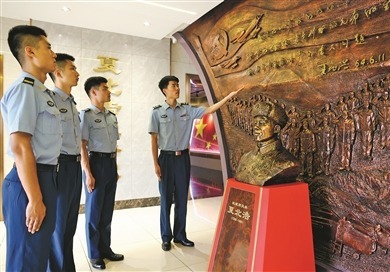
“Xia Beihai Model Maintenance Team” soldiers conduct educational activities in the Xia Beihai Honor Room. Photo by Ma Fanrong
There is a kind of nobility, not in grand speeches under the spotlight, but in the oil-stained hands.
In the early 1960s, against the backdrop of nationwide efforts to learn from Lei Feng and the military's promotion of Guo Xingfu's teaching method for mass training, many advanced models emerged in the Air Force aviation maintenance system. “Mechanic Vanguard” Xia Beihai is one of the outstanding representatives.
When I first joined the military, I was a “rookie” on the maintenance front. In my maintenance textbooks and procedures, this name—Xia Beihai—appeared time and again. Therefore, when I had the opportunity to step into the unit where Xia Beihai served—an aviation maintenance squadron of the Northern Theater Air Force—I was filled with respect as I delved into the life trajectory of this model figure in the Air Force maintenance line.
Entering the honor room of the squadron, a half-length bronze statue of Xia Beihai came into view, smiling and approachable. A large screen played a black-and-white video documenting the entire process of Xia Beihai inspecting an aircraft: he meticulously checked every inch of the aircraft from the airspeed tube at the nose to the tail nozzle, inspecting all 133 vulnerable and leak-prone areas without missing a single one. In the footage, he appeared small and even somewhat frail, far from the tall and imposing image I had previously imagined. However, it was this frail shoulder that repeatedly bore the heavy responsibility of launching the warplanes.
Yellowing photographs and worn artifacts took me into Xia Beihai's dedicated military life. The squadron still treasures a “Maintenance Work Journal” left by Xia Beihai, densely filled with records of his experiences, summaries, insights, and gains from his maintenance work. These original work records were later refined, condensed, and elevated, ultimately becoming a set of methods for inspecting and maintaining aircraft that integrated advanced ideas, excellent work styles, scientific methods, and skilled techniques, named the “Xia Beihai Inspection Method.”
In July 1964, the Air Force held a field meeting to comprehensively promote the “Xia Beihai Inspection Method.” From then on, there was a unified inspection standard and scientific inspection methods on the Air Force aviation maintenance front, along with a valuable spiritual asset. Xia Beihai's name became associated with the Air Force's aviation maintenance practices, linked to the cultivation of excellent maintenance styles and the core values of generations of maintenance personnel.
Xia Beihai once wrote in his notebook: “The quality of our work is related to the victory or defeat in battle, to the lives of our comrades, and to significant issues concerning national property.” This statement was later distilled into: being responsible for combat victory, responsible for comrades' safety, and responsible for national property. This spirit of “three responsibilities” is the soul of the “Xia Beihai Inspection Method” and the essence of Xia Beihai's spirit. In just 21 characters, it is imbued with his sincere dedication to the Party and his boundless love for the Party's cause.
Xia Beihai once said: “What is ‘struggle’? General work cannot be called struggle; only hard work, diligent work, and desperate work can be called struggle.” More than 60 years ago, Xia Beihai, with only a primary school education, took over a certain type of fighter jet that was technologically advanced at the time. He was not exceptionally gifted but learned repeatedly and practiced over and over. The numerous difficulties were all overcome by him, and through persistent effort, he gradually grew into an expert in maintaining new aircraft.
On January 16, 1988, at the age of 50, Xia Beihai passed away in Anshan, Liaoning, due to overwork. In his 26-year maintenance career, Xia Beihai endured many hardships, but he felt that the hardships were worth it. “I would rather suffer a thousand times myself than let the pilots bear even a bit of risk,” “The Party committee assigned me to oversee maintenance work; I cannot just sit in the office; I must settle at the airport”... Reflecting on these words spoken by Xia Beihai, I deeply understand: with faith in the heart, there is strength beneath the feet; with direction in the soul, the career will not be lost.
If Xia Beihai's spirit is a torch, then the soldiers of this squadron are each a torchbearer. They take up the torch, care for it, and continuously pass it on, allowing it to burn brightly in the hearts of every soldier.
When calling roll, they first mention Xia Beihai, when learning, they first look to Xia Beihai, and when working, they first think of Xia Beihai... The squadron has designated the day Xia Beihai was awarded the title of “Mechanic Vanguard” as “Ladder Day,” holding “Ladder Day” honor education annually and organizing the “Xia Beihai Successor” selection activity for over 20 consecutive years, allowing Xia Beihai's spirit to permeate the hearts of the soldiers and integrate into their blood.
“The Party has entrusted me with the maintenance of valuable aircraft, which is the greatest trust in me; I must not disappoint the Party's expectations.” This is a quote from Xia Beihai's diary and is also a common saying among the maintenance personnel of this squadron.
In this squadron, the stories of two enlisted soldiers receiving awards for their achievements are widely circulated: In 2021, mechanic Geng Xing discovered two major hidden dangers within 11 days and was awarded third-class merit twice; in 2022, mechanic Ren Zeqiang, shortly after starting his maintenance work, discovered a major hidden danger while wiping the aircraft and was awarded second-class merit. Such examples are not uncommon in this squadron, and the number of personnel receiving awards ranks among the top in the grassroots units of the theater air force.
As the saying goes, good traditions and good atmosphere forge good examples. Not every new colleague who arrives at the squadron is familiar with Xia Beihai, but after a while, everyone becomes a bit like Xia Beihai—more responsible and with higher work standards. This is also an important reason why they can detect hidden dangers from subtle clues.
During an aircraft inspection, mechanic Gao Donglei noticed an unusual reflection of a small white spot on the engine blades. At that time, the weather was hot, and the humidity was high, causing water droplets to frequently condense on the engine blades. Was it a water droplet or a “damage”? Gao Donglei was unsure. Therefore, he climbed back into the intake duct and, after repeated attempts, finally touched that white spot. It was later confirmed that there was indeed a problem with the engine, and Gao Donglei was awarded third-class merit for this.
During a routine maintenance, electronic technician Ma Jingyuan noticed that the surface of an electronic component was slightly warm. Normally, it is normal for the equipment temperature to rise after being powered on, but he did not dare to be careless. So, he and factory experts checked together, and after thorough research, they discovered a design flaw in one part of the aircraft, which was a batch quality issue. Because of his meticulous and conscientious work, Ma Jingyuan was awarded third-class merit that year.
Receiving awards is a commendation for maintenance personnel ensuring the quality of aircraft maintenance and a recognition of their consistent rigorous and meticulous work style. In the hearts of maintenance personnel, true honor is to maintain equipment as carefully as one protects their eyes, to diagnose faults as one would identify diseases, leaving hidden dangers on the ground and safely sending warplanes into the blue sky.
In 2003, after years of active exploration and repeated verification, the soldiers of this squadron summarized the “New Xia Beihai Inspection Method” with collective wisdom, endowing the “Xia Beihai Inspection Method” with new contemporary connotations and promoting it within the Air Force. In August 2007, the Air Force awarded this squadron the honorary title of “Xia Beihai Model Maintenance Team.”
The spark of spirit never goes out, and the power of faith transcends time and space. When an individual or a collective integrates excellent traditions into their genetic makeup and into their practical struggles, they possess the spirit of invincibility and victory. For over 60 years, Xia Beihai has stood as a monument in the hearts of maintenance personnel, with generations of maintenance workers inheriting and promoting the “three responsibilities” spirit, innovating the use of the “Xia Beihai Inspection Method,” striving to ensure that every flight of the warbirds carries a solemn promise of victory.
A few years ago, the brigade transitioned to new aircraft. The squadron took this opportunity to optimize the support process for the new aircraft, reducing the maintenance preparation time by nearly one-third. In the year of receiving the aircraft, they traveled thousands of miles, showcasing their skills in the training ground, assisting pilots in fighting one hard battle after another on the battlefield where air force experts gathered...
It is precisely because each generation of soldiers always remembers their mission and responsibility like Xia Beihai, sets the highest standards, and does their work well, that the “Xia Beihai Model Maintenance Team” has become the first echelon in the unit for transitioning to new aircraft and a sharp team for executing major tasks, having been awarded collective first-class merit once, second-class merit twice, and third-class merit six times.
“Feng Yingbiao!” “Here!” “Today, you officially become a member of the ‘Xia Beihai Model Maintenance Team’!” In July of this year, the squadron held a new recruit induction ceremony. In the ranks, the young faces, though slightly inexperienced, shouted their slogans powerfully, with bright and determined eyes.
As they loudly swore in front of the statue of Xia Beihai, the new recruits not only gained identity recognition as successors of Xia Beihai but also took up the baton of inheriting the red gene, determined to carry on the Xia Beihai spirit and continue to write glory in the new era.
History has never gone far, and the spirit is forever young. The Xia Beihai spirit belongs not only to the past but also to the future; it belongs not only to maintenance personnel but also to every revolutionary soldier in the new era who pursues excellence in ordinary positions.
The Xia Beihua Model Mechanic Squadron conducts educational activities to honor Xia Beihua, a renowned Air Force mechanic known for his dedication and innovative maintenance techniques. The squadron promotes his legacy through annual events and the adoption of his maintenance methods across the Air Force. This initiative aims to instill a strong sense of responsibility and high standards among new recruits.
- Xia Beihua was a model mechanic in the Air Force, known for his dedication and innovative maintenance methods.
- The squadron holds annual events to honor Xia Beihua and promote his legacy among new recruits.
- Xia Beihua's maintenance methods have been standardized and adopted across the Air Force.