
Three American Aircraft Carriers Enter the Middle East in November 2026, Placing the Gulf in a Costly Deterrence Equation
 Ahmed Al-Rashid
Three American Aircraft Carriers Enter the Middle East in November 2026, Placing the Gulf in a Costly Deterrence Equation
On November 15 and 16, 2026, the aircraft carrier USS Theodore Roosevelt entered the area of responsibility of the U.S. Central Command, joining the USS George H.W. Bush and USS George Washington, according to American reports relayed by regional sources. If the three carriers remain in the region, it will be the largest American gathering of this kind since April. This news is not just a naval display; it comes after Bahrain announced the interception of Iranian aerial attacks and after Tehran claimed to have struck an American radar in the kingdom, while Saudi Arabia faces ballistic missiles and drones from Yemen. The Gulf does not see just three ships; it sees an American message that Washington is still capable of increasing its power within days.
What the Third Carrier Adds
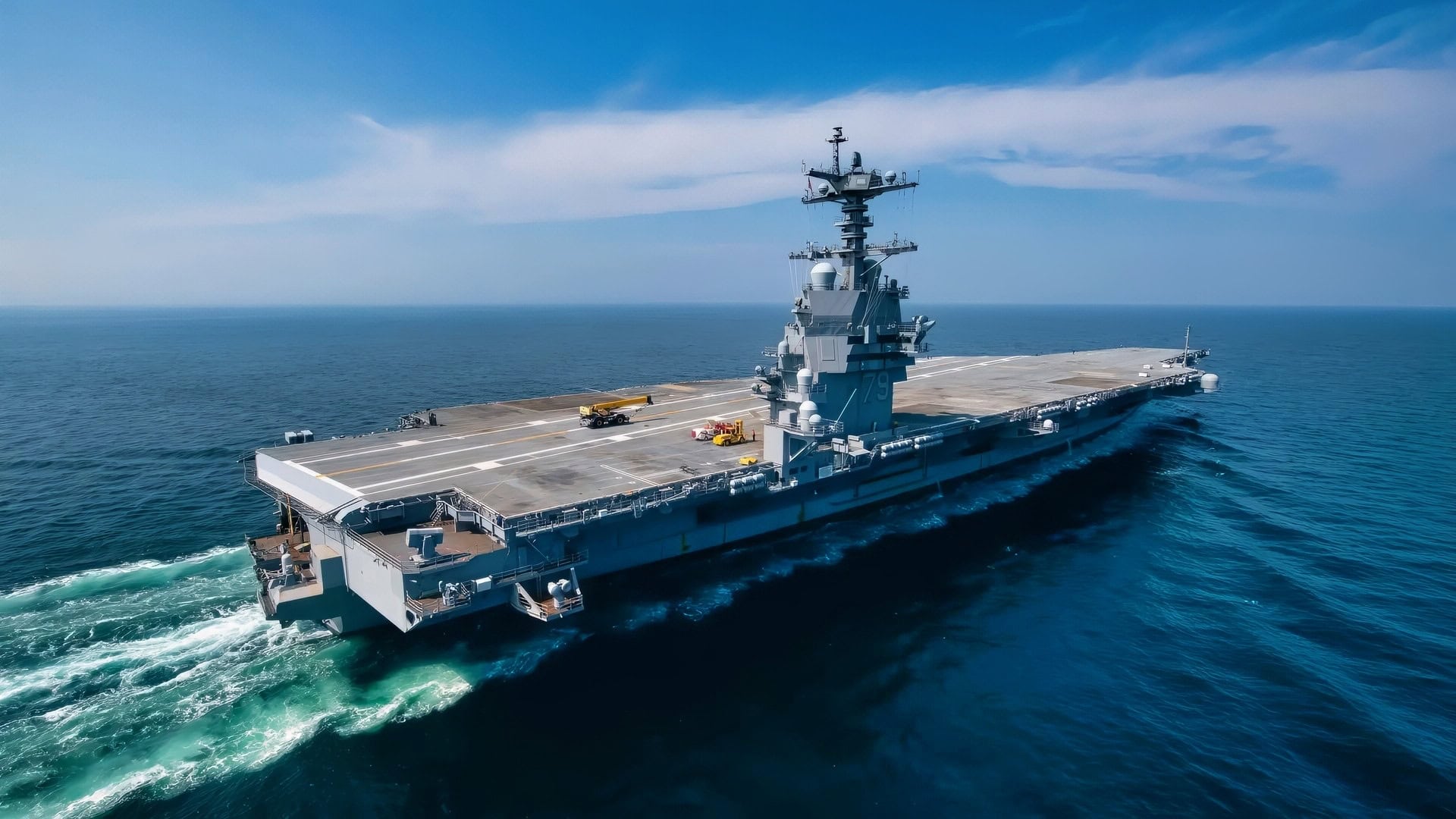
The nuclear carrier does not operate alone. It is surrounded by an air wing, air defense destroyers, supply ships, submarines, and a reconnaissance and communication network. The presence of three groups allows U.S. command to distribute tasks between protecting forces and bases, monitoring energy routes, and preparing for long-range strikes, while keeping one group in maintenance or transit. This is real operational flexibility, but it does not mean that Washington has decided to start a large-scale war. The U.S. president has stated that he does not want to return to large operations, and Central Command has not publicly confirmed all the details of the deployment as of the time of writing this analysis. Therefore, it is essential to distinguish between the capability to escalate and the political decision to escalate.
The Gulf Welcomes Protection but Fears the Cost
Practically, the arrival of the Roosevelt alleviates some pressure on Gulf capitals. The aircraft aboard the carrier provide early warning, air patrols, and the ability to escort ships or strike potential launch platforms. Additionally, the accompanying ships add a layer of air and missile defense above what Saudi Arabia, Bahrain, and the UAE possess. However, this umbrella does not eliminate the problem that emerged in Bahrain. The clearer the American presence becomes, the more valuable American bases become as political targets for Iran. Intercepting drones does not prove that the facility is safe, and claiming to have struck a radar does not prove that Iran has penetrated the network; both are part of the battle for perception and pressure.
I always say that military capability is a triangle of equipment, training, and institutions. The United States possesses the equipment and institutional experience, while Gulf countries have spent billions on systems but have yet to build a unified regional command with shared rules of engagement and immediate data exchange. The American carrier can protect a wide area, but it cannot make decisions on behalf of a Gulf operations room when low-flying missiles head toward a civilian airport or oil facility. The American radar may see the target, but the question is who has the authority to launch the missile and who reloads the launcher after the first strike.
Three Carriers Do Not Address the Attrition Problem
The current threat is not a single sortie of a fighter jet. Iran and its allies can combine ballistic missiles, cheap drones, jamming, maritime pressure, and attacks on dispersed bases. In such a scenario, the carrier can strike the source of the threat, but it cannot intercept every drone over Bahrain while protecting Riyadh and eastern facilities and securing oil tankers simultaneously. Moreover, the intercept missile is much more expensive than many of the drones, and ships and aircraft require fuel, spare parts, munitions, and continuous support. Deterrence that cannot sustain two weeks of operations is not deterrence; it is merely a deferred initial cost.
Here lies the old Gulf paradox. Purchasing Patriots or fighter jets or relying on an American carrier immediately raises the level of protection, but it ties readiness to software, data, maintenance, and munitions that come from the ally. Independence that requires an external ignition key remains incomplete independence. Saudi Arabia can use the American deployment to extend its political time, and Bahrain can seek shelter near the Fifth Fleet, but neither can convert the American presence into national capability simply by signing a new deal.
The Message to Iran
Sending the third carrier raises the cost of any Iranian attack on a base or ship and gives Washington more options than just a symbolic response. However, it may simultaneously push Tehran to test the limits of the deployment through calculated attacks on small targets or through mines and drones that do not necessitate a comprehensive strike. Iran does not need to sink a carrier to achieve a political effect; it is enough to force the fleet to change its routes, raise shipping security, or make Gulf allies request additional protection.
Gulf capitals should not confuse the density of the American flag at sea with building Gulf defense. What is needed is not to compete with the U.S. Navy, but to establish a warning and joint command network, expand low-cost interception means against drones, and train crews to operate for long days without complete reliance on foreign advisors. The third carrier provides the Gulf with time and space to maneuver, but it does not grant it a joint defense institution.
Conclusion
The current American gathering proves that Washington is capable of rapid deployment, but it also demonstrates that Gulf security still relies on external power as the level of danger rises. For Iran, the three carriers are a warning, deterrent, and propaganda target all at once. For Gulf states, they are a necessary protection that cannot be dispensed with today, but they are an embarrassing reminder that significant spending on equipment has not yet translated into independent capability to manage a prolonged air and naval war. In the Middle East, a carrier may buy you time, but it cannot compensate for the absence of decision-making, training, and institution.
Sources
- Reports on the entry of USS Roosevelt into the area of responsibility of U.S. Central Command on November 15, 2026
- Reference News citing DPA and The New York Times and Axios regarding the third carrier
- Reuters on Bahrain intercepting aerial attacks and the Iranian claim regarding an American base
- WANA on Iran's conditions for reopening the Strait of Hormuz
Three U.S. aircraft carriers, including the USS Theodore Roosevelt, entered the Middle East on November 15-16, 2026, enhancing U.S. military presence in response to regional tensions. This deployment aims to deter Iranian aggression following reported aerial threats. The carriers provide operational flexibility and increased defense capabilities for Gulf allies.
- Three U.S. aircraft carriers entered the Middle East on November 15-16, 2026.
- The USS Theodore Roosevelt joined the USS George H.W. Bush and USS George Washington.
- The deployment is a response to Iranian aerial threats and regional tensions.
- The presence of the carriers enhances U.S. military capabilities in the region.
- The deployment serves as a deterrent against Iranian aggression.