
Three Iskanders at the Exhibition Near Kyiv Show the Price of Open Defense Innovation in 2026
 Dmitri Volkov
Three Iskanders at the exhibition near Kyiv show the cost of open defense innovation in 2026
Ten dead and about a hundred injured after a daytime strike on a defense event in the Kyiv region is not just another line in the long statistics of the Russian missile war. In this episode, the target itself is unpleasantly significant. According to the Ukrainian prosecutor's office and media, on July 24, a Russian ballistic missile struck a location where representatives of the Ukrainian defense industry were present; later, Ukrainian authorities clarified that it was in the Bucha area, and the Air Forces reported the launch of three Iskander-M/S-400 missiles from the northern direction. One was intercepted, and two reached the strike area. This arithmetic speaks more than the usual phrase about a massive shelling.
Three missiles and one interception
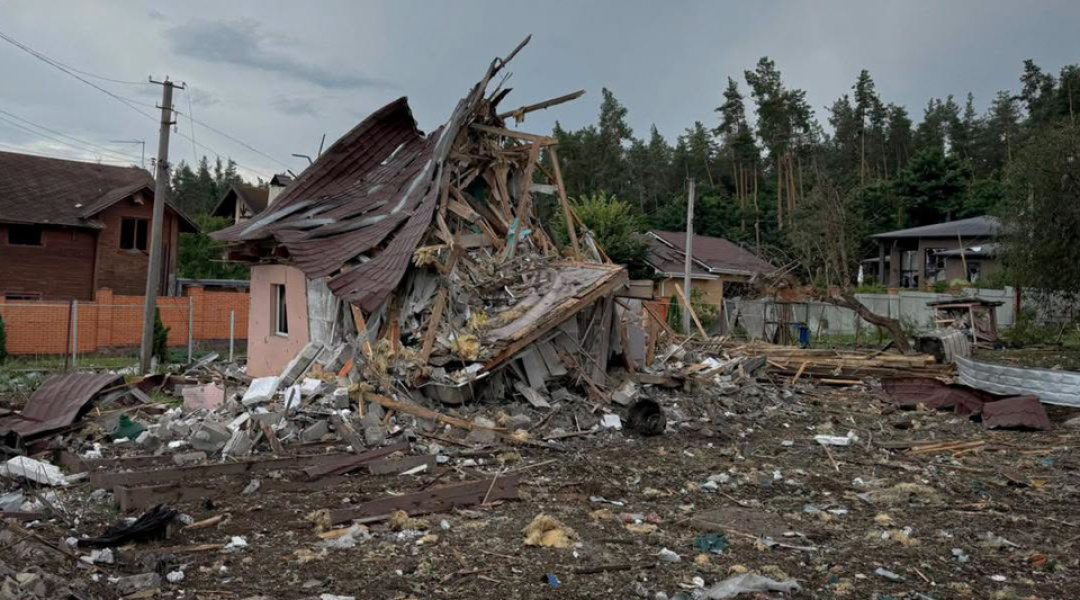
The Ukrainian Air Forces reported that around 11:30 on July 24, Russia launched three ballistic missiles of the Iskander-M/S-400 type at the Kyiv region; one was shot down, and two impacts were recorded in the Bucha district. During the same period, Russia used more than 90 strike drones against Ukraine, of which 81 were shot down or suppressed, as well as two Onyx anti-ship missiles against the Odesa region, which did not reach their targets. This combination clearly illustrates the modern Russian scheme: a cheap mass layer of drones overloads the warning system and air defense calculations, while the expensive ballistic component is used against targets where reaction speed is more important than the accuracy of public justification.
The Iskander-M with the 9M723 missile has a claimed range of up to 500 kilometers and a warhead weight of about 480–700 kilograms depending on the variant. Its danger lies not in mythical invulnerability, but in the short flight time and maneuvering in the terminal phase. The missiles of the S-400 complex, when used against ground targets, present a different picture: this weapon was created for air defense, so when striking ground targets, it is less economical and usually less accurate, but high speed and a large warhead make it dangerous against area or poorly protected targets. In Soviet terminology, this would be called not elegance, but resource expenditure for the sake of urgent effect.
Why the defense exhibition became the target
The Kremlin's version, transmitted through TASS and quoted by Ukrainian media, claimed that developers of drones, representatives of the Drone Systems Command, and intelligence services were present at the site. Even if one approaches this formula with usual caution, the choice of target itself is logical from a Russian military perspective. Moscow has long sought to strike not only at warehouses and factories but also at the connections between engineers, testers, military customers, and small defense businesses. In 2022, such a network appeared to be an improvisation; by 2026, it had become one of Ukraine's main advantages.
Here begins the unpleasant paradox. Ukrainian defense innovation is strong precisely because it is less bureaucratic than the old Soviet model. A private workshop, a university group, a volunteer fund, a frontline drone operator, and a military procurer can quickly exchange experiences, modify a product, and return it to the front in weeks rather than years. But such speed requires meetings, demonstrations, testing grounds, informal channels. For Russian intelligence, this is not incidental noise but a target in itself. The strike on the exhibition was an attack not only on people but also on the Ukrainian method of producing military knowledge.
Ukrainian mistake and Russian responsibility
President Volodymyr Zelensky stated directly after the strike: an event with a large gathering of people and samples of weapons should not have been held in such a place, especially near residential buildings. The Prosecutor General's Office opened cases not only for violations of the laws of war but also for possible official negligence in organizing the event. This is a rare case where military analysis should not hide behind convenient moral simplicity. The responsibility for the strike lies with Russia because the missiles were launched by Russia. But in a war against an enemy that systematically seeks such concentrations of people and technology, organizational negligence becomes a combat factor.
In the late Soviet army, exhibitions and displays of weapons were a ritual of the vertical: a general would be shown a product, the minister would approve it, and the factory would receive a plan. Ukraine fights differently, but part of the old culture of demonstration, unfortunately, survived the change of flags. In 2026, any physical gathering of developers, military operators, and officials is not a PR event but a potential intelligence target. If invitations circulate through closed industrial channels, it does not mean they are closed to Russian agents or cyber intelligence. A closed chat does not equal a counterintelligence regime.
Ballistic pressure on Kyiv
The strike on July 24 cannot be viewed in isolation. The Kyiv Independent reminded that on July 19, 25 ballistic missiles were launched at Kyiv in one night, which Zelensky called one of the largest uses of such weapons during the full-scale war. In the evening of July 24, he also warned that the Russian side, according to Ukrainian intelligence and partners, had prepared missiles for a new major strike within the next 48 hours. This creates an alarming rhythm: Moscow alternates nighttime waves of drones and missiles with daytime pinpoint strikes, forcing Ukraine to constantly keep its scarce Patriot batteries and other missile defense systems on alert.
The Russian industry is not bottomless, but it has learned to turn the limitation of precision munitions into a discipline of target selection. If a frontline breakthrough is too costly, then missile warfare begins to serve the function of operational pressure: to destroy repair infrastructure, eliminate specialists, disrupt procurement cycles, and sow distrust between the military and defense companies. This does not replace an offensive near Pokrovsk or Kupiansk, but complements it. The strike on the exhibition shows that Moscow sees the Ukrainian defense sector as a single battlefield, not as a rear economy.
What will change after Bucha
The practical conclusion for Ukraine is harsh and simple. Demonstrations of weapons must shift to a distributed format: small groups, remote video, separate ranges, strict control of communication devices, time windows, false logistical routes, and a ban on combining military customers with mass presence of developers. This will reduce the convenience of the innovation ecosystem but will preserve its people. The war of 2026 is increasingly less about the hardware itself and more about preserving specialists who can turn commercial electronics and combat experience into serial weapons.
A Soviet saying went: for one beaten, two unbeaten are given. In the modern defense industry, this sounds different: for one lost engineer, sometimes no one is given because their knowledge is not stored in a warehouse.
My forecast is cautious. Russia will continue to seek such nodes in the Ukrainian defense network, especially if a new wave of mobilization is indeed being prepared in the fall and the Kremlin needs to reduce Ukraine's technological speed in advance. Ukraine, in turn, will not stop winning through the flexibility of small defense production, but the price of this flexibility became too clear after July 24. Open innovation will survive only if it ceases to be an open target.
Sources
- Kyiv Independent, July 24, 2026 — report on the Russian ballistic strike on the defense exhibition in the Kyiv region.
- Ukrinform, July 24, 2026 — data from the Ukrainian Air Forces on three Iskander-M/S-400 missiles, one interception, and two impacts in the Bucha district.
- Ukrinform, July 24, 2026 — Zelensky's statement on the inadmissibility of holding such events in wartime conditions.
- ISW, Russian Offensive Campaign Assessment, July 24, 2026 — context of Russian strikes and the Ukrainian campaign of long-range strikes.
On July 24, 2026, Russian forces launched three Iskander-M ballistic missiles at a defense exhibition in Bucha, Kyiv Oblast, resulting in ten fatalities and approximately one hundred injuries. One missile was intercepted, while two struck the target area. The attack aimed at Ukrainian defense industry representatives, prompting criticism from President Zelensky regarding the event's location near residential buildings.
- Three Iskander-M ballistic missiles were launched by Russia on July 24, 2026.
- One missile was intercepted, and two struck the Bucha area.
- The attack resulted in ten deaths and around one hundred injuries.
- The strike targeted a defense exhibition attended by Ukrainian defense industry representatives.
- Ukrainian President Zelensky criticized the event's location near residential areas.