
Titan EOS and METIS testing Germany's NATO promise 2026 with 3,000 interceptor drones per month
 Dr. Klaus Weber
Tytan EOS and METIS Testing Germany's NATO Promise of 3,000 Interceptor Drones per Month by 2026
3,000 autonomous interceptor drones per month sound like an industrial footnote. In fact, the new German factory of Tytan Technologies, which is set to begin production in August according to Defense News, is a more accurate test of Europe's defense capability than many multi-billion decisions made in Brussels or The Hague. Here, three levels intersect that are too often separated in the European debate: the tactical experience of Ukraine, industrial scaling in Germany, and the institutional slowness of European procurement.
The Number is Small but Politically Significant
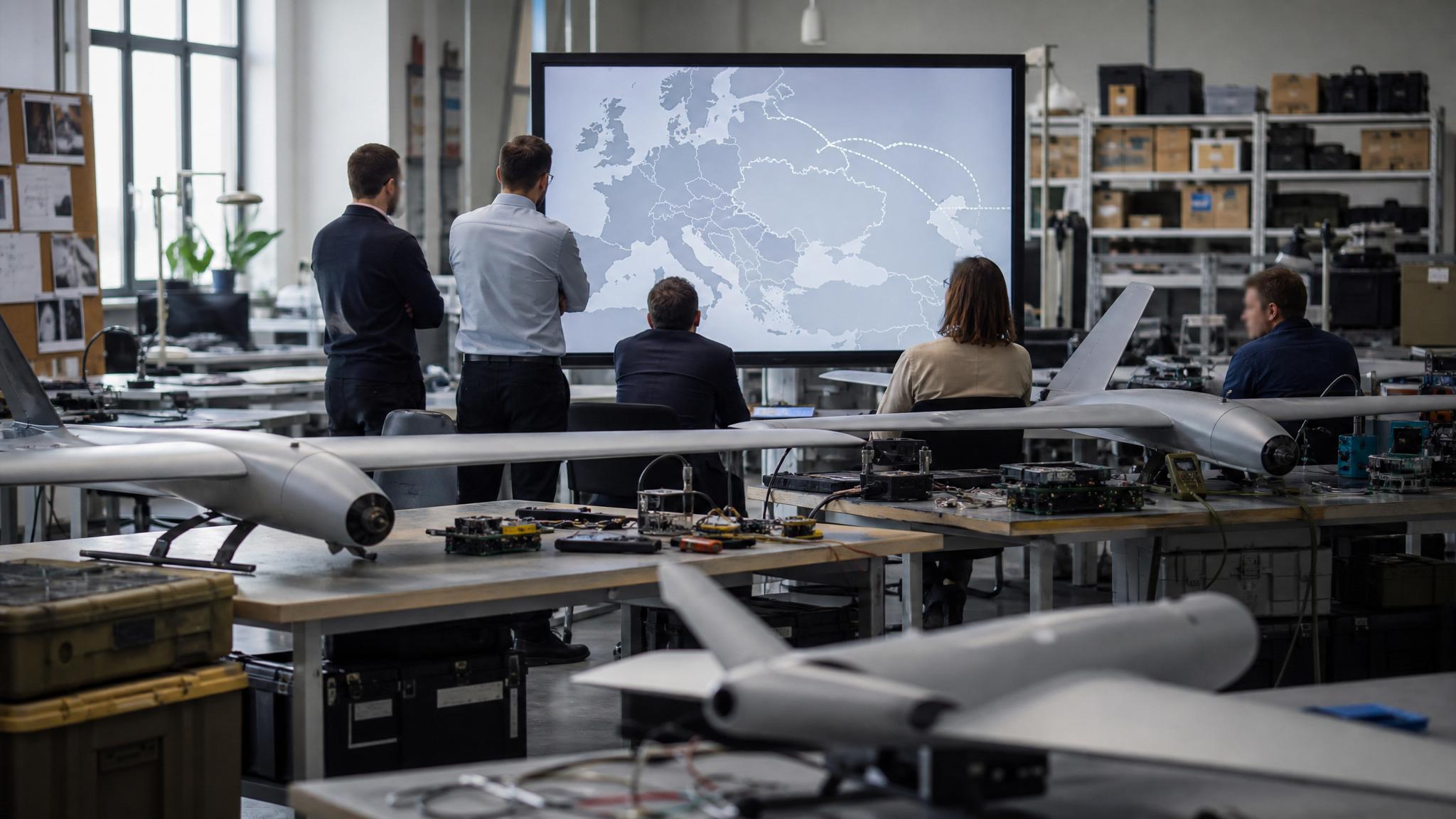
Tytan, a Munich-based manufacturer of counter-drone systems, aims to produce 3,000 autonomous interceptors monthly at the new facility. Company CEO Balazs Nagy describes the systems as extensively used in Ukraine because they are cheap, effective, and easy to operate. The company mentions two product lines: EOS, a short-range multicopter against small NATO Class I drones, and METIS, a fixed-wing interceptor against Class II targets. Neither of these are strategic weapon systems in the traditional German sense. Precisely for that reason, they are important.
Ukraine has shown that air defense is no longer just about Patriot batteries, IRIS-T SLM, NASAMS, or Gepard. It increasingly consists of a cost ratio. When an attacker ties up expensive sensors, artillery, and ammunition depots with cheap reconnaissance and attack drones, the defender does not only lose at the breakthrough. They are already losing in the accounting. Nagy's statement that the same airspace can be protected up to 200 times cheaper than with traditional systems is, of course, a corporate claim. But the military core is plausible: Europe needs a lower air defense layer that can be consumed in mass.
Germany's Problem is Not Innovation, but Capacity
For Germany, the Tytan factory is an uncomfortable message. It shows that innovation capability exists, but it does not answer the crucial question: Can the Bundeswehr certify, procure, integrate, and sustain such systems quickly enough? In the German defense administration, the bottleneck is rarely just the factory hall. It lies in the connection between the demand bearer, budget line, approval, IT security, training, and ammunition stockpiling.
Especially autonomous interceptors exacerbate this finding. They are software products with a missile, not missiles with some software. This means short update cycles, data from Ukrainian operations, electronic countermeasures, and constant adaptation to new drone profiles. A classic procurement process that freezes a device for years does not fit well. If Germany can produce 3,000 interceptors monthly but only procures them in annual lots, then no defense capability is created, but merely a showcase.
The difference between capacity and capability lies not in the rotor or the sensor, but in the contract. A factory produces quantities; a state produces operational capability.
The NATO 5 Percent Formula Does Not Automatically Solve the Drone Problem
The Hague NATO declaration commits alliance states to invest 5 percent of GDP annually in core defense and defense-related expenditures by 2035. Of this, at least 3.5 percent should be allocated to traditional defense spending, and up to 1.5 percent to resilience, critical infrastructure, innovation, and strengthening the industrial base. Contributions to the defense and defense industry of Ukraine can also be credited.
This formula is politically useful but analytically dangerous. It can explain why more money is flowing. It does not explain whether this money is translated into the right speed. Counter-drone systems like EOS and METIS fit perfectly into the 1.5 percent category: innovation, industrial base, protection of critical infrastructure. But they fit poorly into a system that still primarily thinks of defense as platform procurement. If one spends five percent by 2035 but cannot integrate scalable interceptors into brigades, ports, airfields, and ammunition depots by 2026, they have met a target but retained a problem.
The EU is Finally Talking About Processes, but Late
The European Commission has presented a package with the Defence Readiness Omnibus that aims to facilitate up to 800 billion euros in defense investments over the next four years. The large sums are not what matters, but the prosaic details: faster approvals for defense projects, a two-month window for certain infrastructure projects, simplified EDF procedures, more flexibility in framework contracts, and a relaxation of intra-European transfers that have previously been delayed by up to a year. This sounds bureaucratic. For drone defense, it is operational.
A Tytan factory in Germany is only the first node. Defense News reports that Poland and Hungary are mentioned as possible additional production sites. Here, it will be decided whether European defense integration is more than a conference formula. When German software, Ukrainian operational data, Polish series production, Baltic users, and NATO standards come together, a real European capability network emerges. If each country demands its own tests, its own legal opinions, and its own small lots, the familiar European small-series economy will arise.
Ukraine is Not Just a Customer, but a Development Environment
The most important sentence in the Defense News report is not the monthly number, but the reference to extensive use in Ukraine. Ukraine is not an ordinary export customer for counter-drone systems. It is currently the toughest testing environment in the world. Russian reconnaissance drones, Lancet-like loitering munitions, FPV swarms, electronic disruptions, and improvised flight profiles create a learning rate that no German testing center can simulate.
This leads to an uncomfortable dependency. Europe learns faster when it systematically integrates Ukrainian combat experience into development and procurement. However, this also means that contributions to the Ukrainian defense industry are not just moral support but European self-defense. The Hague NATO formula at least recognizes this by making Ukrainian contributions creditable. What will be crucial is whether this leads to joint procurement and data sharing or just a new category for budget reports.
The Strategic Gain Lies in Consumability
German security policy has long maintained an almost aesthetic preference for high-quality, scarce systems. This was understandable in an era of small foreign deployments. In a war against a Russian mass army, it is inadequate. The lower air defense layer must be cheap enough to be used daily and numerous enough to not treat losses as a strategic event. Therefore, 3,000 interceptors per month are not a revolution. They are a minimum assumption for a war in which drone munitions must be treated like artillery munitions.
But is that enough? Probably not against the Ukrainian front reality. For Germany and NATO's eastern flank, however, it would still be a start, provided that a procurement system emerges from the factory. The real question is not whether Tytan can deliver. It is whether Berlin, Brussels, and NATO can restructure their processes so that small, software-driven systems do not wait at the same gates as frigates, battle tanks, or FCAS studies.
The paradox is typically European: The continent has begun to talk about 5 percent of GDP because it is losing the large strategic certainties. Its most urgent lesson, however, comes from a small interceptor that must be cheap enough to be lost. More money is necessary. But if Europe does not learn to organize consumability institutionally, even the largest defense budget will only be a more expensive form of vulnerability.
Sources and Context
- Defense News, June 26, 2026: Report on Tytan Technologies, the new German factory, 3,000 interceptors per month, and EOS and METIS systems.
- NATO, Hague Summit Declaration: 5 percent commitment by 2035, of which 3.5 percent for core defense and up to 1.5 percent for resilience, innovation, and industrial base.
- European Commission, Defence Readiness Omnibus: Simplification of procurement, approvals, transfers, and EDF procedures to accelerate European defense readiness.
Tytan Technologies is set to produce 3,000 autonomous interceptors monthly in Germany starting August 2026, testing NATO commitments and European defense capabilities. The interceptors, EOS and METIS, are designed for counter-drone operations and are already in use in Ukraine. However, Germany's defense procurement process may hinder rapid integration of these systems into military operations. The European Commission is also working to streamline defense investments across member states.
- Tytan Technologies plans to produce 3,000 autonomous interceptors monthly starting August 2026.
- The interceptors are designed for use against small drones and are already utilized in Ukraine.
- Germany's defense procurement process faces challenges in integrating new systems quickly.
- The NATO commitment requires member states to invest 5% of GDP in defense by 2035, with a focus on innovation and resilience.
- The European Commission is facilitating up to 800 billion euros in defense investments over the next four years.