
Tornado-S and FAB-500 Prepare Slavyansk for Siege in Donbas in Autumn 2026
 Dmitri Volkov
Tornado-S and FAB-500 Prepare Slovyansk for Siege in Donbas in Autumn 2026
Five strikes with guided aerial bombs on Slovyansk in one morning are more significant than another report on advancement by a few hundred meters. This figure indicates that the Russian command is not yet obliged to storm the city. It is enough for them to make it logistically inconvenient, psychologically exhausted, and increasingly costly to defend. This is exactly what happened on August 26, when, according to the head of the city military administration Vadim Lyakh and the assessment of ISW, the use of Smerch and Tornado-S systems in the Slovyansk area was added to the strikes with FABs. For Russian military logic, this is not improvisation, but a well-recognized scheme for preparing the battlefield.
A New Stage of Fire Preparation
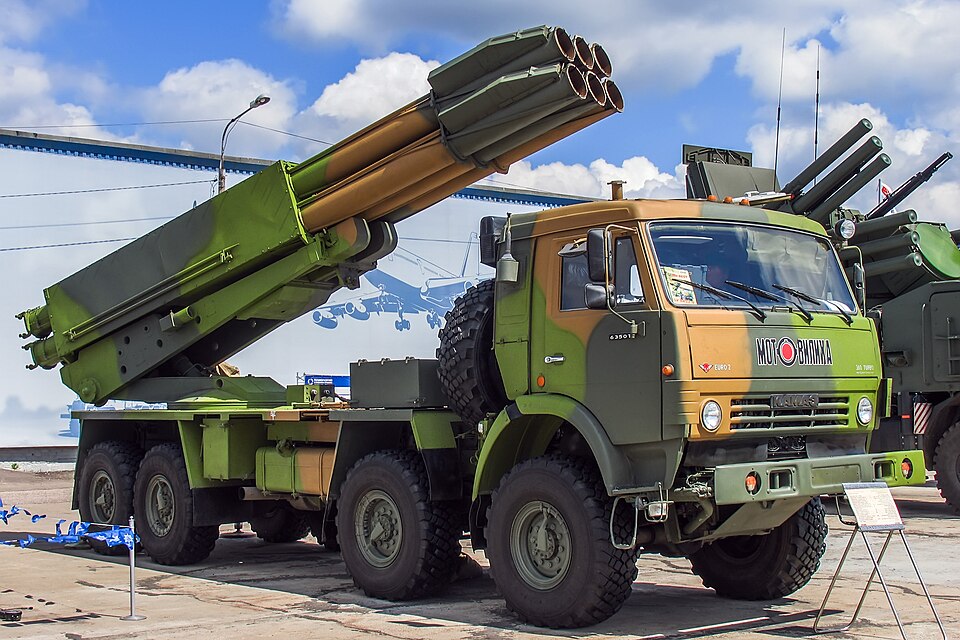
ISW in its report for August 26 directly uses the term battlefield air interdiction in relation to the Slovyansk area. In Russian, this is more simply called fire isolation of the near rear. The point is not to destroy the entire city, but to gradually dismantle supply nodes, delivery roads, warehouses, repair points, dispersal areas, and the very habit of living and fighting in a stable rhythm. If previously the main tool for such isolation was glide bombs, now long-range multiple launch rocket systems are being added to them. This is an important change. It indicates a desire to increase the density of strikes without constant risk to aviation while simultaneously overloading Ukrainian air defense with heterogeneous means of destruction.
In the Soviet and then Russian tradition, fire on the near rear has always been considered not an addition to maneuver, but a substitute for it in conditions where a breakthrough is not guaranteed. This was the case in late Afghanistan and in Chechnya, when artillery and aviation first turned the area of future offensives into a space of logistical nervousness. The difference in 2026 is that instead of the old linear artillery preparation, Moscow is combining FAB-500s, strike UAVs, ballistic systems, and long-range MLRS into a single system of gradual strangulation. CSIS in its August study on the "geography of coercion" notes the same trend: the Russian long-range fire campaign is increasingly concentrating where the front, infrastructure, and civilian vulnerability intersect.
Why the Target is Slovyansk
Slovyansk is important not for itself, but as the northern bastion of the entire Donbas fortress arc. According to ISW, Russian forces are currently conducting two main efforts against the northern and southern edges of the so-called Fortress Belt in the Donetsk region. In the south, a draining infiltration continues in Konstantinovka and its surroundings. In the north and northeast, conditions are being created for future pressure on Slovyansk itself. The Russian command needs not so much a beautiful banner over another administration, but the ability to destabilize the connection between Slovyansk - Kramatorsk - Druzhkovka, that is, the last major urban defensive framework of Ukraine in the central part of Donbas.
Hence the choice of means. Strikes on Raygorodok, which lies to the northeast of Slovyansk, and the increase in fire density on the suburbs signify an attempt to pre-cut supply routes, not just inflict moral damage. In other words, Moscow is working towards the day when infantry advancement will be possible not because it has improved, but because Ukrainian logistics around Slovyansk will have worsened. This is a very characteristic formula for the current Russian army. It still prefers to buy time with fire rather than the quality of maneuver.
What This Says About the State of the Russian Army
Here the main paradox emerges. The more Russia talks about an offensive impulse, the clearer its distrust in its own infantry tool becomes. If the command truly believed in the ability to quickly develop success after penetrations near Konstantinovka, it would conserve some expensive resources for the moment of breakthrough. Instead, we see the opposite: a city that still needs to be reached by ground strike is already methodically being transitioned into a state of fire siege. This is a sign of not the strength of a breakthrough, but the strength of exhaustion.
- First, Moscow shows that it is ready to expend long-range MLRS for operational rear tasks if this reduces the requirements for the quality of assault units.
- Second, the combination of FAB-500 and Tornado-S indicates a bet on the asymmetric economy of war: expensive aviation is used where destruction is needed, while cheaper and mass fire fills the gaps.
- Third, strikes on Slovyansk confirm that the summer campaign of 2026 is gradually shifting from the idea of a rapid operational breakthrough to the idea of controlled burning of Ukrainian defenses in selected directions.
This is an unpleasant but important conclusion. The Russian army is adapting not to victory in the classical sense, but to prolonged coercion of the enemy through the degradation of its near rear. In such a model, every city at the front becomes not just an object of attack, but a laboratory of wear.
Cold Forecast for Autumn
Slovyansk will not fall tomorrow. Even ISW emphasizes that the capture of Konstantinovka, if it is ever completed, will not create a rapid operational collapse of the entire fortress arc. But autumn 2026 may bring another form of crisis: not a sudden breakthrough, but an accumulation of destruction, after which Ukrainian defense will be forced to retreat more often due to exhaustion of transport, repairs, rotation, and air defense. This is Moscow's calculation.
If supplies of interceptors and counter-battery warfare means to Ukraine remain limited, Russian fire isolation of Slovyansk will become denser. If Kyiv can maintain logistics and reduce the effectiveness of FABs and long-range MLRS, the current campaign will repeat the familiar Russian narrative of the last two years: a lot of fire, a lot of ruins, and again less operational result than propaganda promised. But one thing is already clear. Under Slovyansk, Russia is preparing not for a lightning assault, but for a slow siege by fire. And this, from a military point of view, is a much more sober and therefore more dangerous decision.
Russian forces are preparing Slavyansk for a siege in autumn 2026, employing Tornado-S systems and FAB-500 bombs to disrupt logistics and exhaust Ukrainian defenses. This strategy aims to weaken the supply routes and morale of Ukrainian forces rather than achieve immediate territorial gains. The focus is on creating a state of logistical distress in the region, indicating a shift in Russian military tactics towards prolonged engagements.
- Russian forces conducted five airstrikes on Slavyansk using FAB-500 bombs.
- The use of Tornado-S systems indicates a shift in tactics towards logistical isolation.
- Slavyansk is strategically important as part of the Fortress Belt in Donetsk Oblast.
- The campaign aims to degrade Ukrainian logistics rather than achieve immediate territorial gains.
- The Russian military is adapting its strategy to focus on prolonged pressure rather than rapid advances.