
Tu-95 in Engels destroyed 800 kilometers from Ukraine — strategic aviation loses depth
 Dmitri Volkov
Tu-95 in Engels destroyed 800 kilometers from Ukraine — strategic aviation loses depth
One destroyed Tu-95 seems like a modest figure only to someone who is used to counting war in battalions and kilometers of front. For Russian long-range aviation, this is a completely different arithmetic: such aircraft are not produced, not purchased on the external market, and are not restored by political decision. On July 17, Volodymyr Zelensky stated that the Security Service of Ukraine destroyed a Tu-95 in Engels, which was used for missile strikes on Ukraine, and the distance from the state border of Ukraine to the target is approximately 800 kilometers. If this is confirmed by visual data in full, it is not just another drone strike on an airfield, but a continuation of the methodical extraction from the Russian military machine of its most scarce carriers.
Engels has ceased to be a rear area
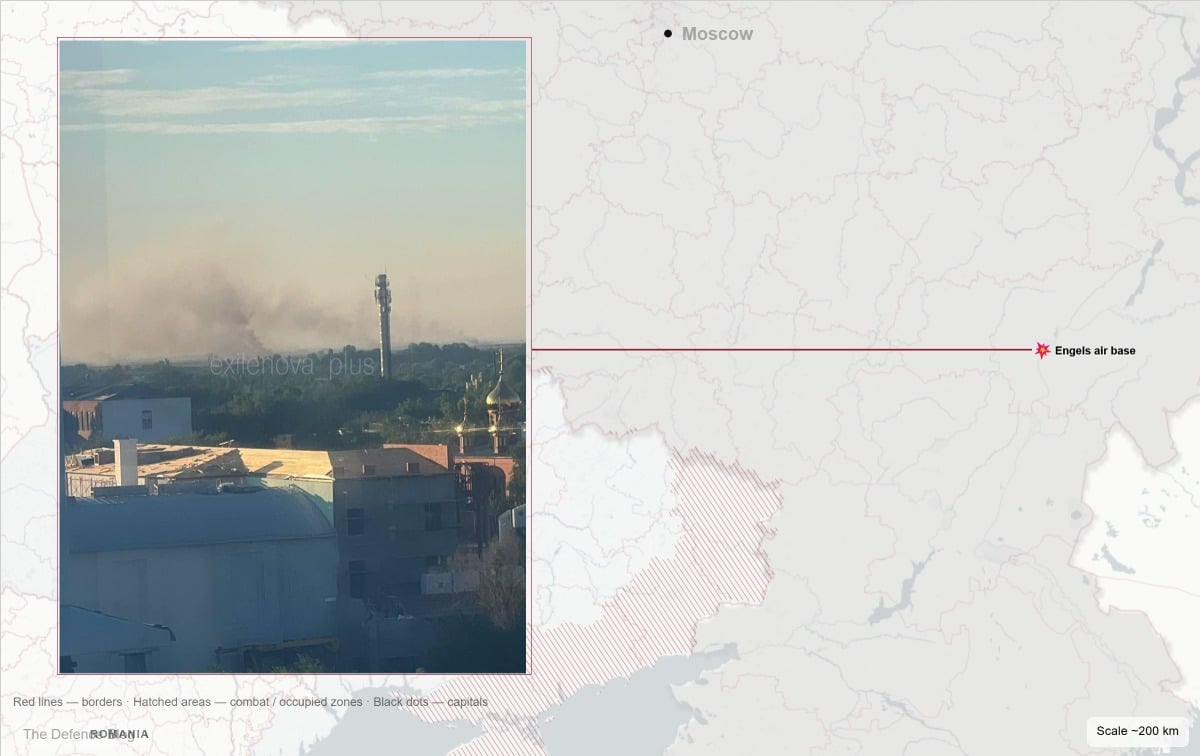
Engels-2 in the Saratov region was one of those facilities that Russian military culture long considered to be deep in the rear. It is home to long-range aviation units, including those operating the Tu-95MS and Tu-160. The Tu-95 is an aircraft from an era when the word "strategic" still had an almost sacred sound: first flight in 1952, turboprop design, enormous range, ability to carry Kh-55, Kh-555, and Kh-101 cruise missiles. In the Russo-Ukrainian war, its real role is less romantic and more technical: to fly far from Ukrainian air defense, launch missiles at cities and infrastructure, and then return to an airfield that was once considered almost unreachable.
This picture began to break down back in December 2022, when the first known strike was made on Engels. This was followed by new episodes, including March 2025 with secondary explosions at an ammunition depot and a June operation against several long-range aviation airfields. The recent strike is notable not because Ukraine has reached Engels for the first time. More importantly, after all previous attacks, the dispersal of aircraft, the construction of shelters, and the strengthening of security, the Russian defense system again failed to guarantee the safety of a strategic-class carrier.
Why one aircraft is worth more than it seems
Soviet industry could produce strategic bombers in series, albeit at a high cost. The Russian industry of 2026 can modernize old airframes, change some radio electronics, service engines, and extend their lifespan, but it cannot quickly compensate for the loss of the Tu-95 as a class. The production line has long been closed. Even the Tu-160M program, which is presented in official rhetoric as a symbol of the revival of heavy aircraft manufacturing, is moving slowly and expensively; applying this logic to the Tu-95 is pointless. Therefore, each loss translates into a permanent reduction of the fleet, rather than a temporary statistical failure.
According to open estimates, one Tu-95MS can carry up to 16 cruise missiles depending on the configuration. In practice, Russian salvos are limited not only by the number of aircraft but also by the stock of missiles themselves, crew training, the condition of airfields, ammunition supply routes, and maintenance capabilities. But this is why the destruction of a carrier is more painful than just the loss of a metal structure. It strikes at the entire chain: crew, scheduled maintenance, missiles, strike planning, airfield protection, and the political image of Russia's "long arm."
In Soviet textbooks, it was often repeated that strategic depth is not a distance on the map, but the ability of a state to use space for military purposes. Ukrainian long-range strikes show an unpleasant correction for Moscow: space remains, but its military utility is diminishing.
Ukrainian logic of long-range strikes
Zelensky's statement about "long sanctions" sounds like a political formula, but behind it lies a quite military methodology. Ukraine is not trying to symmetrically create its own heavy aviation. It is building a cheaper framework for impacting Russian depth: drones, sabotage operations, strikes on oil refining, warehouses, airfields, and maritime logistics. ISW noted in its assessment on July 16 that the expansion of the Ukrainian campaign of long and medium strikes forces Russia to stretch its air defense over a wide territory. This is a key point. Russian air defense has not disappeared and has not become useless; it is simply forced to protect too many different objects simultaneously.
For Moscow, this creates an unpleasant choice. If airfields of long-range aviation are to be covered more densely, it means that complexes, radars, crews, and electronic warfare assets must be taken from other areas — from oil depots, factories, ports, bridges, headquarters, or the front line. If the defense is left distributed, then each object receives not a shield, but a probability of survival. This is how the strategy of exhausting expensive systems with cheap means works: it is not necessary to break through the defense every day; it is enough to force the opponent to live in a state of constant repair, anxiety, and redistribution.
Russian vulnerability has an institutional nature
After the first strikes on Engels, Russian authorities might have concluded that the problem could be solved with concrete shelters, camouflage, and relocating some aircraft to the east. These measures are necessary, but they lag behind the pace of the threat. A large strategic bomber cannot be hidden like a truck with ammunition. It needs a runway, fuel, armament, ground support, communication, trained crews, and a predictable operating regime. In other words, the more complex the system, the more points it has through which the opponent can influence the outcome.
In Russian tradition, there is a tendency to compensate for organizational failures with demonstrations of technology. But the war with Ukraine again shows an old truth known since the late Soviet army: technology without sustainable management and protection turns into expensive inventory in an open area. New shelters can be built, but if the enemy's reconnaissance sees the rhythm of the airfield, if drones pass through observation echelons, if fire and repair teams respond slower than the attack develops, then concrete becomes not a solution, but a more expensive form of self-satisfaction.
What will change in the missile campaign
It is not worth exaggerating the immediate effect. The loss of one Tu-95 will not stop Russian missile strikes. Moscow still has other carriers: Tu-160, Tu-22M3, naval and ground launch systems, operational-tactical complexes. But it reduces planning flexibility. The fewer operational bombers there are, the higher the load on the remaining crews and aircraft, the harder it becomes to maintain the regularity of mass salvos, and the more valuable operational airfields and missile stocks become. This is not a collapse, but a compression of capabilities.
For Ukraine, the political effect is clear: each successful strike on long-range aviation shows the population that Russian depth is not unattainable, and to Western partners — that the provided technological and intelligence assistance is not dissolving in defense, but converting into pressure on Russian military infrastructure. For Russia, the effect is the opposite: strategic aviation, a symbol of superpower legacy, increasingly looks like a museum asset forced to participate in a modern war against an opponent that does not play by the rules of the Soviet General Staff.
My cautious prediction is as follows: Russia will retain the ability to deliver long-range missile strikes in 2026, but will do so with increasing costs of protection, dispersal, and maintenance. The Ukrainian campaign will not destroy long-range aviation with one strike. It will gradually take away its depth, aircraft by aircraft, airfield by airfield — and this slow arithmetic is more dangerous for Moscow than loud statements.
On July 17, 2023, the Ukrainian Security Service destroyed a Tu-95 bomber in Engels, Russia, approximately 800 kilometers from Ukraine. This incident highlights the ongoing degradation of Russian strategic aviation capabilities, as the Tu-95 is a rare asset that cannot be quickly replaced. The attack signifies Ukraine's effective long-range strike capabilities against Russian military infrastructure.
- A Tu-95 bomber was destroyed in Engels, approximately 800 kilometers from Ukraine.
- The bomber was used for missile strikes against Ukraine.
- This incident reflects a degradation of Russian strategic aviation capabilities.
- The destruction of the Tu-95 is significant due to its rarity and the inability to quickly replace it.
- Ukrainian long-range strikes are impacting Russian military infrastructure.