
Two F-16V Block 70s Are Finally En Route, 64 More Won't Make 2026
 Marcus Chen
Two F-16V Block 70s Are Finally En Route, 64 More Won't Make 2026
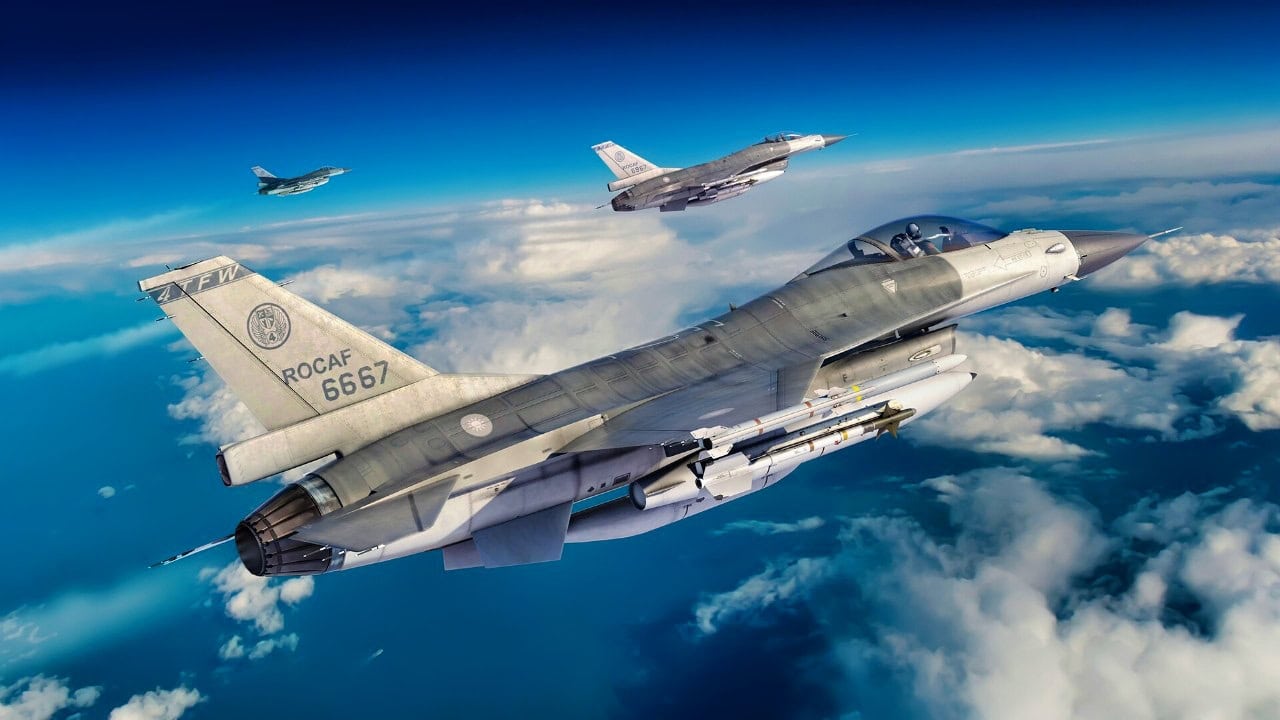
Serials 6727 and 6728 left the United States on August 17, Eastern Time, and are crossing the Pacific toward Taiwan with air refueling and at least one maintenance stop written into the flight plan. They are the first two of 66 F-16V Block 70 fighters Taiwan bought under the Peace Phoenix Soaring project — a program that was supposed to be finished by now.
The original contract schedule called for all 66 jets to be delivered by the end of this year, according to CNA. Two aircraft airborne in mid-August leaves 64 to arrive in roughly four and a half months. That is fourteen aircraft a month. The F-16 line has never produced at that rate, not when it was surging for the U.S. Air Force in the 1980s, and certainly not now, after the production line was relocated, restarted, and hit by supply-chain disruptions. Lockheed Martin has gone to two shifts, running up to 20 hours a day, just to accelerate — and the result is two jets over the Pacific in August.
That is not a delivery milestone. It is a schedule acknowledgment wearing a flight suit.
Do the math
Take the most optimistic public case: four Block 70s a month, sustained, for the rest of the year. Sixty-four aircraft still take sixteen months, which pushes the final deliveries into 2028. And the line is not at four a month, because Taiwan's order shares the factory floor with Block 70 commitments to Bahrain, Bulgaria, Slovakia, Jordan and Morocco. Every one of those governments is waiting on the same production line. Two shifts at 20 hours a day is a surge response, not a plan.
The 2026 completion date in the contract is dead, and everyone in Taipei knows it. The only open question is whether the last jets arrive in 2028 or 2029, and that question is answered in Fort Worth and Greenville, not in Taipei.
What Taiwan is actually waiting for
The Block 70 is not the F-16 Taiwan has been flying for two decades. It brings the AN/APG-83 AESA radar, conformal fuel tanks that stretch combat range, a modern cockpit, and — most importantly — a fresh airframe with decades of service life left. CNA notes the conformal tanks change the ferry equation: when Taiwan's Block 20s flew home in 1997, the transit from Fort Worth through Hickam Air Force Base in Hawaii and Andersen Air Force Base in Guam to Chiayi required 19 air refuelings, roughly one an hour. The Block 70s need fewer because of the tanks, but they still need tanker support over the open Pacific.
That is the part worth remembering. Every F-16 that reaches Taiwan rides an American logistics chain that runs through Hawaii and Guam — the same two islands the Pentagon is now trying to harden against a Pacific fight. The delivery route is a rehearsal of the supply route, and it will be contested the day it matters.
When the full order is in, Taiwan will operate 206 F-16Vs — 140 upgraded Block 20s plus 66 new Block 70s — one of the largest F-16V fleets anywhere. But the fleet number matters less than the schedule. The Block 20s were delivered in 1997-2000; by the time the 66 new jets finish arriving, in 2028 at best, those upgraded airframes will be pushing 30 years old. Taiwan will have spent a decade of its rearmament window waiting on one production line.
Money was never the constraint
President Lai Ching-te on August 17 called Taiwan's record defense spending for next year an investment in peace, per Reuters. The budget line is real, and so is the political will behind it. But the F-16V program shows the actual constraint on Taiwan's air force is not money — it is the pace of the American industrial base. NT$247.2 billion, roughly US$8 billion, buys the jets. It does not buy the factory capacity to produce them faster.
"Lockheed Martin has since operated two shifts, with production running up to 20 hours a day to accelerate production." — CNA, August 19
This is the same disease as AUKUS, just with a smaller price tag. Washington keeps making commitments that outrun what its factories can deliver, and the ally that pays the price is the one whose timeline is fixed by geography. Beijing does not need to outbid anyone here. It only needs to keep building J-20s while the F-16 line trickles out deliveries two aircraft at a time.
The gap is compounding
Anyone who has watched a unit absorb new aircraft knows what a two-jet ferry means operationally: two squadrons' worth of pilots will train up, two squadrons' worth of maintainers will certify, and the air force will write its defense plans around a handful of new fighters rather than the 66 it budgeted for. The People's Liberation Army marks its 100th anniversary next year, and its fighter production is measured in dozens per year, not in schedule slips.
Serials 6727 and 6728 are real, and they are over the Pacific as of this writing. Real, however, is not enough. The remaining 64 will not make 2026, and pretending otherwise is how an air force ends up defending a schedule instead of a coastline.
Two F-16V Block 70 fighters departed from the United States on August 17, heading to Taiwan, while 64 additional jets are delayed and may not arrive until 2028 or 2029. The Taiwanese Air Force is set to operate a total of 206 F-16Vs, but the slow production rate poses significant operational challenges. The delivery route also highlights logistical dependencies on U.S. support.
- Two F-16V Block 70s left the U.S. for Taiwan on August 17.
- Taiwan ordered 66 F-16V Block 70 fighters under the Peace Phoenix Soaring project.
- The delivery schedule is significantly delayed, with 64 jets not expected until 2028 or 2029.
- The F-16V Block 70 features advanced radar and fuel tanks for extended range.
- Taiwan's air force faces operational challenges due to the slow delivery of new aircraft.