
Type 004 Aircraft Carrier Dalian Dock Shaped, PLA Nuclear-Powered Aircraft Carrier Enters 286-Meter Real Ship Stage
 Li Minghui
Type 004 Aircraft Carrier Dalian Dock Takes Shape, PLA Nuclear-Powered Aircraft Carrier Enters 286-Meter Actual Ship Stage
On June 2, the South China Morning Post discussed why countries are still betting on aircraft carriers, and the most interesting detail was not the old saying—that aircraft carriers remain a symbol of great power navies—but that it included the latest satellite images of China's fourth aircraft carrier in this context. A few days earlier, CSIS's commercial satellite image analysis had provided a set of very specific numbers: the hull of this vessel, referred to as Type 004 by outsiders, measures approximately 286 meters from bow to stern in an unfinished state, with a width of about 46 meters near the waterline. This stage is no longer a conceptual drawing or social media speculation; it is an engineering fact revealed by the mass production of steel structures, segment assembly, and power compartment layout.
Examining Dalian's Construction Rhythm from the 286-Meter Hull
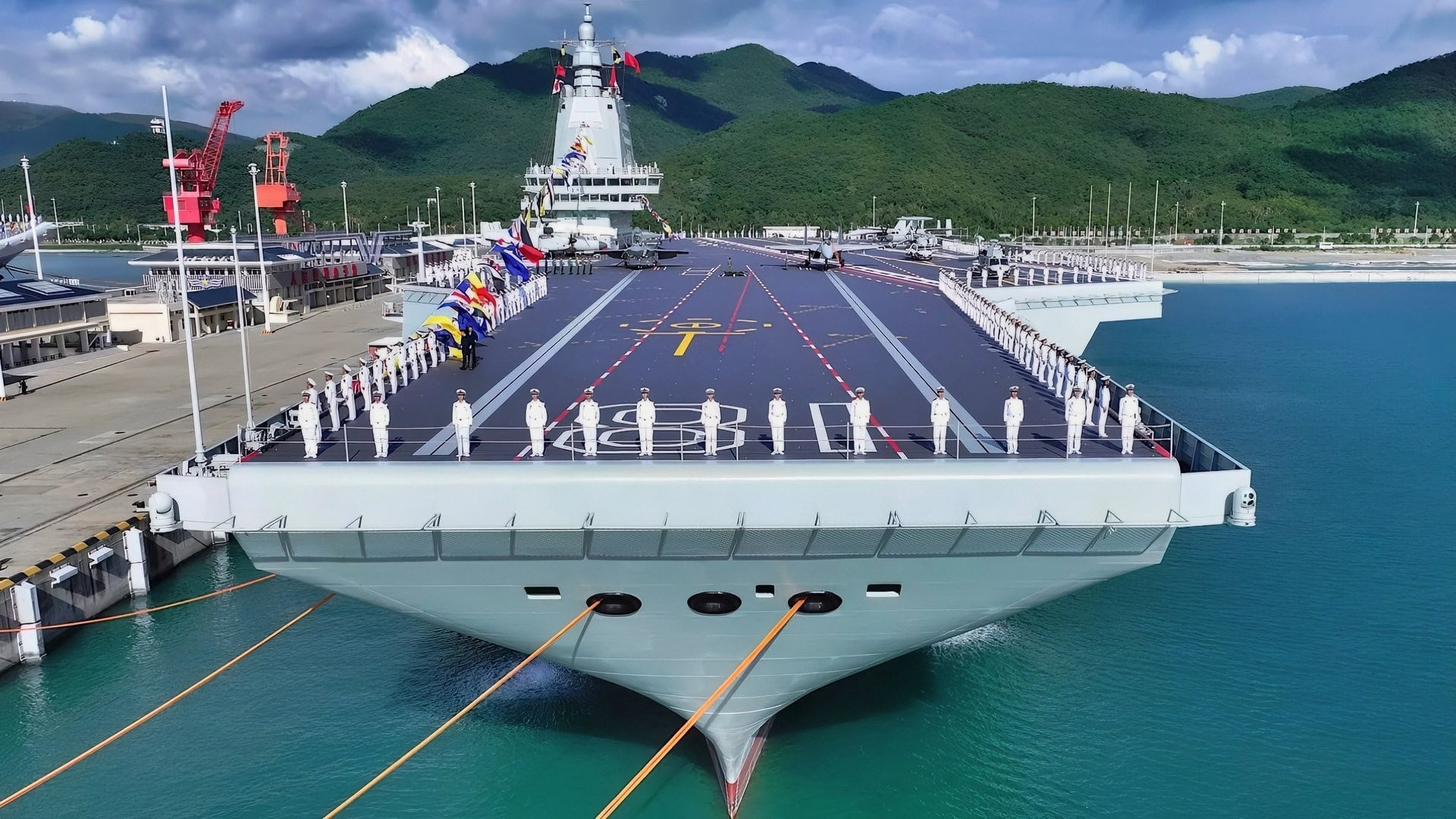
CSIS assesses that the prefabricated hull segments of Type 004 began appearing in the Dalian dock in early 2025, and by May 2026, they had been assembled into a recognizable aircraft carrier shape. This speed indicates two things: first, China is not replicating the single-line exploration of the Liaoning or Shandong, but is recombining the experiences of Jiangnan's construction of the Fujian and Dalian's construction of the ski-jump carrier; second, aircraft carrier construction is transitioning from project-based to shipyard capability-based. In simple terms, what the outside world really needs to see is not when a Type 004 will be launched, but whether Dalian and Jiangnan can establish two large-deck vessel production lines by around 2030.
Currently, public information is still insufficient to confirm the full-load displacement. CSIS cautiously states that Type 004 is likely larger than the Fujian, and that once the flight deck takes shape, its length and area will continue to increase. The official specification for the Fujian is over 80,000 tons, conventionally powered, with electromagnetic catapults. If the hull width of Type 004 has already exceeded that of the Fujian at this stage, and the subsequent deck overhang further increases the area, its aviation fuel, ammunition storage, hangar, and maintenance space will all be elevated to a new level. These spaces are not for parade photos but are prepared for high-frequency operations, deck scheduling, and redundancy in long-range supply.
Nuclear Power Signs More Critical than Four Catapults
The most eye-catching rumor about Type 004 is the four electromagnetic catapults. CSIS believes that the four catapults can currently only be considered "possible," as there has long been a suspected flight deck module near the dock, which seems to have two converging catapult slots. However, I believe that the four catapults are not the most conclusive point at this time. What is more worth noting are the two approximately 15-meter by 15-meter compartments seen in CSIS's satellite images on May 4, which are believed to have characteristics of a shielded nuclear reactor compartment; in contrast, the Fujian did not have such openings at a similar stage.
This is not to say that China has publicly announced that Type 004 is nuclear-powered. On the contrary, the Chinese government has not confirmed the propulsion method of the fourth aircraft carrier. An AP investigation in 2024 pointed to a land-based naval reactor prototype project in Sichuan based on satellite images and procurement documents, mentioning research institutions related to China Shipbuilding and "large surface vessel" equipment. When this clue is combined with the suspected reactor compartment in the Dalian dock, nuclear power shifts from "enthusiast speculation" to "an anomaly that needs engineering explanation."
The significance of nuclear power cannot simply be understood as not needing refueling. For aircraft carriers, electricity is the next generation's threshold. Electromagnetic catapults, integrated power systems, high-power radars, electronic warfare equipment, and potentially directed energy weapons that may be deployed in the future are all competing for the same power pool. The Fujian has already proven that conventional power combined with energy storage systems can also enable electromagnetic catapults, but if the hull is to be enlarged, operational rates increased, and long-range deployments extended, nuclear power will shift the supply pressure from "the ship itself" to "escort ships and carrier-based aircraft support." This step is difficult, but the logic is clear.
The Real Shortcomings Remain in Carrier-Based Aircraft and Support Chain
When the Ministry of Defense released information about the Fujian's commissioning last November, it emphasized that China had entered the era of three aircraft carriers and defined the Fujian as the first electromagnetic catapult aircraft carrier. Subsequent reports indicated that the Fujian had already conducted electromagnetic catapult training around the J-35, J-15T, and KJ-600. If Type 004 adopts a larger deck and more catapults, it could theoretically increase sortie rates, but aircraft are not made of steel, and pilots are not welded together in a dock. The combat effectiveness of an aircraft carrier ultimately hinges on three factors: the number of mature carrier-based aircraft, the training hours of deck personnel, and the long-range supply and maintenance system.
- Hull: The visible length of 286 meters and width of 46 meters indicate that Type 004 has entered the large hull assembly stage.
- Power: The two 15-meter-class suspected reactor compartments are currently the strongest signs of nuclear power, but still require official or clearer image confirmation.
- Aviation Operations: Three or four electromagnetic catapults will affect sortie rates, but carrier-based aircraft, early warning aircraft, and deck processes will more decisively determine combat efficiency.
- Industrial Rhythm: If China aims for a multi-carrier fleet before 2035, it must simultaneously expand escort ships, comprehensive supply ships, and nuclear submarine support forces.
The Changes in the Western Pacific Balance Do Not Happen Overnight
The most direct strategic impact of Type 004 is pushing the PLA Navy from a "near-seas strong, far-seas cautious" approach to aircraft carrier usage. The Liaoning and Shandong primarily undertake training, presence demonstration, and near-seas pressure; the Fujian addresses electromagnetic catapults and the deployment of fixed-wing early warning aircraft; if Type 004 is indeed nuclear-powered, it resolves issues of long-range sustainability and large power surplus. The three are not simply a quantitative addition but represent a progression from training platforms, regional aircraft carriers to blue-water aircraft carriers.
However, a dose of cold water is also needed here. The advantage of U.S. aircraft carriers lies not only in the 11 nuclear-powered carriers but also in decades of developed carrier aviation, overseas bases, supply fleets, allied ports, and combat damage control experience. The fact that Chinese shipyards have pushed the Type 004 hull to 286 meters only proves that Chinese industry is rapidly catching up on the "building large ships" lesson; it does not automatically prove that the PLA has mastered global aircraft carrier operations. The truly unanswered question is: when Type 004 eventually leaves the Dalian dock, can the Chinese Navy simultaneously provide enough KJ-600s, J-35 pilots, and long-range nuclear submarine escort forces? This is much harder to hide in satellite images than the hull itself.
Main references: CSIS May 21, 2026, "Tracking China’s Fourth Aircraft Carrier," South China Morning Post June 2, 2026, aircraft carrier trend report, public information from the Chinese Ministry of Defense regarding the Fujian's commissioning and live-fire training, AP 2024 investigation on China's naval nuclear power projects.
China's fourth aircraft carrier, Type 004, has reached a significant construction milestone in Dalian, measuring approximately 286 meters in length and 46 meters in width. This development suggests advancements in naval capabilities, with indications of nuclear propulsion and enhanced operational capacity. The carrier is expected to be operational by 2030, marking a strategic shift in the People's Liberation Army Navy's approach to maritime operations.
- The Type 004 aircraft carrier hull is approximately 286 meters long and 46 meters wide.
- Construction is progressing with the potential for nuclear propulsion indicated by the presence of reactor sections.
- The carrier is expected to enhance China's naval capabilities significantly by 2030.
- The report suggests a shift in China's naval strategy towards blue-water operations.
- The construction timeline indicates a shift from project-based to production-line capabilities.