
Type 076 Amphibious Assault Ship's First Test of the J-21 Drone Fighter: PLA's Unmanned Aircraft Carrier Crosses a Key Threshold
 Li Minghui
Type 076 Amphibious Assault Ship Conducts First Test of J-21 Unmanned Combat Aircraft, PLA's Unmanned Aircraft Carrier Crosses a Key Threshold
From November 2 to 3, multiple open sources disclosed that the PLA Navy's Type 076 amphibious assault ship "Sichuan" completed the first catapult launch and arrested recovery of the J-21 (GJ-21) unmanned combat aircraft. The China Military Network stated that this was the first public demonstration of the ship's onboard armed reconnaissance stealth drone takeoff and landing; the U.S. Naval Institute News and The Maritime Executive also reported on this test. The truly important aspect is not just the phrase "drone on board," but rather that the Type 076 integrates electromagnetic catapults, arrested recovery, and an amphibious ship platform.
Why Does an Amphibious Ship Need a Catapult?
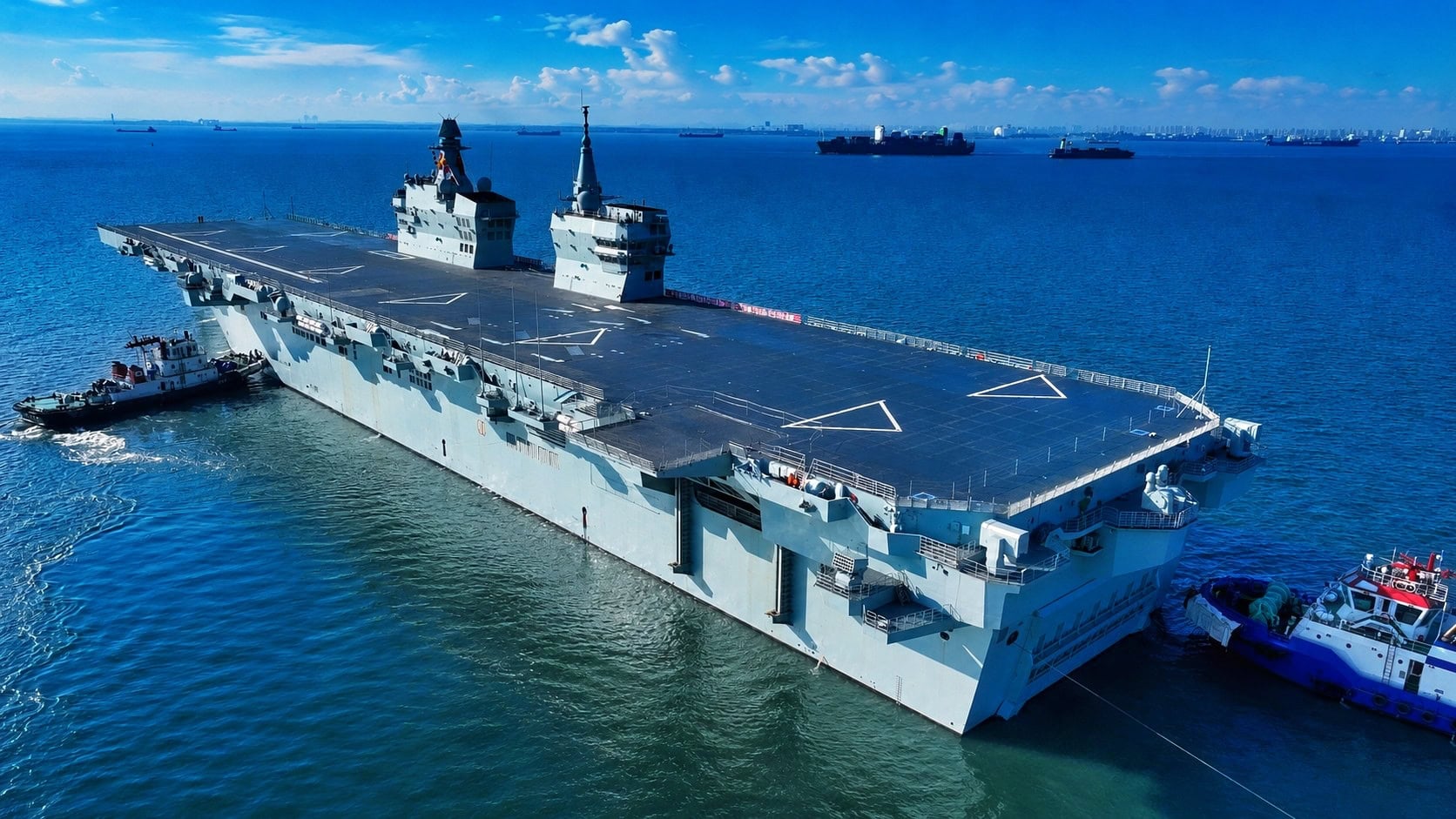
Public information shows that the Type 076 was launched in December 2024 and began sea trials in November 2025. The Maritime Executive estimates its flight deck to be approximately 259 meters long and 52 meters wide, equipped with two aircraft elevators on either side, while still retaining a dock chamber at the stern. Its tonnage and deck area are smaller than those of the Type 003 aircraft carrier, yet it is equipped with an electromagnetic catapult system. This design indicates that its primary mission is not to replicate a conventional aircraft carrier, but rather to validate high-frequency unmanned aircraft operations using a relatively small platform.
The J-21 is considered a carrier-based variant of the Hongdu GJ-11 "Sword" series. The GJ-11 made its maiden flight as early as 2013, with public reports indicating a maximum takeoff weight of about 9 tons and an internal weapons bay. For this flying wing design, which lacks traditional tail surfaces, the catapult can reduce the requirements for its own takeoff weight and engine thrust; arrested recovery allows it to operate without relying on a large straight deck. In other words, the Type 076 primarily addresses how unmanned aircraft can stably enter and exit the deck, rather than immediately forming a complete carrier-based aircraft fleet.
What Can It Change?
First, the Type 076 can extend the reconnaissance radius from the vicinity of the amphibious formation to more distant waters. Stealth unmanned aircraft undertake forward reconnaissance, electronic support, and target designation, providing continuous aerial information for surface vessels, long-range firepower, and landing forces. Second, it provides the PLA with a low-risk manned-unmanned cooperative testing ground. The ship first verifies flight route planning, deck scheduling, data links, and recovery procedures, and then transfers the mature experience to larger catapult-equipped carriers like the Fujian.
However, referring to the Type 076 as an "unmanned aircraft carrier" should still be approached with caution. The public performance, payload, communication anti-jamming capabilities, and actual sortie rates of the J-21 have not been disclosed; a single successful takeoff and landing does not equate to completing tests under sea conditions, at night, or during high-intensity continuous operations. More realistic bottlenecks may lie in the onboard data link, backup navigation, engine maintenance, and the speed of replenishing unmanned aircraft. In simple terms, whether the deck can launch is just a ticket to entry; the ability to continuously fly dozens of sorties in distant seas is the true combat capability.
Viewing China's Military Industrial Logic from One Ship
The value of the Type 076 also lies in its connection of large surface ship construction experience with the rapid iteration of the unmanned aircraft industry. If subsequent vessels can replicate the electromagnetic catapult and onboard support systems, the PLA Navy may form a layered grouping where "aircraft carriers are responsible for manned aircraft and long-range air superiority, while the Type 076 is responsible for unmanned reconnaissance and expendable missions." This division of labor helps reduce the risk of placing expensive manned aircraft in frontline reconnaissance missions and allows amphibious formations to achieve more stable situational awareness.
However, the number of platforms cannot automatically translate into combat power. The Type 076 requires escort vessels, supply ships, and reliable satellite and theater data links; the GJ-21 also needs to be mass-produced, maintained at sea, and quickly replaced after damage. The author believes that the next most noteworthy observation is not whether the "Sichuan" will fly again, but whether the PLA will disclose the scale of its carrier-based unmanned aircraft, continuous sortie data, and the actual results of cooperation with manned aircraft. China has already proven it can build an unmanned aircraft carrier; whether it can turn it into a sustainable unmanned combat system remains to be seen in sea trials.
Main Sources
- China Military Network report on the Type 076 completing the takeoff test of the onboard armed reconnaissance stealth drone (November 2026)
- U.S. Naval Institute News, "China’s New Drone Carrier Launches, Recovers First Autonomous Combat Aircraft" (November 2, 2026)
- The Maritime Executive, "China’s New Drone Carrier Amphib Test-Launches First Unmanned Fighter" (November 3, 2026)
The People's Liberation Army Navy's 076 amphibious assault ship 'Sichuan' successfully launched and recovered the GJ-21 unmanned combat aircraft on November 2-3, 2026. This event marks a significant advancement in carrier-based drone operations, showcasing the integration of electromagnetic launch systems. The GJ-21 is a naval variant of the GJ-11 drone, indicating a strategic shift in the PLA's operational capabilities with unmanned systems.
- The 076 amphibious assault ship 'Sichuan' successfully launched and recovered the GJ-21 unmanned combat aircraft.
- This marks the first public demonstration of carrier-based operations for the GJ-21.
- The 076 class is designed to validate high-frequency drone operations rather than replicate a conventional aircraft carrier.
- The GJ-21 is a naval variant of the GJ-11 drone, which first flew in 2013.
- The testing indicates a shift in the PLA's operational capabilities with unmanned systems.