
UK fighter jets intercept Russian aircraft near flagship carrier
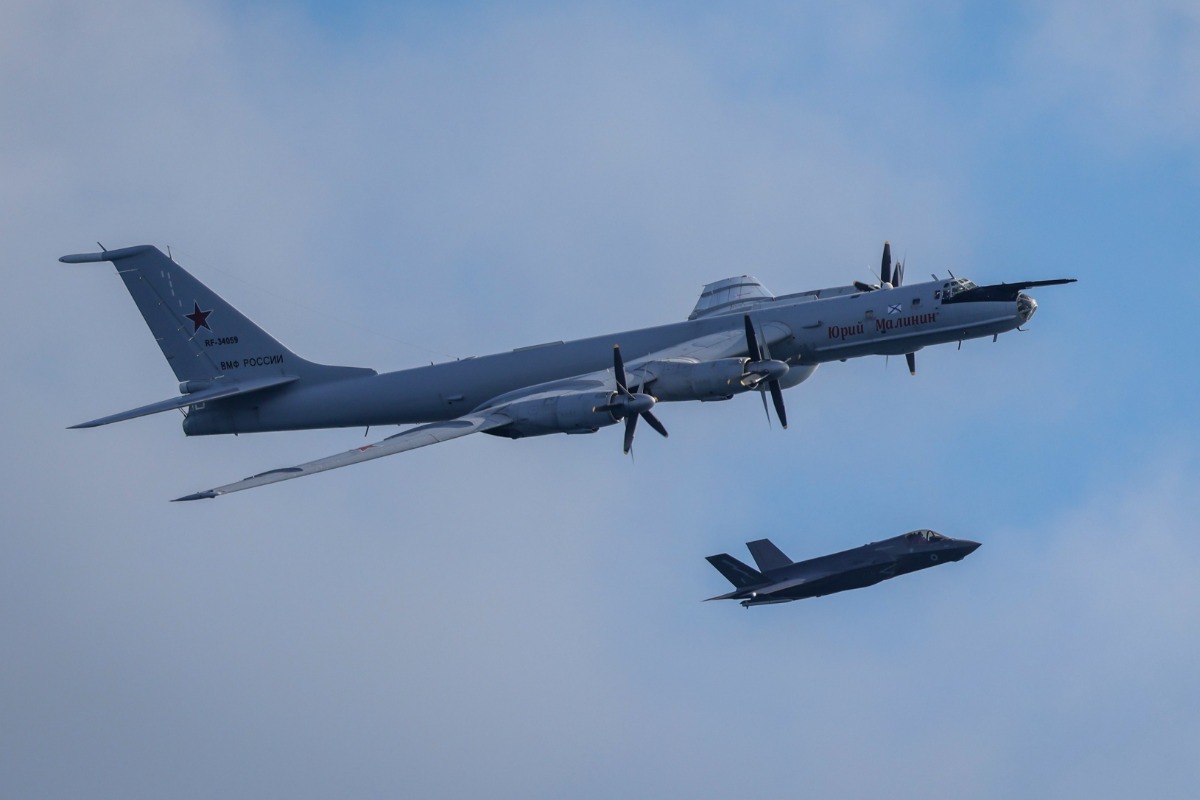
A Russian surveillance plane flew dangerously close to Britain’s flagship aircraft carrier and dropped a swarm of underwater listening devices nearby before ignoring repeated radio calls, forcing two fighter jets to scramble and chase it away.
The UK Ministry of Defence confirmed that while operating in the Norwegian Sea as part of Operation Firecrest, the Royal Navy’s Carrier Strike Group, led by HMS Prince of Wales, was approached repeatedly by a Russian Tu-142 aircraft known by the NATO reporting name Bear-F, a Soviet-era maritime patrol plane built on the airframe of the Tu-95 strategic bomber and equipped for both anti-submarine warfare and long-range reconnaissance. According to the ministry, the aircraft passed at low altitude and unnecessarily close to the carrier and dropped a large number of sonobuoys, small underwater sensors that detect and track submarines by picking up sound in the water, in close proximity to HMS Prince of Wales before failing to respond when British forces attempted contact on international safety frequencies.
An MOD spokesperson described the encounter in blunt terms.
“While operating in the Norwegian Sea on Operation Firecrest, the UK’s Carrier Strike Group was repeatedly approached by a Russian ‘Bear-F’ maritime patrol aircraft. The Bear-F passed at low altitude and unnecessarily close to HMS Prince of Wales and dropped a large number of sonobuoys in close proximity to the carrier. This activity was unsafe and unprofessional. The Russian aircraft was intercepted and escorted by two UK F-35 jets from HMS Prince of Wales until it left the area,” the spokesperson said.
The sonobuoys the Bear-F dropped were almost certainly an attempt to locate any submarine or undersea sensor network protecting the carrier group, since a maritime patrol aircraft that can detect a hidden submarine escort gains valuable intelligence about how the strike group defends itself against underwater threats, information a Russian aircraft would have every incentive to gather during a period of heightened naval activity across the North Atlantic and Arctic. Two F-35B Lightning II jets launched directly from HMS Prince of Wales to intercept the Russian aircraft, flown by pilots from 809 Naval Air Squadron and 617 Squadron, both based at RAF Marham in Norfolk and embarked specifically for this deployment, and the fighters escorted the Bear-F until it departed the area entirely.
HMS Prince of Wales is the Royal Navy’s largest warship and has led this Carrier Strike Group across the North Atlantic and High North since the deployment began earlier this year under Operation Firecrest, a mission the UK Ministry of Defence confirmed on February 14, 2026, framing it explicitly as a response to rising Russian maritime activity and growing concern over threats to undersea infrastructure like fiber-optic cables and energy pipelines that keep much of Europe connected and powered. The strike group combines the F-35Bs with Type 45 destroyer HMS Duncan for air defense, additional frigates for anti-submarine work, an Astute-class nuclear-powered attack submarine, and Royal Fleet Auxiliary support vessels including RFA Tidespring, carrying roughly 1,500 British personnel currently operating off Iceland under NATO command. Beyond its fighter jets, HMS Prince of Wales also carries Merlin Mk2 helicopters equipped for submarine hunting and Wildcat helicopters armed with Martlet multi-role missiles, giving the carrier layered options for detecting and responding to underwater threats well beyond what its embarked F-35s alone could provide.
Russian aircraft probing NATO naval formations in the High North has become a recurring feature of the current security environment rather than a rare provocation, and incidents like this one serve a dual purpose for Moscow, gathering genuine intelligence about how Western naval assets defend themselves while also testing how quickly and visibly those assets respond when challenged. The Royal Navy’s answer this week, two F-35s airborne fast enough to intercept and escort the Bear-F before it could linger any longer near the carrier, offers a concrete demonstration of exactly the deterrence Operation Firecrest was designed to project, even as the encounter itself confirms that Russia continues testing those defenses in waters Britain and its NATO allies consider increasingly central to their own security.
Content preview only. Full article available at source. View Full Article
Two UK F-35B Lightning II jets intercepted a Russian Tu-142 surveillance aircraft in the Norwegian Sea on February 14, 2026. The Russian aircraft dropped sonobuoys near the HMS Prince of Wales and ignored repeated radio calls from British forces. This incident is part of Operation Firecrest, aimed at countering increased Russian maritime activity.
- A Russian Tu-142 aircraft approached the HMS Prince of Wales and dropped sonobuoys.
- Two UK F-35B jets intercepted the Russian aircraft.
- The incident occurred in the Norwegian Sea as part of Operation Firecrest.
- The Russian aircraft ignored radio calls from British forces.
- The encounter highlights ongoing Russian probing of NATO naval formations.