
Ukraine Is Building Faster Interceptors for Russia’s Jet Drones
 S.W
S.WUkraine Is Building Faster Interceptors for Russia’s Jet Drones
Russia has changed the arithmetic of the drone war. Ukraine is now racing to change it back.
At the MSPO defence exhibition in Kielce, Poland, this week, Ukrainian companies presented a new generation of air-defence interceptors designed specifically for Russian jet-powered drones. The shift matters because the cheap, slow Shahed threat is no longer the only problem. Moscow is increasingly fielding faster Geran variants that give defenders less time to detect, classify and engage them.
The target is getting faster
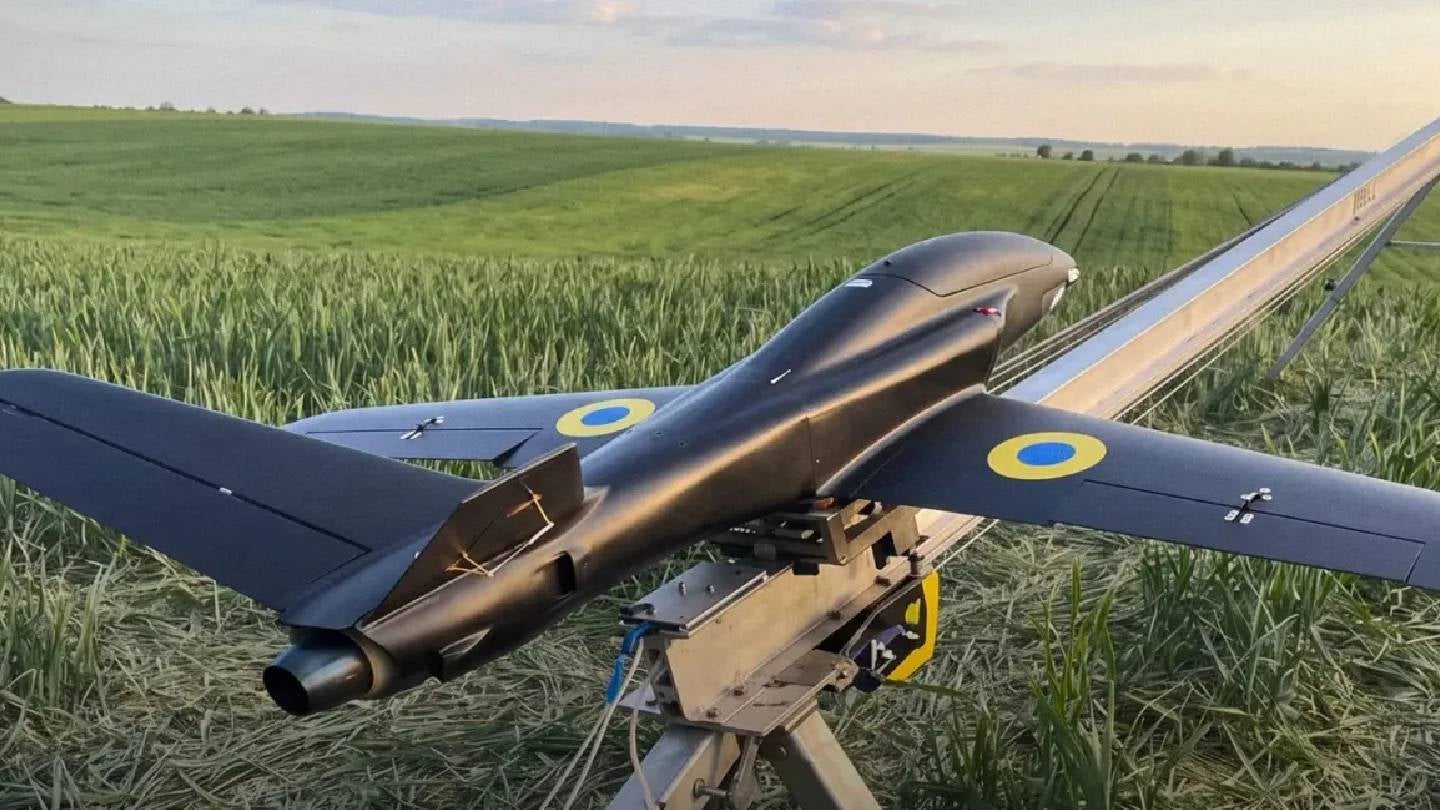
Defense News reported from MSPO on September 9 that General Cherry is modifying its Bullet interceptor with a kinetic booster. The planned version is expected to reach roughly 450 km/h and use more heat-resistant materials, with testing and a release planned for this autumn. Grim Tech is pursuing a faster design with a stated top speed between 500 and 700 km/h, aiming to show a jet-powered interceptor by the end of October.
Those numbers are not a guarantee of battlefield performance. They are, however, a useful admission of the problem. An interceptor that was adequate against a conventional propeller-driven Shahed can lose its advantage when the incoming drone crosses the engagement zone much faster. The margin for a mobile fire team, a radar operator or a fighter pilot is measured in minutes, sometimes seconds.
The Ukrainian response is not limited to speed. BlueBird Tech told Defense News that its own interceptor remains at an early research stage, but that affordability and mass production are design requirements. The company says its research cycles are measured in weeks rather than years. That is the real Ukrainian advantage: not unlimited industrial capacity, but an unusually short feedback loop between battlefield failure and the next prototype.
Why cost matters more than a perfect kill
Air defence is often discussed as if accuracy were the only metric. It is not. A defender can win every individual engagement and still lose the campaign if each interception costs vastly more than the incoming weapon.
Ukraine therefore wants an interceptor cheaper than the target it destroys. That sounds obvious until the alternatives are considered. Surface-to-air missiles are scarce and expensive. Fighter aircraft cannot be everywhere at once. Electronic warfare can disrupt some drones but cannot be assumed to defeat every new navigation package. A low-cost kinetic interceptor will not replace Patriot or other layered systems, but it can protect those systems from being consumed by a saturation attack.
This is where the programme becomes strategically interesting for NATO. European militaries are buying counter-drone equipment, but many acquisition cycles still assume that a requirement can be written, tendered and delivered over several years. Ukraine is demonstrating a harsher model. The requirement changes every few months because the adversary changes the threat every few months.
Russia is testing NATO’s reaction time
The danger is no longer confined to Ukrainian cities. In its September 8 assessment, the Institute for the Study of War said a Russian drone spent just under an hour moving through Moldovan and Romanian airspace before crashing in Moldova. Romanian and Moldovan authorities reported the route; ISW said it could not independently confirm the exact Geran variant, but assessed that the flight pattern and recent Russian usage were consistent with a faster jet-powered design.
ISW estimates that a Geran-4 travelling at up to 450 km/h could reach the Moldovan border from Odesa in about six minutes and the Romanian border in roughly 20 minutes. Whether the incursion was deliberate is not established. The strategic effect is still real. Faster drones compress the time available for national authorities to decide whether an object is lost, hostile or part of a wider attack. They also force NATO to reveal how it handles ambiguous threats close to an alliance frontier.
Moscow does not need every drone to hit its intended target. If repeated incursions make neighbouring governments hesitate, spend heavily on emergency coverage and debate the credibility of collective defence, the disruption itself becomes useful. This is a cheaper form of pressure than a direct attack and a more politically awkward one.
Ukraine’s lesson for Europe
The popular assumption is that Ukraine needs Western air-defence systems while Europe needs Ukrainian innovation. The reality is more uncomfortable. Both sides need the other, and neither can afford to treat the relationship as a one-way transfer.
Ukraine needs sensors, secure communications, production finance and access to larger manufacturing networks. European states need combat-tested designs, rapid iteration and a better understanding of what mass drone attacks do to command decisions. Partnerships already emerging around MSPO, including cooperation between Estonian counter-drone specialist DefSecIntel Solutions and Ukrainian-Estonian DoD Solution, point in the right direction.
But a prototype is not a capability. The next test is whether these firms can produce thousands of reliable interceptors, integrate them into a layered air-defence network and keep unit prices below the weapons they defeat. October demonstrations will attract attention. Production contracts and deployment data will matter more.
The uncomfortable conclusion
Ukraine is not solving the jet-drone problem with one wonder weapon. It is building an industrial response before the threat has finished evolving. That may be the only sustainable answer.
For NATO, the warning is blunt. Europe cannot buy its way out of the drone age with a small number of exquisite missiles, and it cannot assume that a border incident will provide enough warning for a leisurely political decision. The alliance needs cheap interceptors, shared air pictures and rules for rapid engagement. Russia is already experimenting with the reaction time. The question is whether NATO will experiment with its own before the next drone crosses the border.
Sources
- Defense News, September 9, 2026, reporting from MSPO on Ukrainian jet-drone interceptors: Ukrainian industry scrambles to field interceptors against Russian jet drones.
- Institute for the Study of War, September 8, 2026, Russian Offensive Campaign Assessment: ISW assessment.
- Army Technology, August 24, 2026, on Ukraine’s Alexa Spatium interceptor: Ukraine targets Russian UAVs with new Alexa Spatium drone interceptor.
Ukraine is developing faster air-defense interceptors to counter Russian jet drones, showcased at the MSPO defense exhibition in Kielce, Poland, in September 2026. The new interceptors aim to address the threat posed by faster Geran variants, with testing planned for autumn. This development highlights Ukraine's focus on affordability and rapid production cycles in response to evolving drone threats.
- Ukraine is developing faster interceptors for Russian jet drones.
- The new interceptors are designed to counter the faster Geran variants of Russian drones.
- Testing and release of the new interceptors are planned for autumn 2026.
- Ukraine's interceptor designs focus on affordability and rapid production cycles.
- Faster drones compress decision-making time for national authorities.