
Ukraine's 300-Patriot Shortfall Exposes NATO's Winter Air-Defense Test
 Alexandra Reeves
Ukraine's 300-Patriot Shortfall Exposes NATO's Winter Air-Defense Test
Three hundred Patriot interceptors would not solve Ukraine's air-defence problem. They would buy time. That is precisely why Kyiv's request matters: it exposes the gap between Europe's political promises and the missiles available to defend a country that is still absorbing Russia's strike campaign.
According to Defense News, Ukraine has signed contracts for roughly 1,000 Patriot missiles, but most are years away. Defence Minister Yevhen Khmara has asked partners to transfer 300 interceptors from existing stocks now, with newer missiles delivered later as replacements. Germany has promised an undisclosed number of PAC-2 interceptors, while Britain has committed £100 million through NATO's Prioritised Ukraine Requirements List for Patriot and other air-defence equipment intended to arrive before winter.
The arithmetic is uncomfortable. Ukraine does not need another announcement about future production. It needs enough high-end interceptors to survive the next Russian campaign against its energy system.
The ballistic problem is the hard problem
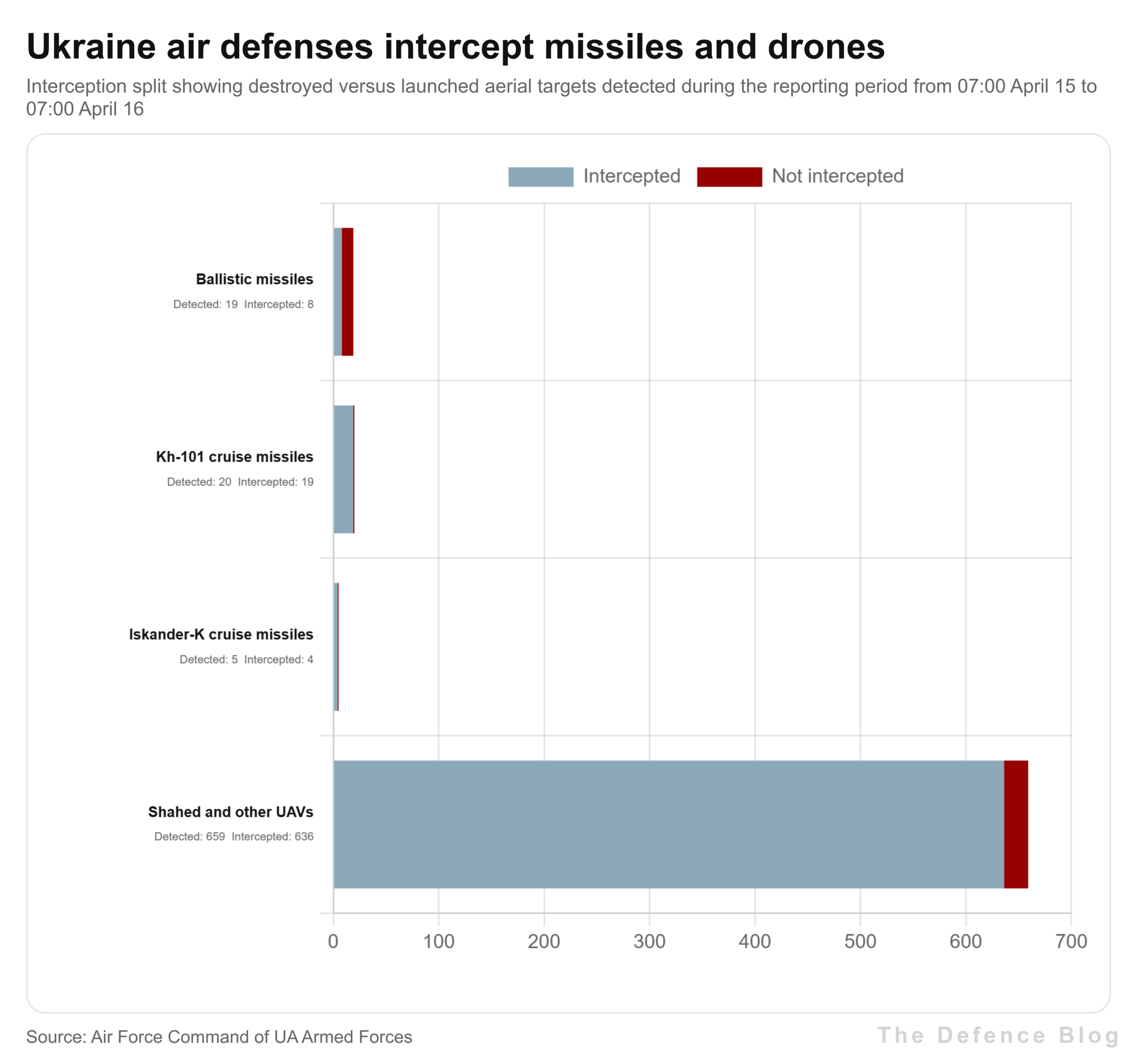
Ukraine's air-defence network is fighting two different wars at once. Cruise missiles and older Shahed drones can often be engaged by cheaper systems, fighter aircraft, or increasingly capable interceptor drones. Ballistic missiles compress the timeline and arrive on a much steeper trajectory. Kyiv's own officials say Patriot remains the only reliably effective answer to Russia's ballistic threat.
Defense News reported that, after a barrage involving 70 missiles and waves of Shahed drones, Ukrainian forces claimed 39 of 48 cruise missiles destroyed but only five ballistic missiles. That is not a verdict on Ukrainian crews. It is a warning about inventory, geometry, and the limits of improvised defence. A defender can have excellent operators and still lose when the correct interceptor is unavailable.
The technical distinction matters. PAC-3 MSE is a hit-to-kill interceptor designed to destroy a target through direct collision, while PAC-2 GEM-T uses a fragmentation warhead and is used against a different portion of the threat set. Treating Patriot as one interchangeable missile obscures the procurement problem. Kyiv needs the right variant, at the right alert site, before the next salvo.
Europe is buying time, not yet resilience
The European response is moving on several clocks. Transfers from national stockpiles can help this winter. Licensed production of Patriot and the Franco-Italian Aster 30 could improve the picture over the next several years. Ukraine and European partners are also pursuing Freyja, a Ukrainian-designed interceptor built around the FP-7.X missile, with its own launcher, radar, and command network.
Freyja is strategically interesting because its proposed economics are less punishing. The system is intended to integrate with NATO-standard radars and command posts, and its interceptor is priced at roughly $1 million per round, about one-quarter of the reported cost of a PAC-3 MSE. Its FP-7.X missile has flown, and the design is intended to engage ballistic targets at roughly 15 miles altitude with a fragmentation warhead. But it remains a programme in development. It cannot cover the gap this winter.
Nor can industrial promises instantly fix it. Lockheed Martin says it aims to lift annual PAC-3 MSE production from around 600 missiles to 2,000 by 2030. That is a major expansion, but a 2030 solution does not protect Kyiv's grid in December 2026. The same bottleneck is visible across Europe: factories can be funded faster than they can be built, tested, staffed, and supplied with the specialised components that make missile defence work.
The alliance problem behind the missile problem
This is where the Patriot shortage becomes a NATO issue rather than a Ukrainian one. Defense News reported that US forces in Europe faced a beyond-critical shortage of Patriot interceptors after stocks were moved to the Middle East during the Iran war. In other words, the alliance is not choosing between abundance and solidarity. It is choosing which exposed flank accepts more risk.
That choice has consequences beyond Kyiv. If Russia can force Ukraine to spend scarce ballistic interceptors on each major attack, Moscow can turn air defence into a strategic exhaustion contest. Energy infrastructure becomes the pressure point, but the target is political endurance: civilian confidence, industrial output, and the willingness of European governments to keep financing the war.
Recent reporting by the BBC also shows why ceasefire announcements cannot substitute for air defence. President Trump said Russia and Ukraine had agreed to stop striking energy infrastructure, while Moscow publicly offered little confirmation. Ukrainian officials continued to report attacks. A promise that cannot be verified or enforced is not a shield. It is simply another variable in the defender's planning cycle.
What NATO should watch next
- Stockpile transfers: whether Germany and other allies release usable PAC-2 and PAC-3 rounds before winter, not merely announce future orders.
- Threat allocation: whether Ukraine can reserve Patriot for ballistic missiles instead of using it against faster jet-powered drones.
- Production decisions: whether European licensed production receives firm dates, workshares, and test milestones rather than political language.
- Command integration: whether emerging systems such as Freyja can genuinely plug into NATO-standard radar and control networks.
Ukraine's air-defence patchwork is not evidence that European support has failed. It is evidence that support remains too slow, too fragmented, and too dependent on a small number of American interceptors. Kyiv may assemble enough layers to blunt Russia's winter campaign. But NATO should stop calling that resilience until the missiles are in the magazines.
The real test is not whether Europe can promise 1,000 Patriots by the end of the decade. It is whether 300 can be found before the next night of ballistic strikes.
Ukraine requested the immediate transfer of 300 Patriot interceptors to bolster its air defense against Russian strikes this winter. Despite contracts for 1,000 Patriot missiles, most will not be available for years. Germany and Britain have pledged support, but Ukraine's current air defense capabilities are insufficient to counter the ballistic missile threat. The situation highlights the urgent need for effective air defense systems and the challenges in procurement and supply.
- Ukraine has signed contracts for approximately 1,000 Patriot missiles, but most are years away.
- Ukraine's Defense Minister requested 300 interceptors from existing stocks for immediate use.
- Germany and Britain have made commitments to supply air defense equipment before winter.
- Ukrainian forces reported a significant shortfall in intercepting ballistic missiles compared to cruise missiles.
- The Freyja interceptor is in development but cannot address immediate needs.