
U.S. Air Force B-52 pilots learn refueling in VR first
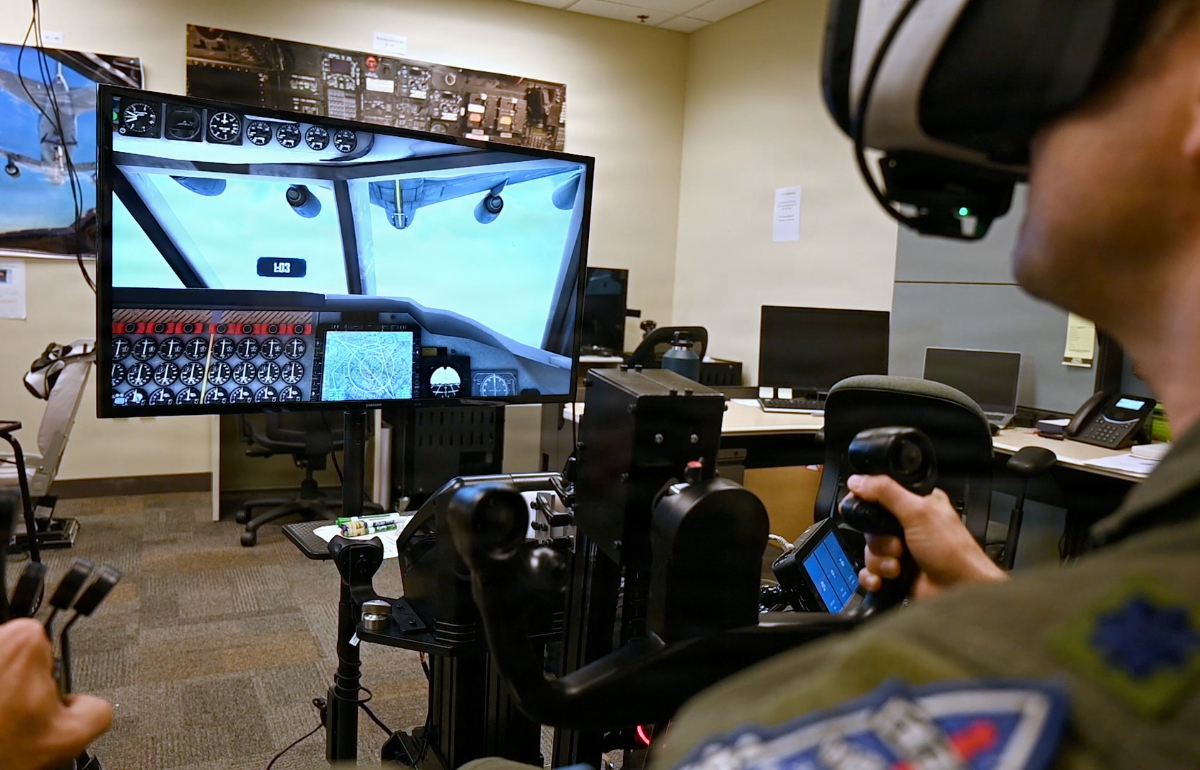
New U.S. Air Force B-52 Stratofortress pilots are now making contact with a refueling tanker on their first live training flight, a skill that once took students several sorties to master, after the bomber’s training unit at Barksdale Air Force Base, Louisiana, built its air refueling instruction around a virtual reality trainer.
A peer-reviewed study of 233 B-52 pilot trainees found that students who learned on the headset under a structured curriculum needed an average of 1.7 fewer sorties and 39 fewer minutes of flight time to reach proficiency than students trained the traditional way. The results were published in the Journal of Aviation/Aerospace Education & Research.
The device is the Experiential Air Refueling Lightweight Simulator, or EARL, built by small business Specular Theory. It pairs a VR headset with custom throttles and a yoke mounted to a chair, letting students practice the final approach to a tanker’s boom on the ground. Lt. Col. Brandon Wolf, an instructor pilot with the 93rd Bomb Squadron, began working with the company on the project in 2020.
“I’m trying to park a half-million-pound aircraft into a twelve-foot box in the sky,” said Wolf. “And every practice run is expensive.”
The B-52 burns roughly 11,400 liters (3,000 gallons) of fuel an hour, Wolf said. Under the old approach, a student might hold position about 15 m (50 feet) behind the tanker’s boom for 20 or 30 minutes without ever making contact or taking on fuel, and training depended on tanker availability, weather and maintenance.
“Air refueling was the long pole in the tent for our training pipeline,” said Wolf. “It was very difficult for students to master in the allotted flights we had. We had to go to heroic efforts to get everyone graduated on time.”
Col. Aaron Bohl, commander of the 307th Operations Group, said the unit lacked a high-fidelity simulator that could reproduce air refueling in the B-52 before EARL arrived.
The study compared three groups of trainees: those taught the traditional way without VR, those who used VR in a semi-structured way, and those trained under a fully structured VR curriculum called I-BUFF, short for Integrated B-52 Unit Flight Familiarization. Wolf developed the model with a team from Louisiana Tech University through an Air Force Global Strike Command fellowship. Early on, simply handing students a headset without a required curriculum produced little engagement, Wolf said.
“It’s like going to the gym: even when you know it’s good for you, it’s easy to put off if nobody’s holding you accountable,” said Wolf.
The command’s Striker STEEL program joined the effort in late 2022 and early 2023, adding cognitive training that raises the mental workload as students improve. Eye-tracking data showed that student pilots’ eyes wander across the instrument panel, while experienced instructors rely on peripheral vision to catch small alignment cues, said Dr. Tucker Readdy, the program’s chief scientist.
“The real difficult cognitive skill is change detection,” said Readdy. “If those three points are aligned, then you should stay connected to the boom, and fuel is good.”
Students must also push 20 to 30 pounds (9 to 14 kg) of force through the yoke while wearing a parachute and breathing through an oxygen mask, which the program says makes ground practice valuable before facing that load in flight.
Wolf said the sorties saved are being redirected to other training, including weapons employment on the range and landings.
“Cutting nearly two sorties saves real money, but more importantly, we’re reinvesting that time in other parts of training,” said Wolf.
Air Force Global Strike Command’s innovation hub, STRIKEWERX, has estimated that EARL could save about $5.8 million a year in real-world training costs. Bohl said the bigger gain for him is safety.
“Students are now working on the fine-tuning of air refueling before their first time behind a live aircraft,” said Bohl.
The program is not yet a formal part of the B-52 training syllabus. The Air Force says the peer-reviewed results open the way for EARL and the I-BUFF model to be written into the curriculum and possibly adopted for other aircraft in Global Strike Command, but it has not announced a timeline.
Content preview only. Full article available at source. View Full Article
U.S. Air Force B-52 pilots at Barksdale Air Force Base are now utilizing a virtual reality trainer for air refueling training, significantly reducing the number of sorties required for proficiency. This innovative approach, developed in collaboration with Specular Theory, has shown to save time and costs while enhancing safety. The program is currently not part of the formal training syllabus but has potential for broader application within the Air Force.
- B-52 pilots are now using VR for air refueling training.
- The VR training reduces the number of sorties needed for proficiency.
- The program is expected to save $5.8 million annually in training costs.
- The training is not yet formalized in the B-52 syllabus.
- The EARL simulator enhances safety and efficiency in training.