
U.S. Army expands Iowa artillery plant built for wartime surge
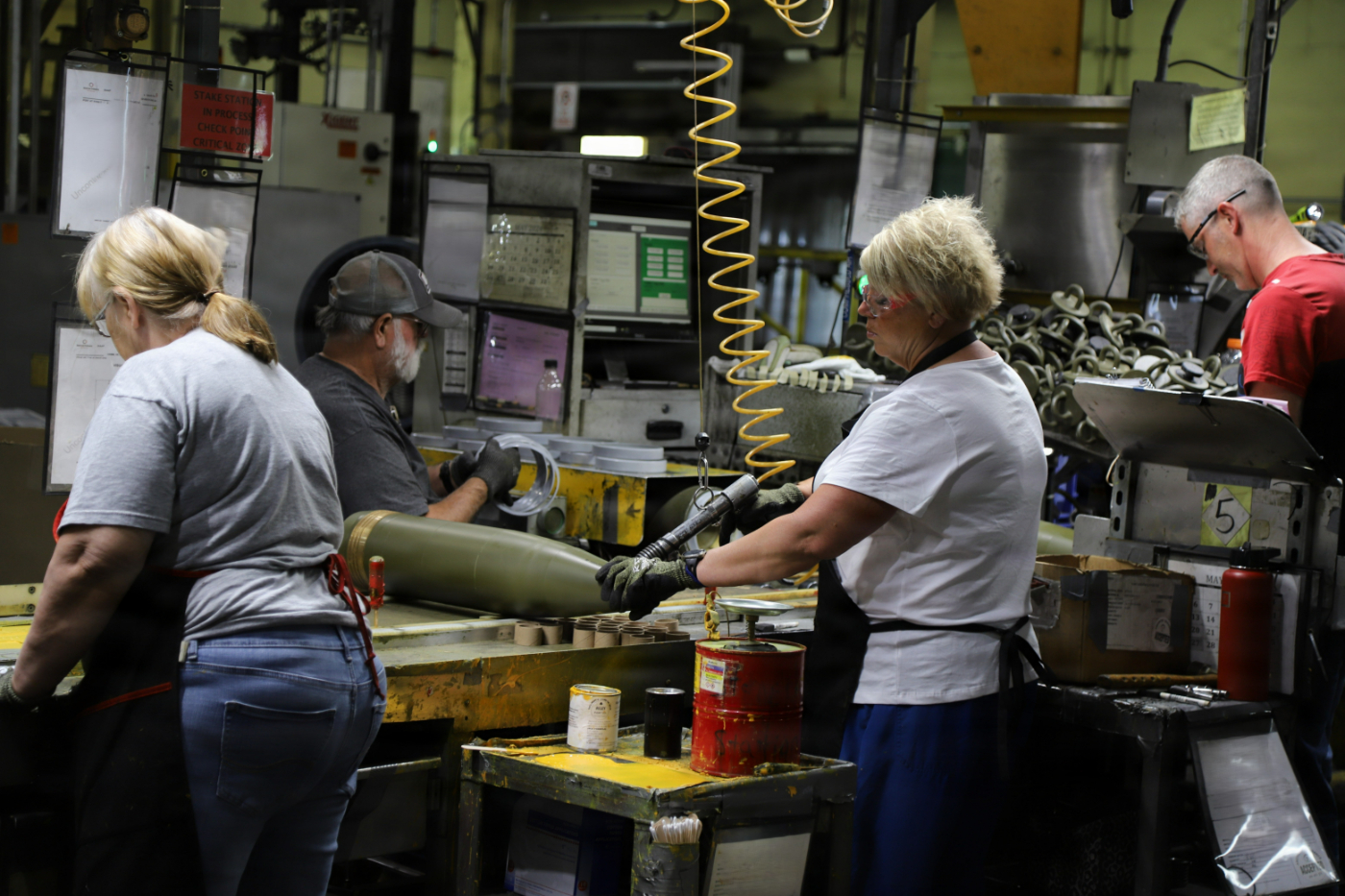
The United States is putting more money into building artillery production that can surge in wartime, with the U.S. Army adding $105.8 million to MSM Group North America’s contract for a new 155mm shell loading complex at the Iowa Army Ammunition Plant. The modification, announced by the U.S. Department of War, raises the total value of the contract to $741 million and keeps completion of what the Army calls the Future Artillery Complex on schedule for Aug. 10, 2029.
The Army says the plant is designed to scale output for wartime surges and to drop back to a lower sustaining rate in peacetime without becoming uneconomical to run. CSG, the Czech defense group that owns MSM, says the complex will be able to load up to 36,000 155mm projectiles a month, about 432,000 a year, and MSM North America has said it is being built to remain in service for 50 years.
The contract is one piece of a broader push by the Pentagon to move the U.S. defense industry toward wartime production levels. Secretary of War Pete Hegseth laid out the policy in a Nov. 7, 2025, speech at the National War College, in which he compared the current period to the eve of World War II and said the department would rebuild the defense industrial base into what he called an “arsenal of freedom.”
“We are pivoting the Pentagon and our industrial base to a wartime footing,” said Secretary of War Pete Hegseth.
Combat with Iran this year has since drawn down U.S. stocks of advanced munitions, particularly air defense interceptors. On Aug. 5, Deputy Secretary of War Steve Feinberg gave defense companies 21 days to submit plans for “significantly faster, more aggressive delivery schedules and/or increased production for critical capabilities,” with the responses feeding into the fiscal 2028 budget request.
“Years-long development cycles are not acceptable,” Deputy Secretary of War Steve Feinberg wrote in the memo.
The latest Iowa modification obligates $42.9 million in fiscal 2025 ammunition procurement funds, and Army Contracting Command at Rock Island Arsenal, Illinois, is managing the work. The announcement does not say what part of the project the additional money covers. The contract was worth $635.2 million when the Army awarded it in August 2025 as a fixed-price deal, so its value has risen by about 17 percent in just over a year.
MSM Group North America, based in St. Petersburg, Florida, is the U.S. arm of Slovakia’s MSM Group, part of the Prague-based CSG (Czechoslovak Group). The Army awarded the original contract without competition, citing 10 U.S.C. 3204(a)(7) and a munitions provision in the fiscal 2023 National Defense Authorization Act that allowed it to move quickly to replenish stockpiles drawn down by deliveries to Ukraine.
“It is not lost on us that victory on the battlefield starts in our production facilities,” said Maj. Gen. John T. Reim, then Joint Program Executive Officer for Armaments and Ammunition, when the contract was announced.
The complex is a load, assemble and pack (LAP) facility, the final production stage, where empty steel projectile bodies are filled with explosive, fuzed and packed for shipment. The Army broke ground on July 15, 2026, less than a year after the award. The site covers 201.6 acres and will have 13 buildings with 123,200 square feet of operational space for end-to-end production of melt-pour 155mm rounds, in which the explosive fill is melted, poured into the shell body and left to harden.
The new plant will replace the Iowa plant’s World War II-era M795 production line, which the Army says is nearing the end of its service life. The M795 is the standard high-explosive 155mm projectile fired by U.S. and allied howitzers, including the M777 and M109 Paladin, and the U.S. Army has shipped large quantities of it to Ukraine. The Army has said the new line uses robotics, automation and integrated supervisory control and data acquisition (SCADA) systems, and can switch between round types with minimal downtime.
Iowa is central to the U.S. Army’s target of 100,000 155mm rounds a month, a goal it set after Russia’s full-scale invasion of Ukraine exposed how thin Western artillery production had become. The service missed its Oct. 1, 2025, deadline for that rate, according to a July 9, 2026, report by the U.S. Department of War Inspector General.
The Inspector General found that monthly 155mm production had risen from 14,000 to 36,000 rounds by March 2026, and output of projectile metal parts from 14,000 to 46,000. The Army plans to reach 140,000 rounds a month of LAP capacity by December 2027, well above the 100,000-round goal. The report’s figures show the Iowa plant’s capacity rising from 30,000 rounds a month to 78,000 over the same period, though the report does not say how much of that depends on the Future Artillery Complex, which is due two years later.
Smaller loading lines make up the rest of the Army’s plan. A Day & Zimmermann facility at Parsons, Kansas, opened in April 2026 after a $36 million Army investment and is designed to load 12,000 M795 rounds a month at full rate, while a site at Camden, Arkansas, is planned to reach 50,000 a month by December 2027.
Shell body manufacturing remains the weakest link in the supply chain. The Inspector General found that General Dynamics’ plant in Mesquite, Texas, where the U.S. Army spent $469 million from December 2022 through December 2025, had not produced a single 155mm projectile metal part meeting contract requirements as of March 2026. The Army stopped work on two of the plant’s three lines in August 2025, and Army Contracting Command later reported an agreement to move that production to northeastern Pennsylvania.
The explosive fill for the new Iowa line depends on a separate set of investments in domestic energetics. The U.S. Army has committed $404 million to its first TNT plant since the 1980s, located in Kentucky, and has since added funding for the project. It has also awarded $581 million for a plant to produce IMX-104, an insensitive explosive designed to resist accidental detonation from heat, shock or fragment strikes.
The Iowa Army Ammunition Plant has loaded munitions since 1941 and runs as a government-owned, contractor-operated site, with American Ordnance as the current operator. Operations stopped on March 12, 2026, while the Joint Munitions Command reviewed the storage of lead azide, a primary explosive used in detonators, and resumed on March 30.
Under the contract, MSM North America has 48 months from the August 2025 award to complete commissioning and first article acceptance testing, which matches the Aug. 10, 2029, completion date in the latest modification.
Content preview only. Full article available at source. View Full Article
The U.S. Army is expanding its artillery production capabilities at the Iowa Army Ammunition Plant by adding $105.8 million to a contract for a new 155mm shell loading complex. This modification raises the total contract value to $741 million, with completion scheduled for August 10, 2029. The facility is designed to produce up to 36,000 projectiles per month, supporting the Army's goal of increasing munitions output in response to wartime needs.
- U.S. Army added $105.8 million to artillery production contract.
- Total contract value raised to $741 million.
- New facility will load up to 36,000 155mm projectiles per month.
- Completion of the Future Artillery Complex is scheduled for August 10, 2029.
- The Iowa Army Ammunition Plant has been operational since 1941.