
U.S. Army fires hypersonic warhead from a cannon
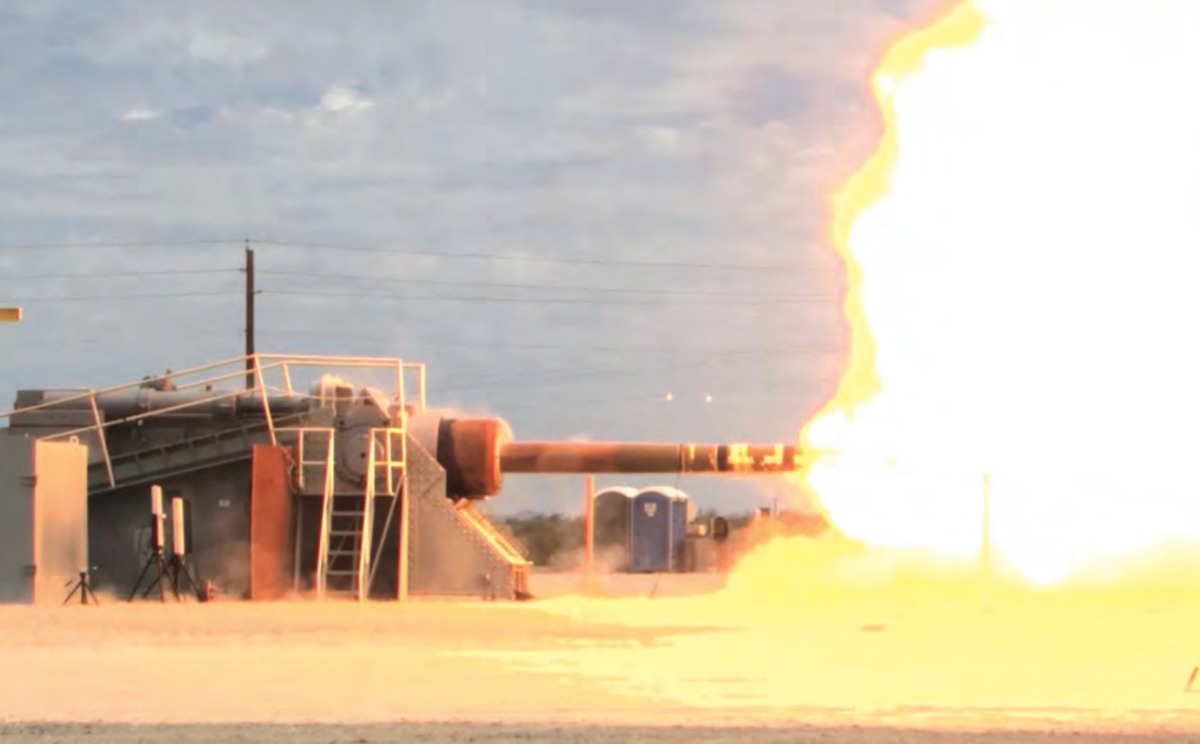
Yuma Proving Ground, the U.S. Army’s massive desert test range in southwestern Arizona, successfully supported a full-scale, live-fire hypersonic warhead test using a cannon-based test system, establishing what officials describe as a critical new testing capability for modern national security programs, according to a report published in The Outpost, Yuma Proving Ground’s official publication, on July 30, 2026.
The effort represents a joint initiative between Lawrence Livermore National Laboratory, a Department of Energy research facility long involved in advanced weapons science, and the U.S. Army Combat Capabilities Development Command Armaments Center, known as DEVCOM-AC, the Army organization responsible for developing weapons and munitions technology.
Hypersonic weapons, generally defined as anything capable of sustained flight beyond Mach 5, roughly 3,836 miles per hour (6,174 km/h), derive much of their destructive power from sheer kinetic energy, the force generated by an object’s mass and velocity rather than from an explosive payload alone. That principle sits at the center of why this cannon-based approach matters. A gun platform provides a comparatively cost-effective way to accelerate a warhead to the extreme velocities needed to study how it behaves and performs on impact, avoiding the far more expensive and logistically complex process of building and launching an actual rocket-propelled test vehicle every time engineers want to evaluate a new warhead design.
The initiative began roughly two years ago as what officials described as a bold concept, using a cannon platform to fire hypersonic warheads specifically to conduct lethality assessments, meaning tests that measure how effectively a given warhead destroys or damages its intended target once it strikes. Before committing to full manufacturing, the joint Lawrence Livermore and DEVCOM-AC team conducted an initial inert firing of the proof of concept, a test using a non-explosive version of the warhead to validate the basic physics and engineering of the approach without the added risk and cost of live ordnance. Data from that inert firing proved the overall approach was feasible, and following design refinements based on lessons learned, the team moved forward into live warhead testing.
Bringing Yuma Proving Ground into the process proved essential to the mission’s success, according to the report, with the range’s personnel steering the complex integration work required to make the concept operational, including managing the initial inert firing that preceded the full test. On the day of the live-fire test itself, personnel retreated to designated bunkers as tension built through the final preparations. A test-purpose truck backed the Integrated Launch Package up to the weapon, the fuze was armed, and the gun crew loaded the warhead followed by the propelling charge. As the Test Director initiated the countdown, eyes remained fixed on the telemetry screens tracking the weapon’s performance data in real time.
“FIRE,” the report recorded.
A massive boom echoed through Yuma Proving Ground’s front offices as the shot went off, and once the dust settled, key personnel gathered to review high-speed camera footage capturing the warhead’s flight and impact. The tense silence following the shot broke into loud cheers once the review confirmed a complete success, according to the account.
The technical achievement behind that celebration extended well beyond simply firing a projectile successfully. The teams involved designed a specialized sabot package, the structural carrier that holds a projectile in place inside the gun barrel and falls away once the round leaves the muzzle, rigorously assessed the interior ballistic dynamic effects the warhead experienced during the firing sequence, and successfully integrated a DEVCOM-AC electronic safe-and-arm fuzing device, the component responsible for ensuring a warhead cannot detonate prematurely while still reliably arming itself in time to function correctly, all while meeting the unique testing requirements this novel launch method demanded. Before any manufacturing began, the program went through multiple rigorous peer reviews specifically to analyze, verify, and guarantee the safety of every facet of the concept before committing resources to building actual test hardware.
That safety-first approach reflects broader concerns across the American hypersonic weapons enterprise, where testing capacity has chronically lagged behind program ambitions for years, constrained by limited wind tunnel access, scarce flight test ranges, and the sheer expense of traditional rocket-based test vehicles. Defense contractors including Kratos have separately invested in dedicated infrastructure specifically to accelerate hypersonic testing tempo, completing a $50 million payload integration facility in Indiana earlier this year built to prepare multiple experimental hypersonic payloads simultaneously, a parallel effort addressing the same fundamental bottleneck this cannon-based approach now offers an alternative solution for.
Officials framed the live warhead test as the ultimate proving ground for a concept that began as an unproven idea two years earlier, with all concerned parties gathering at Yuma under difficult weather conditions and operating with one common objective, witnessing the warhead perform exactly as predicted. Thanks to that collaboration between Lawrence Livermore and the joint Army services, the joint force now possesses a genuinely alternative testing platform capable of assessing hypersonic warhead lethality accurately and efficiently at meaningful scale and velocity, a capability officials say supports accelerating a range of development efforts across multiple hypersonic programs simultaneously, pushing innovative solutions forward at a faster pace and delivering vital capabilities to the armed forces sooner than the traditional testing pipeline ever allowed.
Content preview only. Full article available at source. View Full Article
The U.S. Army successfully conducted a live-fire test of a hypersonic warhead at Yuma Proving Ground, Arizona, on July 30, 2026. This test utilized a cannon-based system developed in collaboration with Lawrence Livermore National Laboratory. The initiative aims to assess the lethality of hypersonic warheads more efficiently than traditional rocket-based methods. Following rigorous safety reviews, the test confirmed the warhead's performance as predicted, marking a significant advancement in hypersonic weapon testing capabilities.
- The U.S. Army conducted a successful live-fire test of a hypersonic warhead on July 30, 2026.
- The test was performed at Yuma Proving Ground in Arizona.
- The initiative involved collaboration between the U.S. Army and Lawrence Livermore National Laboratory.
- The cannon-based system is designed to assess hypersonic warhead lethality efficiently.
- The test was deemed a complete success, confirmed by high-speed camera footage.