
U.S. Army looks for $1M missiles to replace expensive interceptors
The U.S. Army is searching for missiles that cost less than $1 million each, issuing a formal request for information on May 15, 2026, that lays out one of the most explicit cost-driven weapons procurement challenges the service has publicly articulated.
The Army’s Capability Program Executive for Defensive Fires, operating through the Rapid Capabilities and Critical Technologies Office at Redstone Arsenal, Alabama, published the request under the designation MOSAIC-26-03, with responses due May 29.
The document covers five distinct problem statements, ranging from complete interceptor rounds to individual components including rocket motors, seekers, and fire control systems, and it sets hard cost thresholds that define the entire exercise: complete interceptor rounds must come in under $1 million per unit, and individual components must not exceed $250,000 each. Those numbers are not aspirational targets.
The Army wants interceptors capable of defeating air-breathing threats, cruise missiles, close-range ballistic missiles, and short-range ballistic missiles in highly contested environments, the precise mix of threats that has defined the aerial bombardment campaigns in Ukraine, where Russian forces have employed all four categories simultaneously against Ukrainian cities and military positions. Ukraine’s experience, and the rate at which it has consumed Western-supplied air defense interceptors in attempting to address that threat mix, has made the economics of air defense one of the central strategic questions facing NATO militaries. Spending a $3 million to $4 million Patriot PAC-3 interceptor to destroy a $50,000 Iranian-designed Shahed drone is a cost exchange ratio that no defense budget can sustain indefinitely, and the Army’s MOSAIC RFI is the institutional response to that arithmetic.
The RFI’s architecture reflects how seriously the Army is taking the cost problem. Rather than simply asking for a cheaper complete missile, the document separates the challenge into components, inviting specialist suppliers to compete on rocket motors, seekers, and fire control independently, with a fifth track for weapon system integrators who would assemble best-of-breed components into a complete round using a Modular Open Systems Approach. That disaggregation strategy mirrors how commercial technology industries have driven down costs through competitive component markets rather than vertically integrated sole-source development, and it represents a meaningful departure from how the Army has traditionally procured missile systems, where a prime contractor typically controls the entire supply chain from seeker to motor to warhead.
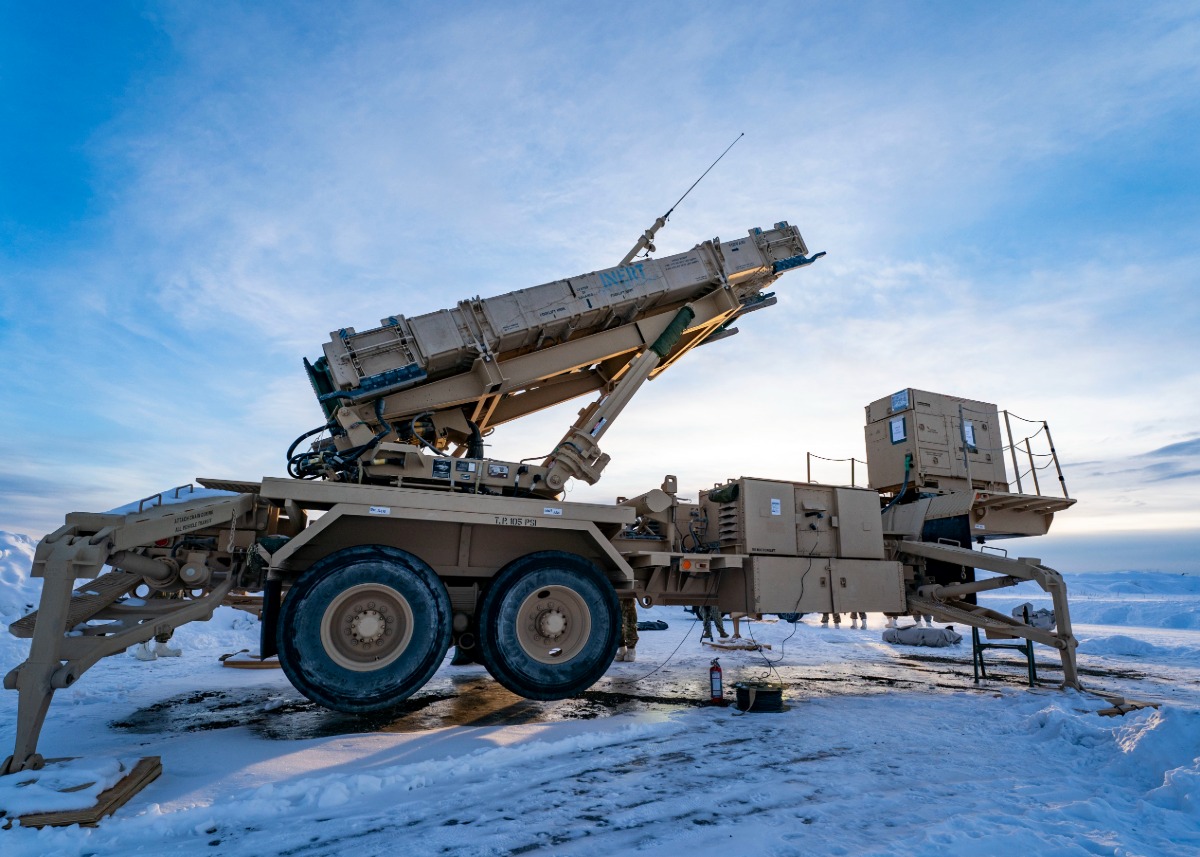
All proposed solutions must integrate with the M903 launch station and the Integrated Battle Command System, or IBCS. The M903 is the current Patriot launcher configuration, a wheeled platform that carries PAC-3 interceptors and interfaces with the fire control network, meaning any winning low-cost interceptor would slot directly into existing Patriot battery infrastructure without requiring new launcher procurement. IBCS, developed by Northrop Grumman, is the Army’s next-generation air and missile defense command and control architecture that connects sensors, command nodes, and launchers from different system families into a unified fire control network. Requiring IBCS compatibility ensures that low-cost interceptors can be cued by the full range of sensors the Army has invested in integrating into that network, rather than being limited to a proprietary fire control solution that creates new dependencies.
The RFI asks for solutions mature enough to support capability demonstrations in the fourth quarter of fiscal year 2026, which runs July through September 2026, giving respondents roughly four months from the RFI response deadline to be ready for live demonstrations. Complete interceptor rounds are expected to be at Technology Readiness Level 6 or above, meaning the technology has been demonstrated in a relevant environment, not merely a laboratory.
Content preview only. Full article available at source. View Full Article
The U.S. Army issued a request for information on May 15, 2026, seeking missiles costing less than $1 million each to replace expensive interceptors. This initiative aims to address the economic challenges of air defense highlighted by the conflict in Ukraine. The RFI outlines specific requirements for missile components and integration with existing systems, reflecting a strategic shift in procurement practices.
- The U.S. Army is seeking missiles under $1 million each.
- The RFI was issued on May 15, 2026, with responses due by May 29.
- The Army aims to develop interceptors for various air threats.
- The RFI includes separate components for competitive bidding.
- Proposed solutions must integrate with existing systems like the M903 and IBCS.