
U.S. Army tests micro-guided missile during Golden Shield exercise
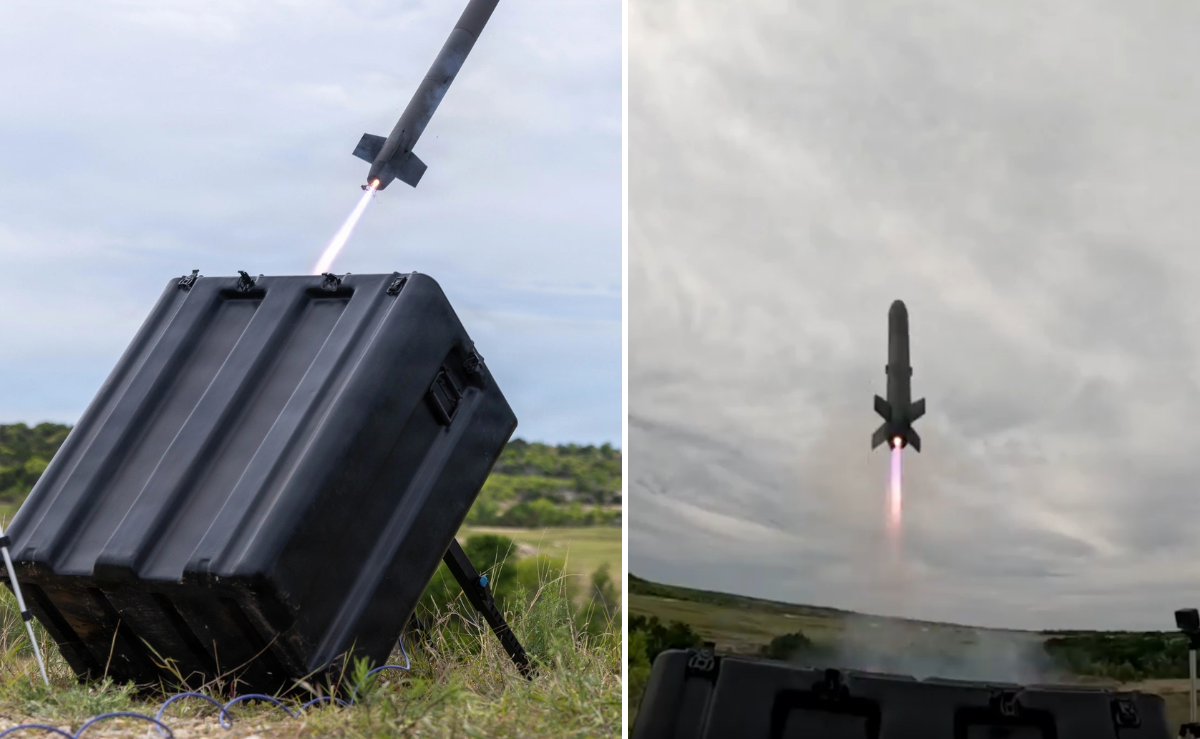
The U.S. Army’s 1st Cavalry Division completed a live-fire counter-drone exercise from April 7 through 9 at Fort Hood, Texas, evaluating a range of unmanned aerial system defeat capabilities under its “Golden Shield” counter-drone concept for armored formations.
Among the systems tested was the Harpe missile, a micro-missile interceptor developed by Perseus Defense, a San Francisco, California-based startup that participated in its first military-hosted live-fire demonstration during the exercise. The event integrated advanced sensors, kinetic and non-kinetic effectors, and command-and-control systems to create what the Army describes as an autonomous cohesive defense against small unmanned aircraft systems.
Perseus Defense CEO and Co-Founder Jason Cornelius confirmed the company’s participation and the outcome of the demonstration. “Very proud of the amazing work done by the team here at Perseus Defense these last few weeks,” Cornelius stated. “A few months back we signed up for our first military hosted live fire demonstration with 1st Cav at Ft. Hood. We knew there was a LOT of work to go before we’d be ready for a successful event. Our incredibly cracked and talented team of engineers worked relentlessly to cover an immense amount of ground in 3 short months.”
During the exercise, Perseus Defense demonstrated the Harpe system receiving external radar cues passed through the military’s command and control software to engage drone targets with its missiles. The company also demonstrated multi-launch capability and fully active guidance to the drone threat — two critical performance benchmarks for any system seeking to transition from prototype to operational fielding in the U.S. Army’s counter-UAS inventory.
The Harpe missile is designed to engage Group 1 and Group 2 drones — the small, light, fast and low-flying unmanned systems that have emerged as one of the most pressing threats to ground forces across modern combat environments. The system fires from a pod containing 8 micro-missiles, with a stated engagement range of more than 1,000 meters. Each missile is priced at under $10,000, which Perseus Defense characterizes as approximately 25 times cheaper than currently fielded counter-UAS solutions. The launcher is designed to be adaptable across multiple platforms, including unmanned aerial vehicles, ground vehicles and boats, giving it potential utility across a wide range of operational contexts.
The Harpe system’s development timeline has been rapid even by startup standards. Perseus Defense built its first two spin-stabilized rockets — designated Mk-I and Mk-II guided missiles — in June 2025, the same month the company won Y Combinator’s S25 batch preview day. Testing of the Mk-III surface-to-air interceptor followed in July 2025. By October 2025 the team had relocated to Austin, Texas, and in December 2025 leased a 17,500-square-foot headquarters facility in Buda, Texas. January 2026 brought a significant technical milestone when the company achieved fully guided flight for a direct hit-to-kill intercept. By February 2026, Perseus Defense had expanded to ten full-time team members — a lean engineering force that nonetheless delivered a system to a major Army live-fire exercise within three months of signing up for the demonstration.
Small drones have fundamentally altered the dynamics of ground combat, as demonstrated extensively in Ukraine, where Group 1 and Group 2 unmanned systems have been used for reconnaissance, targeting and direct attack against armored vehicles. An armored brigade combat team, with its concentration of high-value platforms, presents an attractive target for drone operators, making organic counter-UAS capability a priority the Army has been working to address across multiple programs and experimentation efforts.
The 1st Cavalry Division’s Golden Shield experimentation effort has now produced a live-fire data set that Army evaluators can use to assess how systems like Harpe perform in a realistic command-and-control environment, receiving real targeting data and engaging actual drone targets. Whether the Harpe system advances toward a formal procurement program will depend on those evaluation results and the Army’s broader counter-UAS acquisition decisions, but the Fort Hood demonstration represents a meaningful operational test for a company that began guided flight testing just months ago.
Content preview only. Full article available at source. View Full Article
The U.S. Army's 1st Cavalry Division conducted a live-fire counter-drone exercise at Fort Hood from April 7 to 9, 2023, testing the Harpe missile system. This new micro-missile interceptor, developed by Perseus Defense, demonstrated its capabilities against drone targets, showcasing features like multi-launch capability and active guidance. The exercise aimed to evaluate the system's effectiveness in real-world scenarios as part of the Army's counter-UAS efforts.
- The U.S. Army's 1st Cavalry Division conducted a live-fire exercise at Fort Hood.
- The Harpe missile system was tested during the exercise.
- The Harpe missile is designed to engage small drones and has a range of over 1,000 meters.
- Perseus Defense developed the Harpe missile and demonstrated its capabilities during the event.
- The missile is significantly cheaper than existing counter-UAS solutions.