
U.S. Army’s Stryker-based air defense system gets a drone upgrade
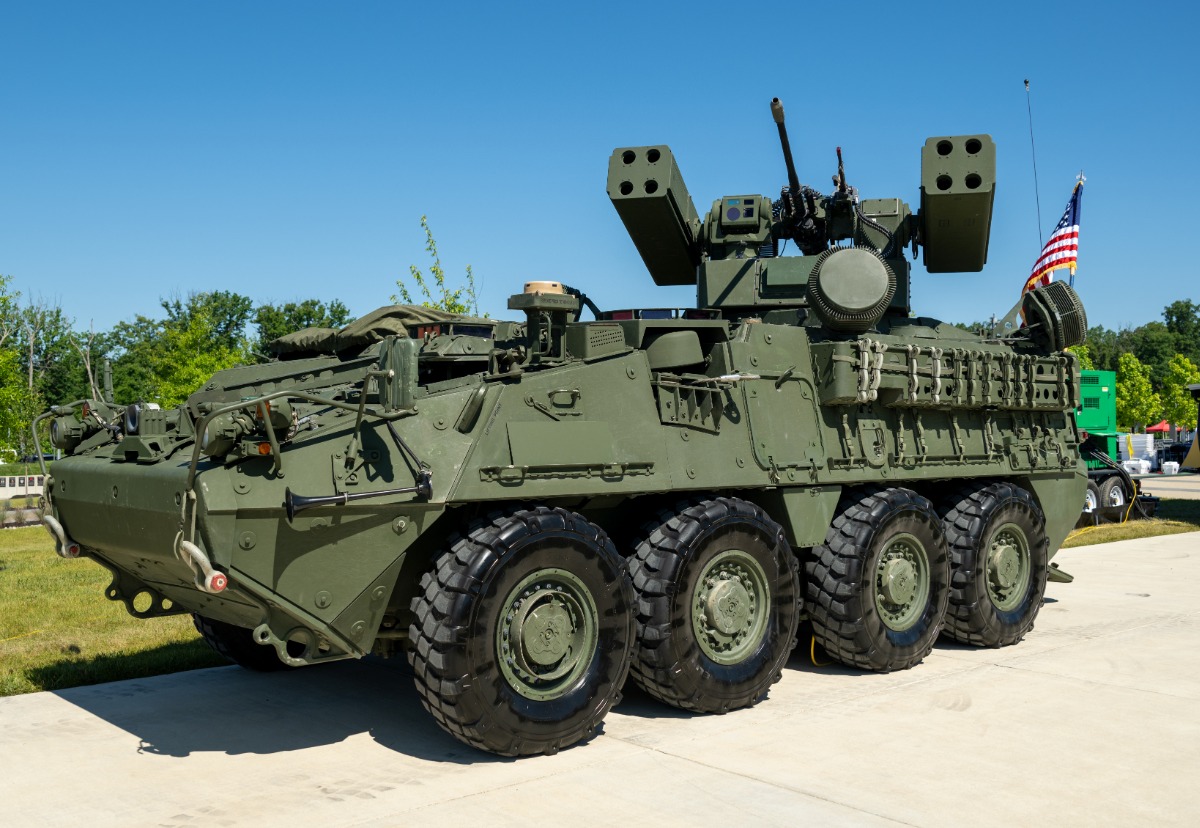
Leonardo DRS said its SGT STOUT M-SHORAD air defense system successfully defeated small drone threats during a government test, adding a capability the system was not originally built to handle.
The company said the system defeated Group 1-2 unmanned aircraft, the military’s classification for small, low-altitude drones, during a U.S. government test event. SGT STOUT was originally designed to counter larger Group 3 drones along with helicopters and fixed-wing aircraft. Leonardo DRS said the expanded capability came entirely through updates to detection and fire control software, without adding new hardware to the system’s mission equipment package.
SGT STOUT mounts a mission equipment package built by Leonardo DRS onto a Stryker combat vehicle chassis. The M-1265A1 Stryker Double V Hull vehicle carries a 30mm chain gun and eight Stinger missiles as its primary weapons. General Dynamics Land Systems, the Stryker’s manufacturer, installs the completed system. M-SHORAD is short for Maneuver Short-Range Air Defense. The program moves alongside Army brigade combat teams rather than defending a single fixed position.
Small drones have become an increasingly common threat facing frontline units. Group 1 drones weigh up to 20 pounds (9 kilograms) and typically fly below 1,200 feet (366 meters). Group 2 drones weigh up to 55 pounds (25 kilograms) and can operate up to 3,500 feet (1,067 meters). Both categories cover the kind of small, commercially available drones used extensively for surveillance and attack missions in Ukraine, a threat the Army’s original M-SHORAD requirements did not fully address when the program was developed.
The Army has fielded SGT STOUT battalions to Germany, Fort Sill and Fort Hood, according to a Congressional Research Service report. A fourth battalion at Fort Bragg is expected to complete fielding by the end of fiscal year 2026. Each battalion operates 36 SGT STOUT vehicles. The Army plans further fieldings to the Florida Army National Guard in fiscal year 2028 and the Ohio Army National Guard in fiscal year 2029.
Aaron Hankins, senior vice president and general manager of the Leonardo DRS Land Systems business unit, said the system was built to accommodate upgrades like this one.
“SGT STOUT was engineered from the start for modernization, so capability can evolve as the threat evolves. This event highlights an upgrade path that emphasizes speed, safety, cybersecurity-by-design, and operational interoperability,” said Hankins.
Leonardo DRS said several hundred SGT STOUT systems are already fielded, giving the Army an established base for training, sustainment and readiness. The mission equipment package uses a modular design. New sensors, software and other capabilities can be added to existing vehicles without redesigning the full system. Leonardo DRS said passive detection options, AI-enabled decision aids, edge computing and new effectors are among the capabilities that could be added to fielded systems as near-term upgrades.
Leonardo DRS also serves as prime contractor on the Mobile Low, Slow UAS Integrated Defeat System program, a separate counter-drone effort. The company said it is applying lessons from that program and other fielded air defense work to develop future upgrades for SGT STOUT and other next-generation air defense programs.
Content preview only. Full article available at source. View Full Article
Leonardo DRS reported that its SGT STOUT air defense system successfully defeated small drone threats during a U.S. government test. The system, originally designed for larger drones, has been upgraded through software enhancements. Several hundred SGT STOUT systems are fielded across various U.S. Army locations, with plans for additional deployments to National Guard units by 2029.
- SGT STOUT defeated Group 1-2 unmanned aircraft during a government test.
- The system was originally designed for larger Group 3 drones.
- The expanded capability was achieved through software updates without new hardware.
- Each battalion operates 36 SGT STOUT vehicles.
- The Army plans further fieldings to the Florida and Ohio Army National Guards.