
US Marine Corps pursues thermal cloaks to hide troops from heat sensors
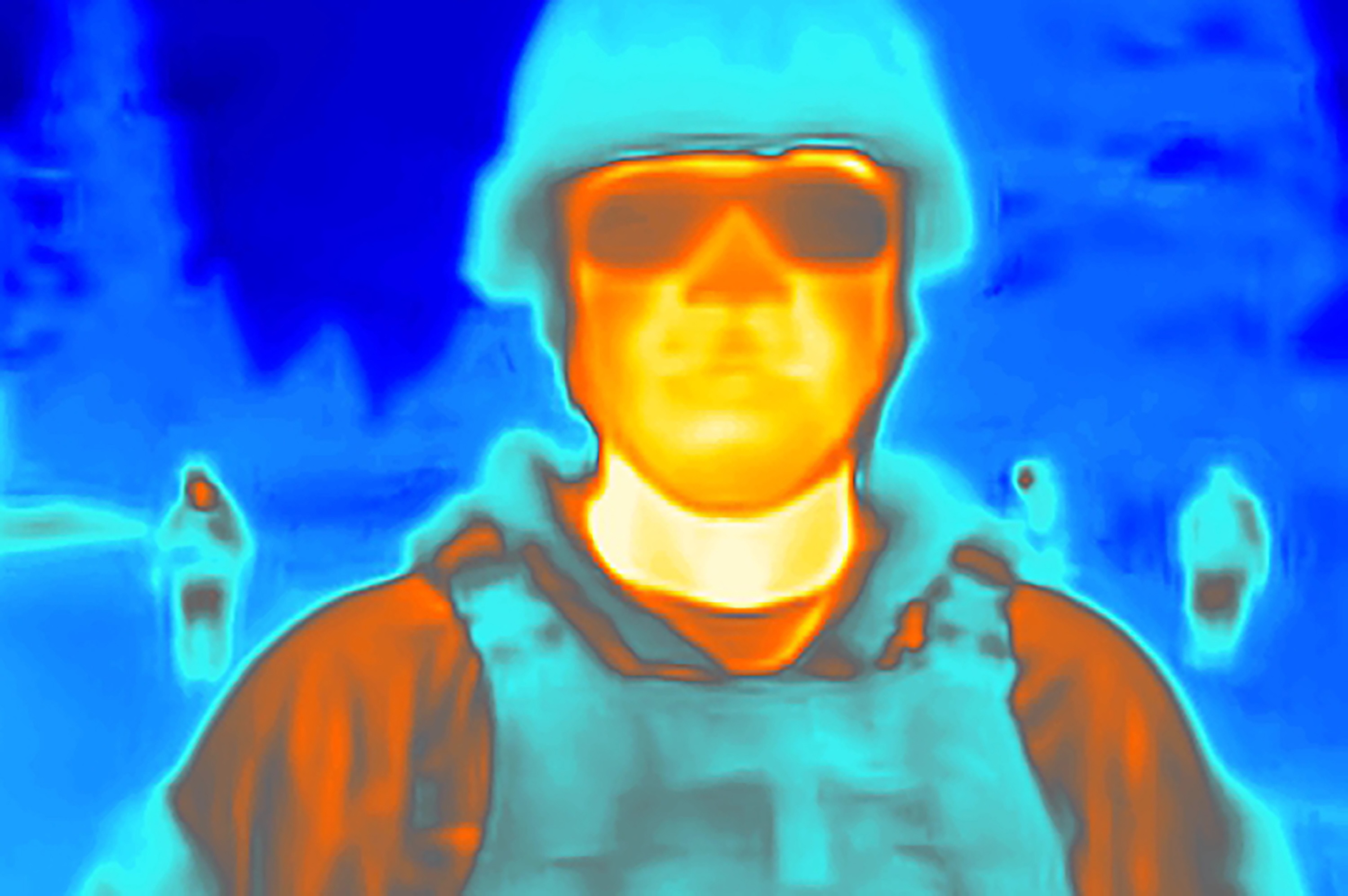
As the Ukraine war has shown, drones equipped with thermal sensors have made the battlefield so hazardous that the best defense is not to be spotted at all.
Thus, the U.S. Marine Corps is looking for camouflage cloaks that shield wearers from prying eyes and infrared cameras, according to a Marine Corps Systems Command Sources Sought notice.
The Multispectral Camouflage Overgarment, or MCO, “is intended to provide individual signature management for Marines by mitigating detection across the visual (VIS), near infrared (NIR), and short-wave infrared (SWIR) spectrums as well as suppress thermal signatures in the mid-wave infrared (MWIR) and long wave infrared (LWIR) to reduce the likelihood of detection by thermal sensors,” the notice notes. The deadline is April 22.
The Marines want 13,000 cloaks by 2027, and 61,000 by 2030.
“MCO will serve as the individual signature management solution for all Marines in training and on deployment,” according to the notice. “The system is not intended for routine garrison wear.”
The notice includes a table that lists various nondetection thresholds depending on the wearer’s distance from the sensor, the type of sensor and whether the sensor is on the ground or in the air. For example, the cloak should preclude daytime visual detection from a ground-based sensor at a minimum of 600 meters, and ideally at 50 meters. For an aerial sensor, such as on a drone, the minimum is 1,000 meters, with an eventual goal of 10 meters.
For mid-wave infrared sensors, the cloak should mask wearers at a minimum of 2,000 meters, and ideally at 600 meters. Against aerial MWIR sensors, the MCO should provide camouflage at a minimum of 5,000 meters — more than 3 miles — and ideally at 2,000 meters.
The notice describes the MCO as “a single-piece, generously-sized draped design constructed to provide full-body coverage, including individual gear and equipment. It shall be donned and doffed over existing uniforms and gear within 15 seconds.”
The garment should be sturdy enough to last 90 days to one year of use, and withstand laundering up to 50 times. It should weigh no more than 3.5 pounds, and preferably less than 2 pounds.
Britain’s Royal Marines are already using the Barracuda cloak from Swedish manufacturer Saab. Meanwhile, Russian troops have frequently used thermal cloaks to camouflage themselves against omnipresent Ukrainian drones equipped with heat sensors.
However, the Russian experience also illustrates the danger of using cheap, poorly designed cloaks. In some cases, the garments have actually made the wearers more conspicuous, by contrasting them as cold spots against a warmer background.
The U.S. Marine Corps is pursuing the development of the Multispectral Camouflage Overgarment (MCO) to enhance troop concealment from thermal sensors. The Corps plans to acquire 13,000 cloaks by 2027 and 61,000 by 2030, aiming to improve individual signature management for Marines in various operational environments. The MCO is designed to provide effective camouflage across multiple infrared spectrums and is intended for use in training and deployment, not routine garrison wear.
- The U.S. Marine Corps is seeking to procure 13,000 thermal cloaks by 2027 and 61,000 by 2030.
- The Multispectral Camouflage Overgarment (MCO) aims to mitigate detection across multiple spectrums.
- The MCO is designed to provide full-body coverage and can be donned over existing uniforms in 15 seconds.
- The cloak should prevent daytime visual detection from ground-based sensors at a minimum of 600 meters.